EENI
Business School

Doing business in Central Asia Iran Pakistan Certificate program

EENI Home EENI International Business - Business in Asia - Courses: Doing Business in ...


International business

Master International Business


Specialization course "Certificate program Doing business in Central Asia" - Syllabus:


M Doing Business in Pakistan

- Introduction to the Islamic Republic of Pakistan.
- Pakistan's economy.
- Foreign trade of Pakistan. Foreign direct investment (FDI).
- Pakistan main exports: products and markets. Trade development authority of Pakistan (TDAP).
- Sales promotion in Pakistan.
- Doing business in Karachi, Islamabad and Lahore.
- Case study: Pakistani Information technology (IT) industry. Automobile sector. Hinopak motors. Pakistan telecommunication (PTCL). Chawla Group.

Pakistan Free Trade Agreements (FTAs)

- ECO, SAARC, ACU.
- Free Trade Agreements (FTAs) of Pakistan: China, ASEAN, Bangladesh, Sri Lanka.

   China Pakistan Free Trade Agreement (FTA)

- Free Trade Agreement between China and Pakistan.
- The Agreement on Trade in Service.
- China-Pakistan FTA Certificate of Origin.

   ASEAN Pakistan Free Trade Area (FTA)

- ASEAN Pakistan Free Trade Area (FTA)
- Trade relations between ASEAN and Pakistan.

M Doing Business in Iran

- Introduction to the Islamic Republic of Iran. Tehran. Religion Shi'ite.
- Economy of Iran. Privatization. Banking system. Financial sector.
- Foreign trade of Iran. Potential export sectors. Export development bank of Iran. Iran customs administration (IRICA).
- Foreign direct investments in Iran (FDI).
- Iranian companies. Iranian national shipping lines. Wagon Pars. Iran carpet. Cooler Iran. Misr-Iran textile. Aburaihan pharmaceutical.
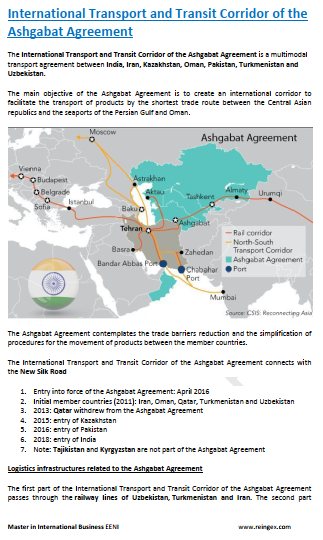
- Case study: Esfahan`s Mobarakeh steel. International north-south transport corridor (INSTC).

Iran Free Trade Agreements (FTAs)

- Economic Cooperation Organization (ECO).
- Ocean Rim Association for Regional Cooperation (IORARC).
- Asian Clearing Union (ACU).
- SCO and SAARC (Observer).
- Free Trade Agreement (FTA) of Iran: Algeria, Armenia, Syria, Venezuela.
- Organization of the Islamic Conference (OIC). League of Arab States. Islamic Development Bank.

M Doing Business in Turkey

- About Turkey.
- Turkish economy. OCE, BSEC, GUAM.
- Foreign trade of Turkey: export import.
- Foreign direct investment (FDI).
- Doing business in Turkey.
- EU - Turkey Customs Union.
- Free Trade Agreement with EFTA.

Organizations and Free Trade Agreements (FTA´s) of Turkey

- Black Sea Economic Cooperation (BSEC).
- Economic Cooperation Organization (ECO).
- Euro-Mediterranean Partnership (EUROMED). Black Sea Synergy (EU).
- EU Enlargement. EU - Turkey Customs Union.
- Free Trade Agreements (FTA's) of Turkey: Chile, Albania, Bosnia and Herzegovina, Croatia, Macedonia, Egypt, Georgia, Israel, Jordan, Lebanon, Montenegro, Morocco, Palestine, Serbia, Syria, Tunisia.
- League of Arab States. Organization Islamic Conference. Islamic Development Bank.
- Economic and Social Commission for Asia and the Pacific (ESCAP).
- Economic Commission for Europe (UNECE).
- European Investment Bank (EIB).
- Asia - Middle East Dialogue (AMED).
- Regional Cooperation Council (RCC).
- IORARC (Dialog partner). GUAM (Observer).

Turkey - Chile FTA

- Free Trade Agreement between the Republic of Chile and the Republic of Turkey.
- Bilateral Trade in Goods: Chile – Turkey.

EU - Turkey Customs Union

- EU - Turkey trade relations.
- European Union and Turkey Customs Union.

M Doing Business in Azerbaijan

- Introduction to the Republic of Azerbaijan.
- Azerbaijani Economy. Azerbaijani Oil. Foreign trade. FDI.
- Doing business in Baku.
- Case study: State Oil Company of Azerbaijan Republic (SOCAR).
- European Union - Azerbaijan Trade Relations.

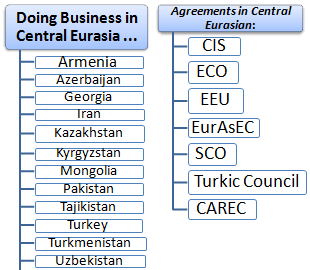
M Doing Business in Central Asia Countries

- The ECO Region (Central Asia): Economy, Foreign Trade (import export).
- Doing business in: Afghanistan, Kazakhstan, Kyrgyz Republic, Tajikistan, Turkey, Turkmenistan and Uzbekistan.

M Regional Institutions and Agreements

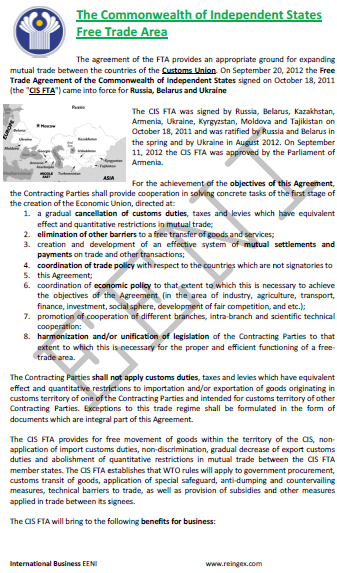
Community of Independent States (CIS)

- Community of Independent States (CIS).
- Economic profile of CIS countries.
- Russian Autonomous Republics.

Economic Cooperation Organization (ECO)

- Introduction to Economic Cooperation Organization (ECO).
- Organizational Structure. Objectives. Activities.
- Regional Institutions. ECO Shipping Company. ECO Chamber of Commerce and Industry.
- ECO Trade and Development Bank.
- Directorate of Trade and Investment.
- ECO International Relations.

Eurasian Economic Community (EurAsEC)

- Introduction to the Eurasian Economic Community (EurAsEC).
- Economic profile of the EurAsEC region (Belarus, Kazakhstan, Kyrgyzstan, Russia, Tajikistan).
- EurAsEC Customs Union.
- EurAsEC Common Economic Space.
- Eurasian Business Council.

Shanghai Cooperation Organization (SCO)

- Introduction to the Shanghai Cooperation Organization (SCO).
- Economy and trade relationships between SCO members.
- The Business Council of the Shanghai Cooperation Organisation
- The Interbank Consortium of the Shanghai Cooperation Organisation

Asian Clearing Union (ACU)

- Asian Clearing Union (ACU).
- Objectives. Participating members. Achievements.

South Asian Association for Regional Cooperation (SAARC)

- Introduction to the South Asian Association for Regional Cooperation (SAARC).
- Areas of cooperation: economy, communications, transport, ...
- SAARC Preferential Trading Arrangement (SAPTA).
- South Asian Free trade area (SAFTA). South Asian Economic Union.
- SAARC foreign trade.

M Request Information of the certificate program Doing business in Central Asia.

M Duration: 6 weeks

Course objectives:
The primary objective of the "Certificate program Doing business in Central Asia" is to offer a global vision of Central Asia and the business opportunities in the region in order ...:

  • To understand the importance of CIS, ECO and EurAsEC.
  • To learn to do business in Central Asian countries (Iran, Pakistan, Azerbaijan ...)
  • To know the business opportunities in Central Asian markets
  • To know the Free Trade Agreements in the region
  • To analyze foreign direct investment FDI flows

M Addressed to: The "Certificate program Doing business in Central Asia" is intended for all those wishing to specialize in the central asian markets

M Course "Doing business in Central Central Asia" -  Professors and Coach:
Hazem El SheickAudicianTurk

M Course learning materials: En

M Registration functions on a continuous basis, allowing the student to begin the Course at any time.

M Communication with professors (student's questions, exercises ...) in: En Fr Pt Es

M Methodology: e-learning / Distance learning.

M Educational level: Continuing education / Executive education programs.

M The course "Doing business in Central Asia" contains exercises that are evaluated which the student must work out and pass in order to obtain their respective diploma.

M Students who have taken this course (Doing business in Central Asia) can validate and register for a post graduate course or Master at EENI: Master Business in Asia - Master in Emerging Markets - Master in business with Muslims countries - Middle East

Spanish: Comercio Exterior Asia

Course summary (Doing business in Central Asia):

Program e-learning Business in Central Asian markets. Turkey. ECO (Economic Cooperation Organization)

Strategically located in South Asia, Pakistan is at the crossroads between Eastern and Western Asia. Automobile Sector of Pakistan has been playing a vital role in the overall national economy. The outlook for economic growth remained pessimistic as import demand shriveled, tax collection declined, and inflows of foreign investment and privatization dampened. The sector is one of the major contributors to the manufacturing sector in the country and is registering a growth of over 30% per annum. The Pakistani Information technology (IT) industry and IT-enabled services (ITeS) marketplace offers lucrative opportunities for developing countries to join the ranks of the developed world.

Example of the course Doing business in Central Asia:
Pakistan Business economy

Iran's economy, once one of the most advanced in the region. Iran ranks 4th on Diversity of Agricultural Products in the world, is the 2nd Producer of Oil and Gas in the world. Iran holds 4th to 9th rank in the production of Zinc, Lead, Cobalt, Aluminum, Manganese, and Copper in the world. Iranian petroleum industry is a large and vastly developed industry with highly rated and valuable resources and capabilities. The December 1979 constitution, and its 1989 amendment, define the political, economic, and social order of the Islamic Republic of Iran. It declares that Shi'a Islam (Shi'ite) of the Twelver school of thought is Iran's official religion.

Iran Business

The Turkish economy has had a steady growth rate for the last 20 quarters. GNP and GNP per capita figures highlight the strength and the stability of the national economy as well as its integration to macroeconomic global trends. Fiscal discipline and a tight fiscal policy continue to be the main pillars of Turkey’s economic program and have contributed a great deal to disinflation as well as to a strong growth performance. Turkey is the 13th most attractive country in the world for FDI, a total of 16,500 companies with international capital were operating in Turkey.

The ECO (Economic Cooperation Organization) region is geographically vast and well endowed with potential economic resources in different fields and sectors, such as agriculture and arable land, energy and mining, human resources, and a vast strategic trading region. With more than 400 million inhabitants, ECO region houses around 6% of the world population, whereas the total trade share of the region in the world trade is about 2%. The intra-export ratio of the region reached around 6% in 2008.

Central Asia Business

Business in Russia

Doing, Business, Central Asia, Iran, Pakistan, Certificate, Program, e-learning, Central, asian, markets, Turkey, ECO, Economic, Cooperation, Organization


UN (c) EENI- The Global Business School (1995-2012)
EENI Headquarters: Spain. Subsidiaries: France and Brazil.
EENI is a certified member of the International Commission on Distance Learning (ECOSOC United Nations).

Collaborator member of the Tripartite Foundation for On-the-job Training - European Social Fund (ESF).
European