Economic Cooperation Organization ECO, Iran


ECOTA Agreement (Economic Cooperation Organization) Trade Development Bank, Turkey
- Introduction to the Economic Cooperation Organization (ECO): Afghanistan, Azerbaijan, Iran, Kazakhstan, the Kyrgyz Republic, Pakistan, Tajikistan, Turkey, Turkmenistan, and Uzbekistan
- ECO Organizational Structure
- Objectives and activities of the ECO
- Regional Institutions;
- Shipping Company of the Economic Cooperation Organization
- Chamber of Commerce and Industry
- ECOTA Trade Agreement
- Partial Scope Agreement of the ECO: Iran, Pakistan and Turkey
- International Trade and Development Bank
- Directorate of Foreign Trade and Investment
- International Relations of the Organization for Economic Cooperation (ECO)
The objectives of the subject “Economic Cooperation Organization (ECO)” are the following:
- To understand the purposes and activities of the ECO
- To assess the benefits for ECO member countries (ECOTA trade agreement) and the areas of cooperation
- To know the regional institutions of the Economic Cooperation Organization
- To analyze the international relations of the Economic Cooperation Organization

The Subject “Economic Cooperation Organization (ECO)” belongs to the following Online Programs taught by EENI Global Business School:
Masters: International Business, Foreign Trade.
Doctorate: Islamic Business, European Business, World Trade.

Languages:  or
or  Organización para la Cooperación Económica
  Organization de coopération économique.
Credits of the Subject “Economic Cooperation Organization”:
1 
Economic Cooperation Organization (ECO).
In 1955, Iran, Pakistan, and Turkey founded the Economic Cooperation Organization (ECO).
The objective of the ECO is to promote the economic, regional trade, technical, and cultural cooperation among the member economies: the Islamic State of Afghanistan, Azerbaijan, the Islamic Republic of Iran, the Republic of Kazakhstan, Kyrgyz Republic, the Islamic Republic of Pakistan, the Republic of Tajikistan, the Republic of Turkey, Turkmenistan, and the Republic of Uzbekistan.
- Observers: Turkish Cypriot State, Cooperation Council of Turkic Speaking States, International Energy Charter
The Economic Cooperation Organization (ECO) is, therefore, a predominantly a Muslim economic organization.
One of the main goals of the ECO is to promote the international trade within the region and the rest of the World based on the principle of free trade. Several projects has been implemented:
- Regional Trade liberalization
- International Trade facilitation
- Cooperation with other international bodies
The Economic Cooperation Organization (ECO) region is geographically immense and well gifted with potential economic resources (agriculture, arable land, energy, mining, and human resources).
- Population of the Economic Cooperation Organization: 400 million people, (6% of the world's population)
- The Economic Cooperation Organization is a huge strategic trade region
- Total trade share of the countries of the ECO in the global trade: 2%
- Intra-export ratio in the region reached 6%
The ECO (Economic Cooperation Organization) economies are implementing reforms to create the favorable conditions for Foreign direct investment attracting: legislation optimization related to the foreign direct investment, privatization of the state-owned companies, and liberalization of the foreign direct investment flows.
The Economic Cooperation Organization (ECO) belongs to the Central Eurasian Economic Area (Islamic Civilization).
The ECO Chamber of Commerce and Industry was created in 1990 by the Union of Chambers and Commodity Exchanges of Turkey, Iran Chamber of Commerce, Industries and Mines, and Federation of Pakistan Chambers of Commerce and Industry.
The Economic Cooperation Organization Trade and Development Bank is a multilateral development Bank established in 2005 by Iran, Pakistan, and Turkey.
- Almaty-Bishkek Corridor
- China-Pakistan Corridor
- China-Central-West Asia Corridor
- Corridor of the Ashgabat Agreement
- Asia-Africa Corridor
- India-Afghanistan Corridor
- Afghanistan-Turkey Corridor
- North-South Corridor (India-Russia)
- Trans-Caspian Corridor
- Kyrgyzstan-Iran Corridor
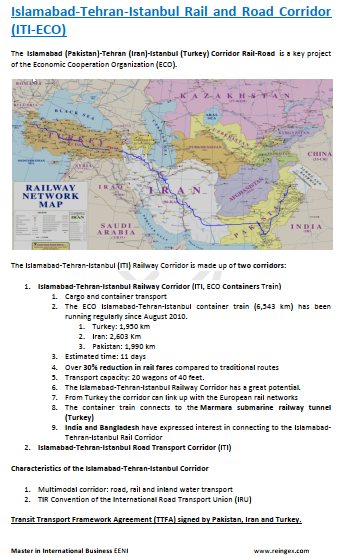
- Islamabad-Istanbul Corridor
(c) EENI Global Business School (1995-2024)
We do not use cookies
Top of this page