
European Neighborhood Policy, Armenia


EU Neighborhood Policy, EUROMED, Eastern Partnership. Georgia. Jordan
- Introduction to the European Neighborhood Policy
- EU Eastern Partnership
- Euro-Mediterranean Partnership
- European Neighborhood Policy with Morocco and Tunisia
- The EU Partnership agreements with Jordan and Egypt
- The EU relations with Armenia, Azerbaijan, Georgia, and Ukraine
The objectives of the subject “European Neighborhood Policy” are the following:
- To understand the strategic importance of the European Neighborhood Policy
- To analyze the EU Trade Relations with Armenia, Azerbaijan, Jordan, Egypt..

The Subject “European Neighborhood Policy” belongs to the following Online Programs taught by EENI Global Business School:
Doctorate: European Business, African Business, Islamic Business, World Trade.

Masters: International Business, Foreign Trade, Business in Africa.

Courses: International Relations of Africa.
Masters adapted for  EU Students.
Languages:  or
or  Política de Vecindad UE
  Politique européenne de voisinage
  Política Europeia de Vizinhança.
Sample - European Neighborhood Policy (European Foreign Policy):
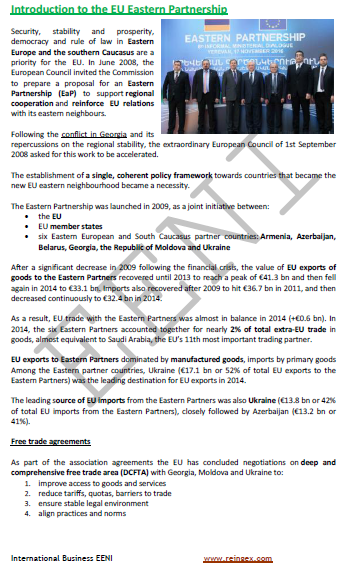
The objective of the European Neighborhood Policy is averting new dividing lines emergence between the enlarged European Union and neighbors nations and instead strengthening the welfare, stability, and security. The European Neighborhood Policy was created in 2004.
The European Neighborhood Policy is managed by the European External Action Service (EEAS).
The members of the European Neighborhood Policy are Algeria, Armenia, Azerbaijan, Belarus, Egypt, Georgia, Israel, Jordan, Lebanon, Libya, Moldova, Morocco, Palestine, Syria, Tunisia, and Ukraine.
The European Neighborhood Policy (ENP) is mainly a bilateral policy between the EU and each partner nation, the European Neighborhood Policy is enhanced with cooperation initiatives:
- The Eastern Partnership, the European Commission introduce concrete ideas for improving the relationship with Armenia, Azerbaijan, Belarus, Georgia, Moldova, and Ukraine. The Easter Partnership may involve new Association Agreements (Free Trade Agreements)
- The Union for the Mediterranean: The Euro-Mediterranean Partnership, formerly known as the Barcelona Process, and
- The Black Sea Synergy
The European Neighborhood Policy (ENP) belongs to:
- Afghanistan-Turkey Corridor
- Europe-Caucasus-Asia Corridor
- Atlantic Corridor (Portugal-Germany)
- Baltic-Adriatic Corridor (Poland, Slovenia)
- North Sea-Baltic Corridor (Finland, Belgium)
- North Sea-Mediterranean Corridor (Ireland, France)
- International North-South Corridor
- Trans-Caspian Corridor
- Pan-European Corridor II (Russia-Germany)
- Pan-European Corridor IX (Finland-Greece)
(c) EENI Global Business School (1995-2024)
We do not use cookies
Top of this page