Organization of the Black Sea Economic Cooperation BSEC


Black Sea Trade Development Bank (Economic Cooperation BSEC) Russia, Turkey
- Introduction to the Organization of the Black Sea Economic Cooperation (BSEC): Albania, Armenia, Azerbaijan, Bulgaria, Georgia, Greece, Macedonia, Moldova, Romania, Russia, Serbia, Turkey, and Ukraine
- Areas of cooperation of the Organization of the Black Sea Economic Cooperation:
- International Trade
- Customs
- Transport
- Black Sea Trade and Development Bank
The purposes of the subject “Organization of the Black Sea Economic Cooperation (BSEC)” are the following:
- To understand the purposes and functions of the Organization of the Black Sea Economic Cooperation
- To analyze the areas of cooperation of the BSEC
- To evaluate the role of the Black Sea Trade and Development Bank

The Subject “Organization of the Black Sea Economic Cooperation (BSEC)” belongs to the following Online Programs taught by EENI Global Business School:
Masters: International Business, Foreign Trade.
Doctorate: Islamic Business, European Business, World Trade.

Course: Orthodoxy and Business.
Languages:  or
or  Cooperación Económica del Mar Negro (BSEC)
 Organization de la Coopération économique de la mer Noire.
Masters for the Students from the Black Sea Economic Cooperation:  Armenia,
  Azerbaijan,
  Georgia,
 Moldova,
Romania,
Moldova,
Romania,  Russia,
 Turkey, and
  Ukraine.
Organization of the Black Sea Economic Cooperation (BSEC).
In 1992, Armenia, Azerbaijan, Bulgaria, Georgia, Greece, Moldova, Romania, Russia, Turkey, and Ukraine created the Black Sea Economic Cooperation.
In 1999, the Organization of the Black Sea Economic Cooperation was transformed into a regional economic institution: The Organization of the Black Sea Economic Cooperation.
The member countries of the the BSEC are Albania, Armenia, Azerbaijan, Bulgaria, Georgia, Greece, Macedonia, Moldova, Romania, Russia, Serbia, Turkey, Ukraine.
- observer countries of the BSEC: Austria, Belarus, Croatia, Czech Republic, Egypt, France, Germany, Hungary, Israel, Italy, Poland, Slovakia, Tunisia, and the U.S.
- In 2003, Serbia became a member of the Organization of the Black Sea Economic Cooperation
- The region of the Organization of the BSEC has 350 million people with an international trade capacity of USD 300 billion every year
- After the Persian Gulf region, the region of the Organization of the Black Sea Economic Cooperation is the second largest petrol and natural gas source
- The region of the Organization of the Black Sea Economic Cooperation is a major transport and energy corridor in Europe
- The Organization of the Black Sea Economic Cooperation (BSEC) is an organization that has both Muslim Countries as Orthodoxy Christian
The Black Sea Trade and Development Bank is an international financial institution formed by Albania, Armenia, Azerbaijan, Bulgaria, Georgia, Greece, Moldova, Romania, Russia, Turkey, and Ukraine.
- The goal of the Black Sea International Trade and Development Bank is to speed up regional development and promote the cooperation between the Member States
Member states of the Organization of the Black Sea Economic Cooperation: Albania, Armenia, Azerbaijan, Bulgaria, Georgia, the Hellenic Republic, Moldova, Romania, Russia, Serbia, Turkey, and Ukraine.
Economic Corridors related to the BSEC:
- Europe-Caucasus-Asia Corridor
- North-South Corridor (India-Russia)
- Trans-Siberian Railway (Russia, North Korea)
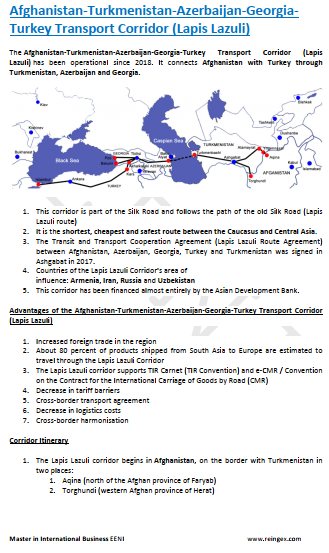
- Afghanistan-Turkey Corridor
- Trans-Caspian Corridor
- Atlantic Corridor (Portugal-Germany)
- Islamabad-Istanbul Corridor
- Pan-European Corridor II (Russia-Germany)
- Pan-European Corridor IX (Finland-Greece)
(c) EENI Global Business School (1995-2024)
We do not use cookies
Top of this page