Master in Foreign Trade
Professional Master in Foreign Trade and International Marketing (e-learning,  )
)
The Master of Science (MSc) in Foreign Trade and International Marketing (21th edition, 1 year, 60 ECTS) taught by EENI Global Business School, is an essential higher education program focused in international trade and global marketing.

The Master is designed to provide all the knowledge, tools, and techniques necessary to manage all the technical aspects related to the international trade and global marketing of an import-export company, offering to the student a practical training on the techniques of the foreign trade (customs, documents, customs, international logistics...) and international marketing (international distribution, promotion, export prices...).
The Master's Degree consists of two modules and a Thesis:
 Enrol / Request for Information

- Credits of the Master: 60

- Duration: 1-year It is recommended to dedicate about twelve hours of study per week following a flexible schedule. It is possible to reduce the duration dedicating more hours a week
- Tuition Fees: € 1,000
- Open Online Enrollment
- Download the Admission Form
- Frequently Asked Questions (FAQ)
- Download the syllabus of the Master (PDF)
Master intended for all those wanting to specialize in international trade and global marketing. The Master is designed for people without previous knowledge or experience in International Business as it begins with the basic knowledge of the international trade.
Students of this Master can validate and register for the Master in International Business (120 ECTS) or the Doctorate in World Trade (they only need to complete the research methodology module, Thesis, and other modules not studied in this Master).
A Professional Master in International Trade and Marketing that fits your schedule and helps you to get a better job. |
Language of the Master:
- Also available in For improving the international communication skills, the student has free access to the learning materials in these languages (free multilingual training). The student can review the subjects in whatever language and use one of the four languages as a vehicular language of the campus and to complete the exercises. The student can do the exercises, thesis or communicate with professors in English, French, Spanish or Portuguese.
 Master Comercio Exterior
 Master Commerce International
 Comércio Exterior
Modules and Subjects of the Master
First module of the Master - Foreign Trade
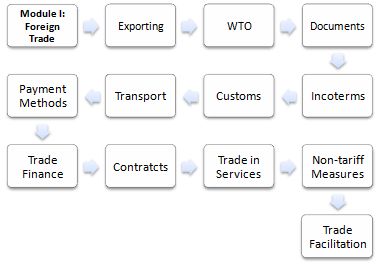
The main objective of the first module of the Master in Foreign Trade and Marketing is to provide all the knowledge, tools and techniques necessary to manage all the aspects related to foreign trade of an exporting or importing company: Incoterms® 2020, international transport, customs, export and import documents, international payments methods, documentary credits, trade in services, international financing, international contracts, non-tariff measures, etc.
The module on foreign trade consists of twelve subjects:
- Introduction to Exporting
- Import/Export Documents
- Incoterms
- Customs Procedures
- International Contracts
- Anti-corruption Clause of the ICC
- UNCITRAL
- Trade in Services
- Sanitary and Phytosanitary Measures
- Technical Barriers to Trade
- Pre-shipment Inspection
- Anti-dumping Measures and Safeguards
- Import Licensing and Quotas
- World Trade Organization (WTO)
- Trade Facilitation Agreement
- Kyoto Convention
- Convention Harmonization of Frontier Controls of Goods
- Global System of Trade Preferences
- Trade Negotiations Among Developing Countries
Download the syllabus (PDF) of Foreign Trade Related Subjects.
Second module of the Master - International Marketing
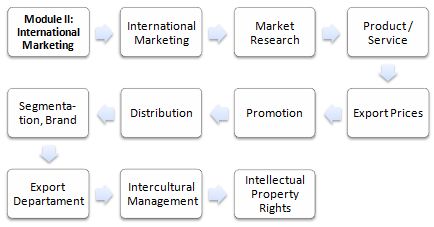
The main objective of the second module of the Master is to provide all the knowledge, tools and techniques necessary to manage all the aspects related to the international marketing of an exporting company: adapting export products, international pricing policy, global promotion and distribution, international marketing, country brand, segmentation, positioning in the international markets, organization of an export department, intercultural negotiation, international market research, intellectual property rights...
The module on international marketing consists of ten subjects:
- International Marketing
- Market Research
- International Product (Services) Policy
- Quality and International Marketing
- International Pricing Policy. Export Prices
- International Promotion Policy
- International Fairs
- Country Brand
- International Business Trip
- e-Promotion
- Social Networks and international promotion
- International Distribution
- Importers and distributors
- Foreign subsidiaries
- International Sales Network Management
- International Segmentation, Brand, and Positioning
- Export Department
- Intercultural Management
- Intellectual Property
Rights (TRIPS)
- WIPO
Download the syllabus in PDF of the international marketing Related Subjects.
Thesis of the Master in Foreign Trade and Marketing [5 ECTS]
For the successful completion of the Master, the student must submit a Thesis. The topic must be related to Foreign Trade or Global Marketing.
The Thesis normally reports on a research project or an extended analysis of a topic.
- The coach will provide the guidelines and requirements for writing the paper
- If the student works in a company; he can develop his thesis related to his work
- The delivery of the exercises and thesis is done digitally, through our e-campus
- EENI encourages the creation of work groups with students from different countries
Some Examples of thesis:
- “International Marketing Plan” (for a company / market)
- “Creating international distribution networks”
- “International promotion strategies”
- “Electronic documents in foreign trade”
- “Analysis of the trade facilitation programs in the ASEAN Region”
- “Analysis of the Road Transport in the Eastern African markets”
- “Electronic international payments”
- ...
No to Corruption in International Business.
The Master in Foreign Trade and Marketing includes the module No to Corruption in International Business.
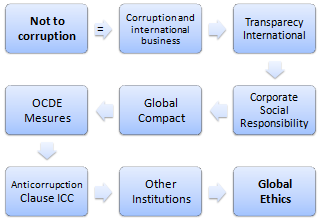

Download the syllabus “No to Corruption” (PDF).
The master includes the Market Access Tool:
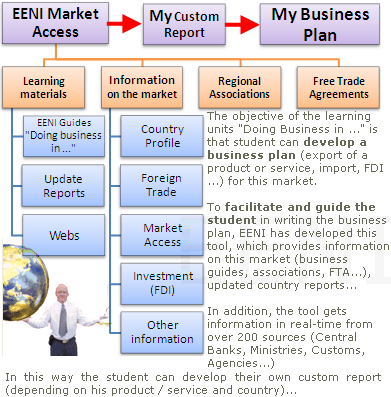
The student has to pass the online continuous assessment exercises for each subject as well as the final online Master's Thesis. If the professor considers that the minimum level has not been reached, he will guide the student to improve the quality of his exercises or thesis and send them back.
The most important thing for EENI is that the student correctly learns the Master's subjects and objectives.
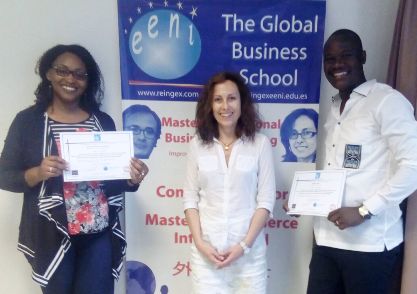
Once all the exercises and thesis have been approved, the student obtains the “Diploma of Professional Master of Science (MSc) in Foreign Trade and International Marketing” issued by EENI Global Business School.
In this case, it will be necessary to send us by mail (not valid by email) a certified photocopy of your diploma of Bachelor's Degree. This is necessary for the issuance of your diploma and not to enroll.
Those students, who are not in possession of a Bachelor's Degree, may Enroll but will receive the “Advanced Certificate Program in International Trade and Marketing.”
In what types of job positions can a person work with this Master?.
For example, in the export department of export companies, service companies (logistics department, banking, consulting companies), public and private institutions such as chambers of commerce, business associations, multilateral Organizations and as an entrepreneur, or creating one's business.
Video Master in Foreign Trade and Marketing.
Video Career opportunities related to the Master.
Alliances with educational institutions to jointly teach Master's Degrees.