
Import/Export Documents. Documentation Foreign Trade


Documentation for International Trade. Bill of lading, packing list
- Introduction to Import/Export Documents
- Documents Required for international trade
- Documents of Origin (Certificate of Origin)
- Commercial Documents (Proforma, Invoice, Packing List)
- Transport Documents
- Administrative Documents
- Other Documents
- Case Study:
- Documents needed for exporting to Brazil
- Documentation for exporting fish to Angola
The main purposes of the Subject “Import/Export Documents” are to learn about the different types of documents used in Foreign Trade, which documents usually require the customs, the requirements for the various documents and how to fill in these documents correctly.
In this subject, the student will learn about the various types of documents used in Foreign Trade.
This will be achieved by:
- Analysing the various classifications and requirements related to the export documents
- Learning what function the export documents perform
- Learning the different types of documents of origin that evidence the origin of the products
- Analysing the various commercial and administrative documents
- Examining other documents that may be required in the international business transactions

The Subject “Import/Export Documents” belongs to the following Online Programs taught by EENI Global Business School:
Courses: Export Assistant, Foreign Trade Management.
Diploma in International Trade.

Masters: International Business, Foreign Trade, International Transport.
Doctorate: Global Logistics, World Trade.

Languages:  or
or  Documents
  Documentos
  Documentos.
Credits of the Subject “Import/Export Documents”: 1 ECTS.
Import/Export documents.
Most international trade transactions require some transport, administrative, commercial, and insurance documents.
There are a great variety of documents that may need to be produced to complete export/import transactions; some estimates indicate 200 different documents are used in Foreign Trade.
However, in most export transactions, only a few certain documents are used (invoice, packing list, and logistics documents).
The Import/Export Documents fulfill the following functions:
- Proof of a contract. Documents such as transport documents (bill of lading) or the insurance documents evidence the existence of a contract of sale, and the conditions stipulated there
- Title to the products. Certain transport documents represent title to the products, that is; they give the right to collect the products from the carrier (just as a Bank draft gives you the right to collect funds against the drawer)
- Information. Certain documents provide information related to the price of the product (invoice), the package of the units contents (packing list)
- Customs. The Customs of the destination country require documents that evidence the origin of the products to establish whether the products are importable to the country and to charge appropriate taxes and duties
- Proof of compliance. Certain documents serve as proof that the conditions stipulated in the contract of sale are complied with, such as date of shipment (transport documents) and origin of products (Certificate of origin)
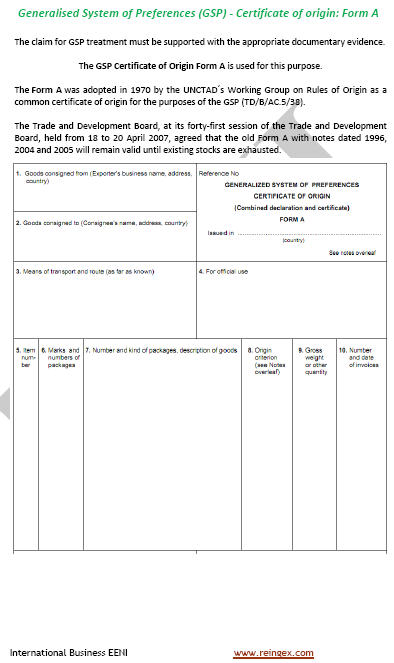
DOCUMENTS OF ORIGIN
The objective of these documents is to show where the products originated. Therefore; they play a major role to establish taxes and duties to be paid on products at customs. One must find out what type of document exactly is required at customs to be able to benefit from possible reduced tariffs.
(c) EENI Global Business School (1995-2024)
We do not use cookies
Top of this page