
International Market Research. PEST Analysis


International Market Research. Sales potential in foreign markets
- Introduction to the global market research
- How to export?
- Where to export?
- What to export?
- Methods of conducting a market research
- Quantitative analysis
- Qualitative methods
- Market profitability
- Sales potential in foreign markets
- PEST analysis (Political, Economic, Social, and Technological Factors)
- Market research study
- Case Study:
- Market research using the market access tool (MADB) of the EU
- Mitsui Co
- Cargill
The main purpose of the Subject “International market research” is to understand the key tools and concepts of the international market research and how best to apply them.
- To understand the importance of the global market research in the strategies of Internationalization
- To know how to analyze an international market research
- To learn how to use the PEST analysis (Political, Economic, Social, and Technological)
This will be achieved by:
- Analysing the goals of researching a new export market
- Outlining the features of both qualitative and quantitative analysis
- Detailing the type of information that the student should obtain to assess the commercial viability of an export market

The Subject “International market research” belongs to the following Online Programs taught by EENI Global Business School:
Masters: Foreign Trade, International Business.


Diploma: International Marketing.

Courses: Foreign Trade Assistant, Advanced Global Marketing.


Languages:  or
or  Études de marché
  Estudios de mercado
  Estudo de Mercado.
Credits of the Subject “International market research”: 2 ECTS.
Area of Knowledge: International Marketing.
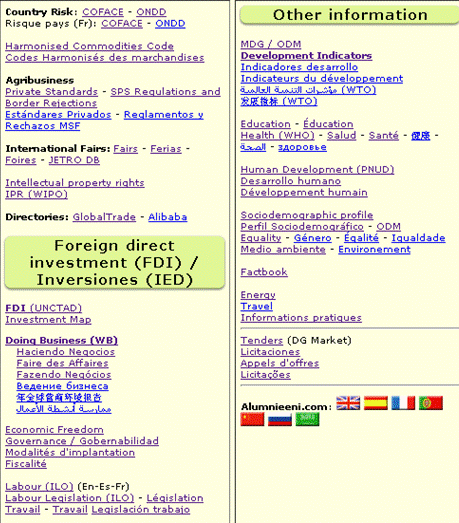
This subject includes the EENI Global Business School Market Access tool
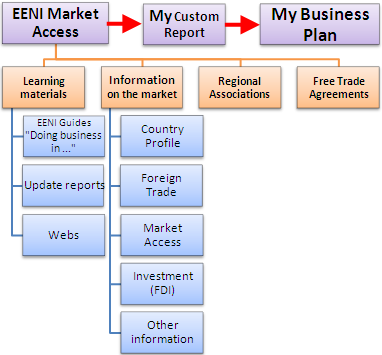
Sample - International market research:
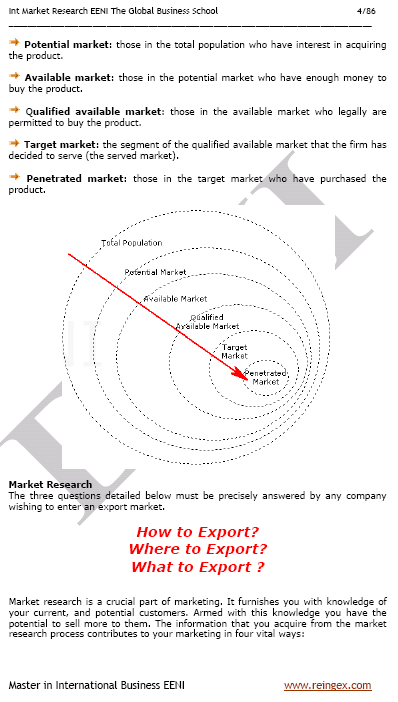
The first step that a potential export enterprise should take is to estimate the sales potential in each foreign market. There are more of 200 potential markets in the World, which implies the analysis of a huge amount of information. Many Export Directors select the markets, which share a cultural proximity (Spanish exporters seek to approach to the Latin America markets, Portuguese exporters to Brazil or Angola).
The exporter can use several parameters to describe the potential market:
- Total population
- Potential market (segment of the population interest in buy -or import- the product or service)
- Available market (segment of the population who have enough money to purchase the product or service)
- Qualified available market
- Target market (segment of the market defined in the marketing plan)
- Penetrated market (people of the company in the target market who have to buy the product or service)
- Digital / e-business topics
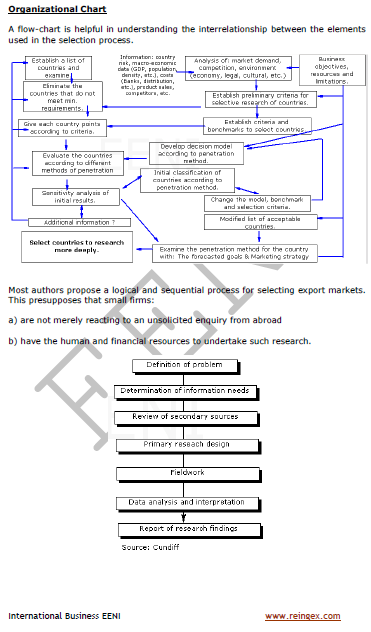
A PEST (Political, Economic, Social, and Technological) analysis is an evaluation of the external macro environment that affects the business. The external factors can be threats or opportunities; normally they are beyond the control of the exporter.
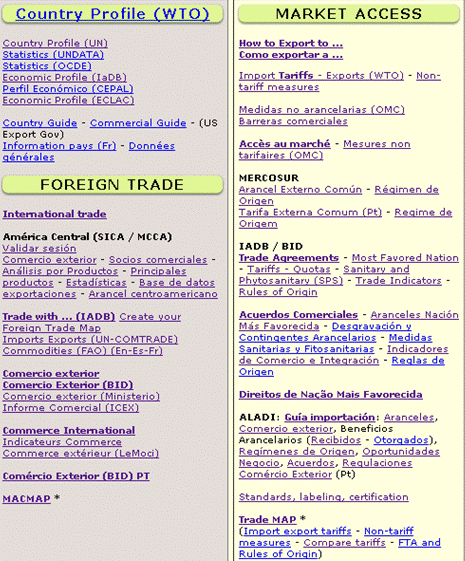
An example of the Market Access Tool
(c) EENI Global Business School (1995-2024)
We do not use cookies
Top of this page