
Export Prices. International Pricing Policy


Global prices and Incoterms. Pricing options available to the exporter
- Introduction to the international pricing policy
- Product life cycle and international pricing policy
- Calculation of the export prices
- International prices and Incoterms® 2020
- Analysis of the prices of the competitors
- International Pricing Strategies;
- Pricing strategy when entering new export markets
- Pricing options available to the exporter
- E-Business and pricing policy
- Case Study:
- Pricing Policy and Inflation
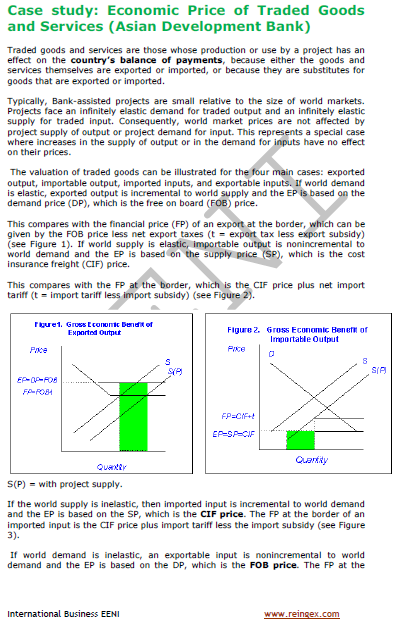
- Price of Traded Goods and Services in Asia
The main objective of the Subject “International Pricing Policy” is to understand the importance of an appropriate pricing strategy when entering new export markets.
- We are going to examine the pricing options available to the exporter and outline the criteria to be used when establishing a pricing strategy
- We will also look at the criteria defined in pricing under the Incoterms
This will be achieved by:
- Examining the pricing options available to the exporter
- Outlining the criteria to be used when establishing a pricing strategy
- Analysing the goals of a pricing policy
- Detailing how to calculate an export price
- Introducing the criteria defined in pricing under the Incoterms® 2020

The Subject “International Pricing Policy” belongs to the following Online Programs taught by EENI Global Business School:
Courses: Foreign Trade Assistant, Global Marketing.
Diploma: International Marketing.

Masters: Foreign Trade, International Business.

Doctorate: Global Logistics, World Trade.

Languages:  or
or  Prix exportation
  Precios exportación
  Preços de exportação.
- Credits of the Subject “International Pricing Policy”: 1

- Duration: 1 week
Area of Knowledge: International Marketing.
Sample - International Pricing Policy:
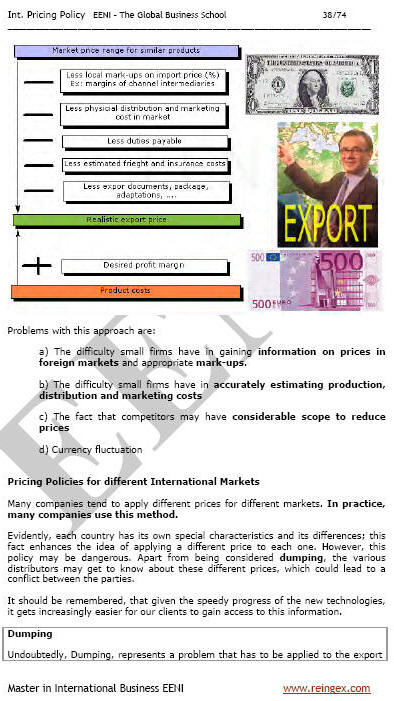
One of the most complicated aspects of the foreign trade is the pricing policy. An incorrect pricing policy can lead to a total failure in the international markets.
First of all; we should find out about prices in various foreign markets, this information will allow us to have some real criteria for setting our export prices.
However, we will meet the familiar dilemma: global or local prices?.
From another point of view, the price is attached to the selected Incoterm. In the more competitive markets; it is habitual to deliver the product to client´s premises, thereby offering DDP prices. In some countries this is impossible, and it will cause us problems.
When designing the international pricing policy; we will have previously carried out a survey of our competitor's prices in our different target markets.
We will be able to act according to this information one-way or the other. It will be a basic reference when establishing international prices. In this respect, the Internet is a valuable research tool for the exporter.
The pricing strategies to be followed in the foreign markets are often closely linked to the product life cycle. We must examine the pricing strategies for the various stages of the life cycle:
1- Introduction strategies:
- Setting low prices for penetration
- “Skimming” the market
2- Strategies for existing products:
- Maintaining a prestige prices
- Maintaining a given low price, when commercializing mass sale products
- Corrective actions
(c) EENI Global Business School (1995-2024)
We do not use cookies
Top of this page