Business in Russia
International Trade and Business in Russia
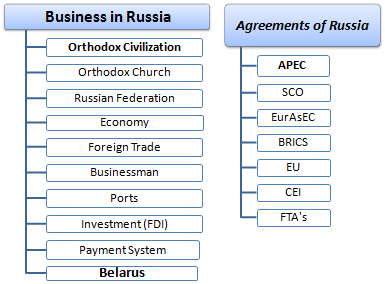
- Orthodox Economic Area
- The Russian Federation
- Russian Economy and Foreign Trade
- Transport and Logistics in Russia
- Russian Foreign Trade.
- Investment in Russia
- Russian Free Trade Agreement
- Foreign Trade and Business in Belarus
The main objective is to provide an overview of the economy of Russia and the business opportunities to develop a business plan for the Russian market:
- To learn to do business in Russia
- To analyze the Russian Foreign Trade and foreign direct investment flows
- To know the business opportunities in the Russian Market
- To know Russian Trade Agreements
- To develop a business plan for Russia
- To carry out an International Marketing Plan or a Project to Set Up a Company in Russia
Language: 



EENI Online Higher Education Programs:
Doctorate: European Business, World Trade.

Masters: International Business, Foreign Trade.
 Masters adapted to Russian Students.
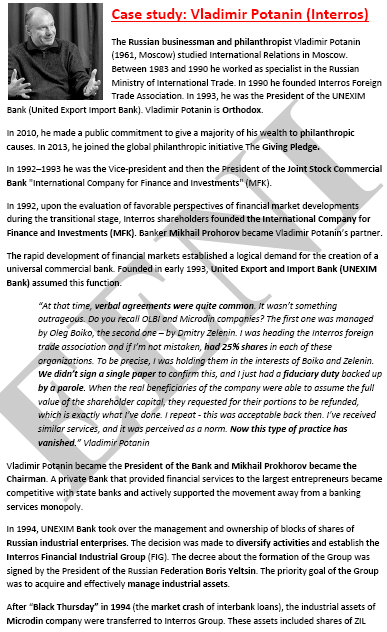
Russian Economy and Foreign Trade.
Foreign direct investment in Russia.
Russian Free Trade Agreement (FTA) and Markets Access
- APEC
- Shanghai Cooperation Organization
- Eurasian Economic Union
- Eurasian Economic Union (EAEU)-Vietnam Agreement
- Commonwealth of Independent States
- Moldova has a Trade Agreement with the CIS
- EU-Russia
- Andean Community-Russia
- BRICS Countries
- Africa-BRICS Countries Cooperation (Russia is a member of the BRICS)
- Black Sea Cooperation
- Russia has Trade Agreements with Armenia, Azerbaijan, Belarus, Georgia, Kyrgyzstan, Moldova, Serbia, New Zealand, Uzbekistan, Turkmenistan, Belarus, and Cameroon
- Belarus-Kazakhstan-Russia-Ukraine Common Economic Space
- Free trade agreement between Russia, Belarus, and Kazakhstan
- Russia-Belarus-Kazakhstan Customs Union
- Russia has a Customs Union with Vietnam
- ASEAN-Russia Business Forum
- Council of the Baltic Sea States
- SICA (observer country)
- ALADI (observer country)
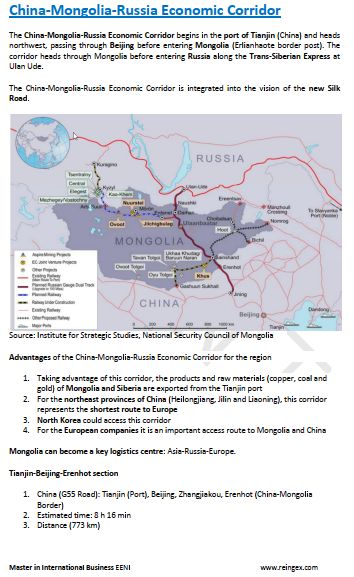
Russian Economic Corridors. Ports of Russia.
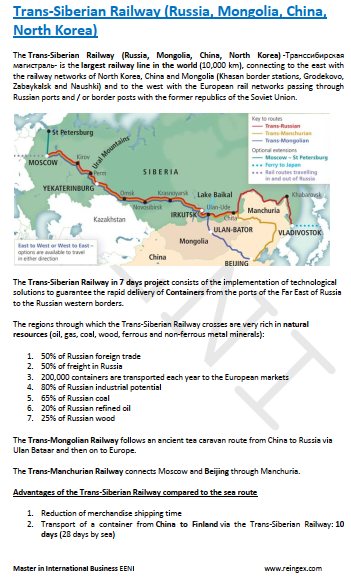
- Trans-Siberian Railway (Russia, North Korea)
- China-Russia Corridor
- North-South Corridor (India-Russia)
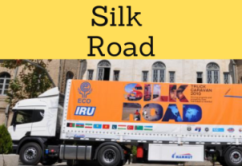
- Silk Road
- Almaty-Bishkek Corridor
- China-Central-West Asia Corridor
- Pan-European Corridor II (Russia-Germany)
- Pan-European Corridor IX (Finland-Greece)
- Access to the
- Afghanistan-Turkey Corridor
- Europe-Caucasus-Asia Corridor
- India-Afghanistan Corridor
- Corridor of the Ashgabat Agreement
- Trans-Caspian Corridor
- North Sea-Baltic Corridor
- Baltic-Adriatic Corridor
Access to the Russian market.
Includes the
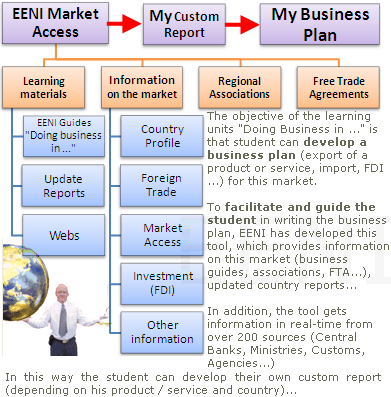
Market Access Tool
- WTO
- WCO
- Convention Harmonization of Frontier Controls of Goods
- COTIF Convention (Rail)
- BIC (Containers)
- Chicago Convention (ICAO)
- IMO
- Customs Convention on Containers
- Organization for Cooperation between Railways (OSJD)
- IRU
- TIR Convention
- Guidelines on Safe Load Securing for Road Transport
- CMR Convention (UN)
- CIM, CIT Rail Rules
- International Chamber of Shipping
Regional Economic Institutions to which Russia belongs:
- ESCAP
- Asia Cooperation Dialogue
- Asia-Europe Meeting
- UNECE
- European Investment Bank
- UN
- UNCTAD
- ITC
- UNCITRAL
- WIPO
- WB
- WTO
- IMF
- OECD
- OSCE
- Organization of Islamic Cooperation (OIC) (observer)

EENI European Students: