
New Asian-African Strategic Partnership






 WhatsApp
Pillars of the Afro-Asian Cooperation. Foreign Trade Asia-Africa
Module: International Relations of Africa
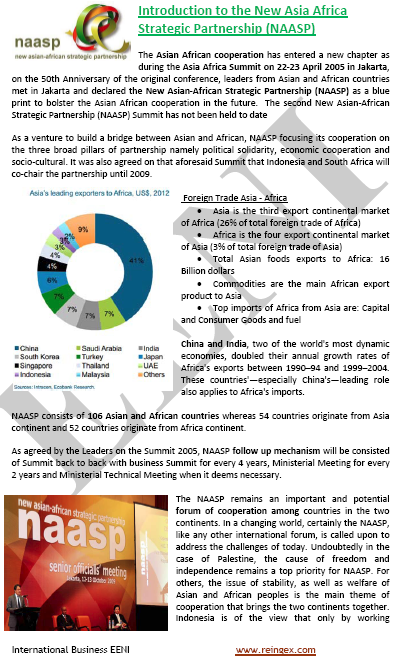
At the Asia-Africa Summit held in Indonesia (Jakarta, 2005), African and Asian leaders adopted the New Asian-African Strategic Partnership (NAASP) with the main objective of encouraging bi-continental cooperation between them.

- Introduction to the New Asian-African Strategic NAASP
- Africa-Asia Sub-regional Organization Conference (AASROC)
- Afro-Asian Conference (Bandung Conference)
- Declaration on the New Asian-African Strategic Partnership
- Foreign Trade Africa-Asia
Sample - New Asian-African Strategic Partnership (NAASP):
The objectives of the subject “New Asian-African Strategic Partnership” are:
- To understand the objectives of the New Asia-Africa Strategic Partnership
- To evaluate the advantages for African Countries
- To learn about pillars of the Afro-Asian cooperation
- To analyze International Trade between Asia and Africa

The Subject “New Asian-African Strategic Partnership” is included within the curriculum of the following academic programs at EENI Global Business School:

Doctorate in African Business.

Languages:  or
or  Afrique-Asie
 África-Asia
  África-Asia.
The three pillars of the Strategic Partnership between Asia and Africa are:
- Economic Cooperation
- Socio-Cultural Relations
- Political Solidarity
The New Asian-African Strategic Partnership is a forum for cooperation between fifty-four Asian Countries and fifty-two African Countries.
The New Asian-African Strategic Partnership has defined eight top areas of collaboration:
- SME
- Food security
- University networking
- Tourism
- Energy security
- Gender equality
- Women empowerment
- Fight against trans-national organized crime
- Counterterrorism
The New Asian-African Strategic Partnership devotes particular attention to the liberation of Palestine.
Asia-Africa Foreign Trade.
- Asia is the third export continental market of Africa (26% of total African Foreign Trade)
- Africa is the four export continental market of Asia (3% of total Asian Foreign Trade)
- Total Asian foods exports to Africa: 16 billion dollars
- Commodities are the largest African export product to Asia
- Top African imports from Asia are capital and consumer goods and fuel
Asia-Africa Bilateral Relations:
- China-Africa Cooperation
- Africa-India Cooperation
- Africa-Japan (TICAD)
- Africa-Korea
- Asia-Africa Logistics Corridor
African Countries: Algeria, Angola, Benin, Botswana, Burkina Faso, Burundi, Cameroon, Cape Verde, Central African Republic, Chad, Comoros, Congo, Ivory Coast, Democratic Republic of the Congo, Djibouti, Egypt, Eritrea, Eswatini, Ethiopia, Equatorial Guinea, Gabon, Gambia, Ghana, Guinea, Guinea-Bissau, Kenya, Lesotho, Liberia, Libya, Madagascar, Malawi, Mali, Mauritania, Mauritius, Mozambique, Namibia, Niger, Nigeria, Rwanda, São Tomé and Príncipe, Senegal, Seychelles, Sierra Leone, Somalia, South Africa, Sudan, South Sudan, Tanzania, Togo, Tunisia, Uganda, Zambia, and Zimbabwe.
Asian Countries: Afghanistan, Armenia, Australia, Azerbaijan, Bangladesh, Bhutan, Brunei, Cambodia, Hong Kong, India, Indonesia, Iran, Japan, Kazakhstan, North Korea, South Korea, Kyrgyz Republic, Laos, Macau, Malaysia, Maldives, Mongolia, Myanmar, Nepal, Pakistan, Philippines, Singapore, Sri Lanka, Tajikistan, Thailand, Turkmenistan, Uzbekistan, Vietnam.
(c) EENI Global Business School (1995-2025)
Top of this page
