Business in Equatorial Guinea, Malabo



 WhatsApp
Equatoguinean Foreign Trade. Oil sector. Port of Malabo, Bata, Logistics
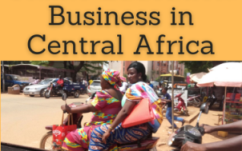
Equatorial Guinea: The richest per capita African Country.
One of the fastest African growing economies (Oil sector).
- Equatorial Guinea is the third largest oil producer in sub-Saharan Africa
- Ports of Equatorial Guinea: Malabo, Bata, and Luba Freeport

- Introduction to the Republic of Equatorial Guinea (Central Africa)
- Economy of Equatorial Guinea
- Equatoguinean Oil sector
- Infrastructures in Equatorial Guinea
- International Trade of Equatorial Guinea
- Transport and Logistics
- Business and Investment Opportunities in Equatorial Guinea
- Agriculture sector
- Tourism
- Financial sector
- Oil sector (Equatorial Guinea is the third largest oil producer in sub-Saharan Africa)
- Shipping industry
- Access to the Equatoguinean Market
- Business Plan for Equatorial Guinea
Sample: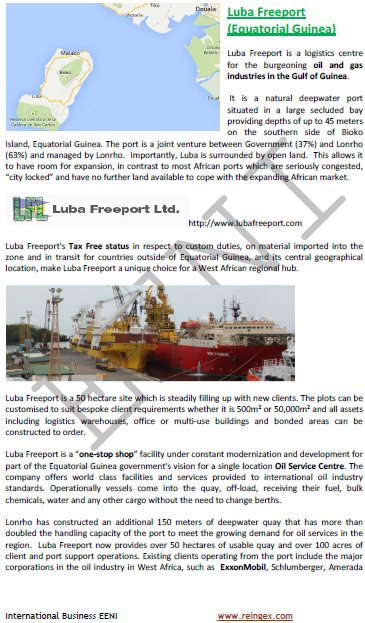

The educational aims of the Subject “Foreign Trade, Logistics and Business in Equatorial Guinea” are:
- To analyze the Equatoguinean Economy, Logistics and Global Trade
- To conduct research on business opportunities in Equatorial Guinea
- To explore the Equatoguinean trade relations with the student's country
- To learn about Equatoguinean trade agreements
- To develop a business plan for the Equatoguinean Market

The Subject “Foreign Trade, Logistics and Business in Equatorial Guinea” is included within the curriculum of the following academic programs at EENI Global Business School:
Doctorate in African Business.

Master in Business in Africa, Transport and Logistics in Africa
Languages:  or
or  Guinée Équatoriale
  Guinea Ecuatorial
  Guinea Ecuatorial.
- Subject Credits “Doing Business in Equatorial Guinea”: 1

International Trade, Logistics and Business in Equatorial Guinea.
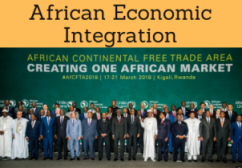
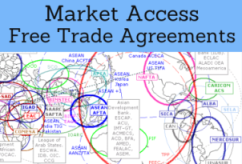
Preferential trade agreements of Equatorial Guinea
- WTO (in process of accession)
- Arab Bank for Africa (BADEA)
- Harmonization of Business Law in Africa (OHADA)
- Is not a member of WCO
- Kyoto Convention
- Economic Commission for Africa
- African Union
- AU Convention on Preventing and Combating Corruption (not signed)
- African Development Bank
- AUDA-NEPAD
- China-Africa Cooperation
- Africa-India Cooperation
- Africa-BRICS
- Africa-Turkey Partnership
- Afro-Arab Cooperation
- Arab Bank for Africa (BADEA)
- Africa-South America Summit
- United Nations
- World Bank
- World Trade Organization (WTO)
- International Monetary Fund
- World Customs Organization (WCO)
- International Organisation of La Francophonie (OIF)
- CPLP
Equatorial Guinea returned to the Francophonie (OIF) in 1988.
- The official languages of Equatorial Guinea are Spanish, Portuguese and French
- Equatorial Guinea (Africa) has a population of 1.1 million people
- Equatoguinean Capital: Malabo
- The second-largest city of Equatorial Guinea is Bata
- The borders of Equatorial Guinea are Cameroon and Gabon
- 70% of the Equatoguinean population falls below the poverty line
- Equatoguinean Independence: 1968 (Spain)
- Area of Equatorial Guinea: 28,051 km²
- Presidential Republic
More information about Equatorial Guinea (EENI African Business Portal).
Religions in Equatorial Guinea:
- Christianity (Catholicism)
- African Traditional Religions
Equatorial Guinea belongs to the Central African Economic Area.
Economy of Equatorial Guinea.
- Equatorial Guinea is a member of the Economic Community of Central African States (economic integration area of 124 million consumers)
- Equatorial Guinea is one of the fastest growing markets (Oil sector)
- Huge petroleum reserve
- Equatoguinean currency: CFA Franc (since 1985)
- Equatorial Guinea has the highest per capita Investment in health in Africa
- Top trading partners of Equatorial Guinea are the United States, China, Spain, Italy, and France
- Equatoguinean emerging sector: construction and real estate
- + 800 construction projects
- Equatoguinean top exports: petrol and gas, timber, and cocoa
- Bata-Mbini Bridge: The longest African bridge
(c) EENI Global Business School (1995-2025)
Top of this page
