Business in Mauritania, Nouakchott, Mining




 WhatsApp
Mauritanian Economy, Logistics and Foreign Trade. Mining, fisheries
The Islamic Republic of Mauritania: The importance of the mining and fishing sector
Main Mauritanian resources are Iron ore, fisheries, agriculture, livestock, Petrol, and gas
The most dynamic sectors of the Mauritanian economy are mining (10% GDP), agriculture, and construction
Port of Nouakchott (Deep-sea port)
- Introduction to the Islamic Republic of Mauritania (Maghreb). Mining, fisheries
- Business in Nouakchott
- Mauritanian Economy
- International Trade of Mauritania
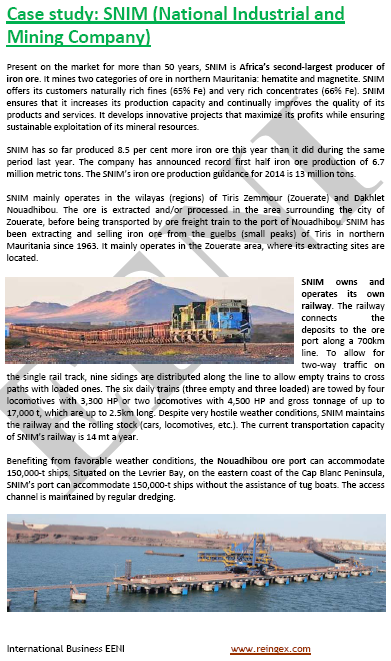
- Case Study: SNIM (National Industrial and Mining Company)
- Business and Investment Opportunities in Mauritania
- Fisheries
- Farming
- Mining sector
- Invest in Mauritania
- Transport and Logistics
- Access to the Mauritanian Market
- Business Plan for Mauritania

The educational aims of the Subject “Foreign Trade, Logistics and Business in the Islamic Republic of Mauritania” are:
- To analyze the Mauritanian Economy, Logistics and Global Trade
- To conduct research on business opportunities in the Islamic Republic of Mauritania
- To explore the Mauritanian trade relations with the student's country
- To learn about Mauritanian Trade Agreements
- To examine the profile of Mauritanian companies
- To develop a business plan for the Mauritanian Market

The Subject “Foreign Trade, Logistics and Business in Mauritania” is included within the curriculum of the following academic programs at EENI Global Business School:
Doctorate in African Business.

Master in Business in Africa, International Business, Foreign Trade.
Languages:  or
or  Mauritanie
  Mauritania
  Mauritania.
Credits of the Subject “Doing Business in Mauritania”: 1 
International Trade, Logistics and Business in Mauritania.
Mauritanian Preferential Access and Trade Agreements:
- Mauritania and the Maghrebian Economic Area
- Arab Maghreb Union
- Community of Sahel-Saharan States (CEN-SAD)
- African Continental Free Trade Area
- AGOA
- Bilateral trade agreement with ECOWAS
- In 2000, Mauritania left ECOWAS
- The EU:
- Africa-EU Partnership
- GSP
- Euro-Mediterranean Partnership
- Islamic Trade Preferential System
- Arab Bank for Africa (BADEA)
- G5-Sahel
- Organization for the Development of the Senegal River
- Global System of Trade Preferences among Developing Countries (GSTP) - accession process
- Greater Arab Free Trade Area (GAFTA) - not a member
- World Trade Organization (WTO)
- Agreement on Trade in Services (GATS)
- Agreement on the Application of Sanitary Measures
- Agreement on Technical Barriers to Trade
- Agreement on Preshipment Inspection
- Agreement on Safeguards
- Trade Facilitation Agreement
- World Customs Organization (WCO)
- Kyoto Convention
- Economic Commission for Western Asia (ESCWA)
- Arab League
- Organization of Islamic Cooperation (OIC)
- Committee for Economic Cooperation
- Islamic Chamber of Commerce
- Islamic Centre for Development of Trade
- Economic Centre for Islamic Countries
- Asia - Middle East Dialogue
- Summit of South America-Arab Countries
- Afro-Arab Cooperation
- Arab Bank for Africa (BADEA)
- Arab Development Funds
- OPEC Fund for International Development (OFID)
- Economic Commission for Africa
- African Union
- AU Convention on Combating Corruption
- AUDA-NEPAD
- African Development Bank
- Africa-Turkey Partnership
- Africa-Asia Partnership
- Africa-India Cooperation
- Africa-BRICS
- World Bank
- International Monetary Fund
- United Nations
- Conference on Trade and Development (UNCTAD)
- International Trade Centre (ITC)
The Islamic Republic of Mauritania
- Mauritania is located between the 15th and 27th north parallel and covers an area of 1,030,700 km²
- Mauritania It is bounded on the north by Algeria and the Western Sahara, to the east by Mali, on the south by Mali and Senegal on the west by the Atlantic Ocean
- Mauritanian Official language: Arab
- French is also used
- Government: Islamic Republic
- Population of Mauritania: 4.3 million inhabitants
- Density: 1.95 inhabitants/km²
- Capital of Mauritania: Nouakchott (800,000 habitants).
- Nouadhibou is the second Mauritanian city
- Mauritanian independence: 1960 (from France)
- Abolition of Slavery in Mauritania: 1981
- Mauritanian Currency: Ouguiya (MRO)
More information about Mauritania (EENI African Business Portal).
Religion in Mauritania: Sunni Islam.
- Fiqh (Islamic Jurisprudence): Maliki school
Mauritania belongs to the Maghrebian Economic Area (Islamic Civilization and African Civilization).
Economy of Mauritania:
- Fishing agreement with the European Union
- Top Mauritanian trading partners: the EU (France) and China
- Top Mauritanian export markets: France (25% of total exports), Japan, Spain, and Italy
- Trade with other African Markets: only 4% of total Mauritanian trade
With more than fifty years of experience, SNIM (National Industrial and Mining Company) is the second largest African iron ore producer. The company manages his Rail transport from the mines to the Port of Nouakchott (700 kilometers).
Nearest foreign ports:
(c) EENI Global Business School (1995-2025)
Top of this page
