Business in Ivory Coast. Abidjan, Yamoussoukro



 WhatsApp
Ivorian Economy and Foreign Trade, Cocoa, African Frontier Market (Ivory Coast)
Ivory Coast: The first world cocoa producer, an African Frontier Market. Headquarters of the African Development Bank
Ivory Coast is an African frontier market
Main resources of Ivory Coast (Africa) are cocoa (first world producer), yams (second largest producer), coffee (tenth largest producer), bananas, palm oil, cotton, wood, Petrol, gas, diamonds, gold, nickel, and tourism
The South of Ivory Coast concentrates 85% of the economic activity
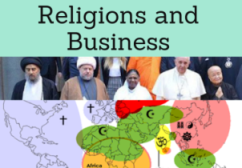
Religions and Global Business -
Religious diversity
- Introduction to the Republic of Ivory Coast (Côte d'Ivoire - West Africa)
- Ivorian Economy
- International Trade of Ivory Coast
- Business and Investment Opportunities in Ivory Coast
- Agribusiness
- Construction, public works and infrastructures
- Petrol
- Tourism
- Industry
- Investment Promotion Centre of Ivory Coast (CEPICI)
- Case Study: Prosuma Group
- Access to the Ivorian Market
- Business Plan for Ivory Coast
Sample: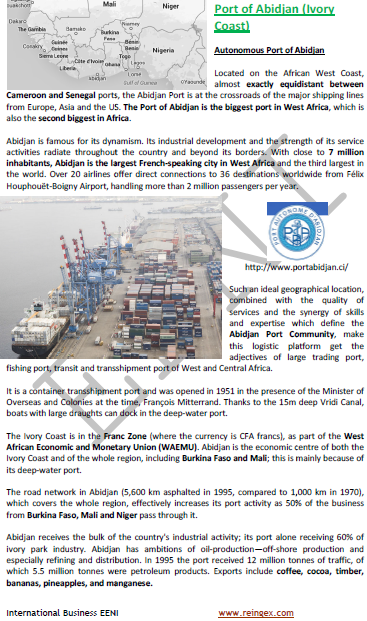

The educational aims of the Subject “Foreign Trade, Logistics and Business in Ivory Coast (Côte d’Ivoire)” are:
- To analyze the Ivorian Economy, Logistics and Global Trade
- To conduct research on business opportunities in Ivory Coast
- To explore the Ivorian trade relations with the student's country
- To learn about Ivorian Trade Agreements
- To examine the profile of Ivorian companies
- To develop a business plan for the Ivorian Market

The Subject “Business in Ivory Coast (Côte d’Ivoire)” is included within the curriculum of the following academic programs at EENI Global Business School:
Doctorate in African Business.

Master in Business in Africa, International Business.
Languages:  or
or  Côte d'Ivoire
  Costa do Marfim
  Costa de Marfil.
- Subject Credits “Doing Business in Ivory Coast (Côte d’Ivoire)”: 2

Trade Agreements and preferential access of Ivory Coast.
- Ivory Coast and the the West African Economic Area
- Economic Community of West African States (ECOWAS)
- Community of Sahel-Saharan States (CEN-SAD)
- Mano River Union
- Niger Basin Authority
- Harmonization of Business Law in Africa (OHADA)
- African Continental Free Trade Area
- The United States-Ivory Coast
- UK-Ivory Coast Agreement
- European Union-Ivory Coast
- Trade Agreement with India
- Islamic Trade Preferential System
- World Trade Organization (WTO)
- Agreement on Trade in Services (GATS)
- Trade Facilitation Agreement
- Agreement on Sanitary Measures
- Agreement on Technical Barriers to Trade
- Agreement on Preshipment Inspection
- Agreement on Safeguards
- Is not a member of WCO
- Kyoto Convention
- Economic Commission for Africa
- African Union
- AU Convention on Combating Corruption
- AUDA-NEPAD
- Africa Agriculture Development Programme
- African Development Bank (In 2014, the African Development Bank returns to Abidjan)
- Africa-Asia Partnership
- Africa-Korea Partnership
- Africa-Japan Cooperation
- China-Africa Cooperation
- Afro-Arab Cooperation
- Arab Bank for Africa (BADEA)
- Organization of Islamic Cooperation (OIC)
- Islamic Development Bank
- United Nations
- World Bank
- World Trade Organization (WTO)
- International Monetary Fund
- Capital of the Republic of Côte d'Ivoire (Ivory Coast): Yamoussoukro
- Economic centre and largest city of Ivory Coast: Abidjan (12 million)
- Other Ivorian cities: Abidjan, Yamoussoukro, Bouaké, Daloa, Korhogo, Man, and San-Pédro
- Population of Ivory Coast: 24 million (15 million in 1998)
- Ivorian official language: French
- Local languages: Senufo, Baoule, Diola, and Dan
- Independence of Ivory Coast: 1960 (from France)
- Two recent civil wars: 2002-07 and 2010-11
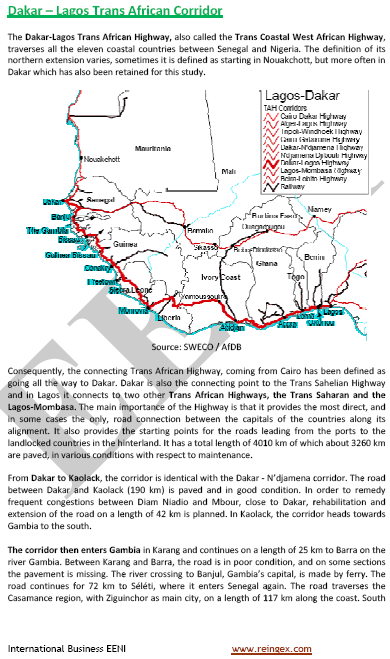
- Ivorian borders: Burkina Faso, Mali, Guinea, Liberia, and Ghana
- Currency of Ivory Coast: West African CFA Franc
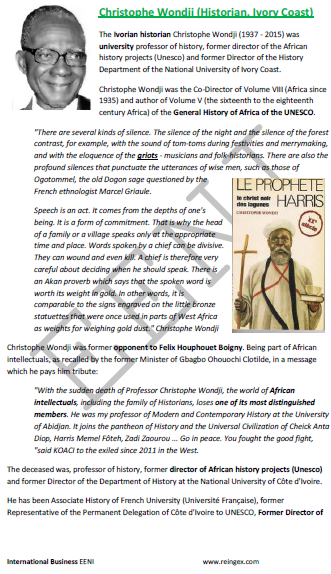
- The Historian Ahmadou Hampaté Bá died in Abidjan
More information about Ivory Coast (EENI African Business Portal).
Main religions in Ivory Coast:
- African Traditional Religions
- Christianity (32%)
- Catholicism (6 million)
- Protestants (Methodists: 1.3 million)
- Islam (38% of the population, 7 million)

Ivory Coast belongs to the West African Economic Area.
Ivorian Economy:
Ivorian Agriculture
- Humid tropical climate for the crops especially in low Coast
- Diverse agriculture (food, cash crops, and industrial crops)
Ivorian main productions:
- Cocoa. 1,367,200 tones/year. The first world producer
- Coffee. 117,000 tones/year
- Cola. 50 000 to 75,000 tones/year. The first in the World
- Palm oil. 284,500 tones/year
- Hevea. 130,000 tones/year
- Cotton seed: 221,700 tones/year
- Sugar: 152,900 tones/year
- Rubber: 179,000 tones/year
- Cashew: 230,000 tones/year
Ivorian Industry
- Ivorian industry contributes with 20% to the GDP and accounts for 40% of the West African Economic and Monetary Union countries
- 50% of the enterprises have a turnover less than 1 billion FCFA
- Best recent performance Ivorian sectors: Chemicals, water, electricity, mineral extractions, and various industries
- Main Ivorian Industries affected by the crisis: construction, agribusiness, textiles, and wood
- Food industry production accounts for 25% of GDP in the secondary sector
International Trade of Ivory Coast.
- Notwithstanding the socio-political crisis of the last decade, the economic partnerships of Ivory Coast with the emerging countries have markedly augmented, particularly those with the Asian Countries, including, China, South Korea, India, Singapore, Thailand, Brunei, Indonesia, and Malaysia
- Asia is the third largest trading partner (12.5%) of Ivory Coast, after Europe (44%) and African Countries (29%)
- China, which is the Ivorian leading Asian trade partner, still represents a modest share (3.2%) of the economy compared with its wider efficiency in Africa
(c) EENI Global Business School (1995-2025)
Top of this page
