Business in Colombia, Bogota, Medellin


Colombian Economy and Foreign Trade. Business in Bogota, Barranquilla
- Introduction to Colombia
- Colombian Economy
- Case Study:
- Business Process Outsourcing Sector
- Information Technology Services
- Agribusiness
- Manufacturing
- Cosmetics
- Textile
- Automotive
- Colombian Foreign Trade
- Investment in Colombia
- Business in...
- Bogota
- Barranquilla
- Medellin
- Case Study: Business Opportunities in Bogota
- Contact centers
- Business Process Outsourcing/Shared Services
- Information Technology Sector
- Medical Devices
- Pharmaceutical
- Cosmetics
- Audiovisual Production
- Case Study:
- South American Investment Group
- Luis Carlos Sarmiento Angulo
- Access to the Colombian Market
- Business Plan for Colombia
The aims of the subject “Foreign Trade and Business in Colombia” are the following:
- To analyze the Colombian Economy and Global Trade
- To know the trade opportunities in Colombia
- To explore the Colombian trade relations with the country of the student
- To know the Colombian Trade Agreements
- To examine the profile of Colombian businesspeople and enterprises
- To develop a business plan for the Colombian Market

The Subject “Foreign Trade and Business in Colombia” belongs to the following Online Programs taught by EENI Global Business School:
Masters: International Business, Foreign Trade.


Languages:  or
or  Colombia
  Colombie
  Colombia.
- Credits of the subject “Doing Business in Colombia”: 2

- Duration: two weeks
International Trade and Business in Colombia.
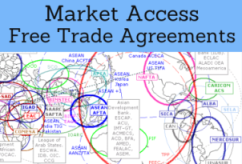
- Colombia and the Latin American Economic Area
- Andean Community
- ACS
- ALADI
- Pacific Alliance
- UNASUR
- SELA
- Trade Agreements with the CARICOM, Costa Rica, and the EFTA
- Colombia-Northern Triangle Free Agreement
- Colombia-Canada Agreement
- U.S.-Colombia Agreement
- UK-Colombia Free Trade and Economic Integration Agreement
- Mexico-Colombia Agreement
- Colombia-Chile Agreement
- Trade Agreements (as a member of the Andean Community) with the MERCOSUR, Chile, Mexico, Panama, and the EU
- MERCOSUR (Associate)
- Trade Relations: India, China, and Russia
- Mesoamerica Project
- CARICOM (Observer State)
- SICA (observer country)
- Trans-Pacific Partnership (CPTPP) - Candidate Country
- WTO
- GATS
- Agreement on the Application of Sanitary Measures
- Agreement on Technical Barriers to Trade
- Agreement on Preshipment Inspection
- Agreement on Safeguards
- Trade Facilitation Agreement
- WCO
- International Road Transport Union (IRU)
American Trade and Economic Organizations. Colombia is a member of:
- OAS
- ECLAC
- Inter-American Development Bank
- East Asia-Latin America Cooperation
- Summit South American-Arab Countries
- Africa-South America Summit
- CELAC
- EU-CELAC Summit
- UN
- WB
- WTO
- IMF
- PEEC
- OECD
- Colombia is the oldest and the most stable democracy in the region
- Colombian official language is Spanish
- With nearly 48 million people, Colombia ranks third in population in Latin America (after Brazil and Mexico)
- Area of Colombia: 1,141,748 km²
- Colombia ranks first in the member countries of the Andean Community regarding the transparency of the Government Policies (World Competitiveness Yearbook)
- Some of the most important publications in the World like the New York Times or The Guardian have given special consideration to the new image that Colombia is projecting to the world
- Colombian borders: Brazil, Ecuador, Peru, Panama, and Venezuela
- Capital of Colombia: Bogotá
- Colombia gained the independence from Spain in 1810
- Abolition of Slavery in Colombia: 1851
- African Diaspora in Colombia: 9 million people (21% of the Colombian population)
The main religion in Colombia is Christianity (42 million):
- Catholicism (38 million)
- Protestantism (1 million Colombians)

The Republic of Colombia belongs to the Latin American Economic Area (Western Civilization).
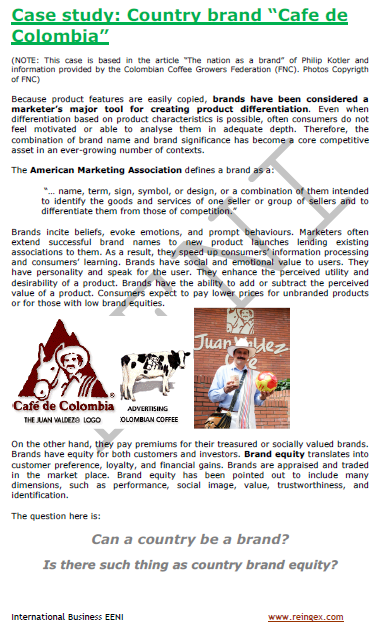
Colombian Economy.
- The Republic of Colombia is advantageously situated at the middle point between North and South America
- Colombia is in the same time zone as the East Coast of the United States which is an advantage compared to other countries as it facilitates the Call-centre activities and Business Process Outsourcing from Colombia to the entire continent
- The Republic of Colombia is one of the most steady economies in Latin America
- Macroeconomics indices also reveal the stability of Colombia
- Colombian economy is the fourth in Latin America (IMF) or the fifth according to the WB
- Colombia has had sustained economic growth above the average of the Andean Community member countries
- 2014: Slowdown of the Colombian Economy
- Colombia offers to investors the option of signing legal stability contracts
- Bogotá (7 million people) is the economic centre of Colombia and the most attractive city for doing business in the Andean Community (Source: America Economia), Bogota generates 40% of the Colombian GDP
- According to the WB, Colombia is the Latin American Economy that has implemented more reforms to facilitate business
- Colombia has in place several Free Trade Agreements (FTAs) and tariff preferences
- More than 700 multinational companies have investments in Colombia: Procter Gamble, Johnson Johnson, 3M, SAB Miller, Telefonica, Nestle
- Currency of Colombia: Peso
- The inflation rate has been substantially reduced over the last few years to reach 4.5%
- The foreign debt has been reduced by 20% of the GDP in the past few years
Bogota is the cultural and political centre of Colombia, and its leading city in education, international trade and foreign direct investment. Over the last few years, 700 multinational companies have had excellent results Bogota has access to USD 29 million markets.
Luis Carlos Sarmiento Angulo, the richest men in Colombia: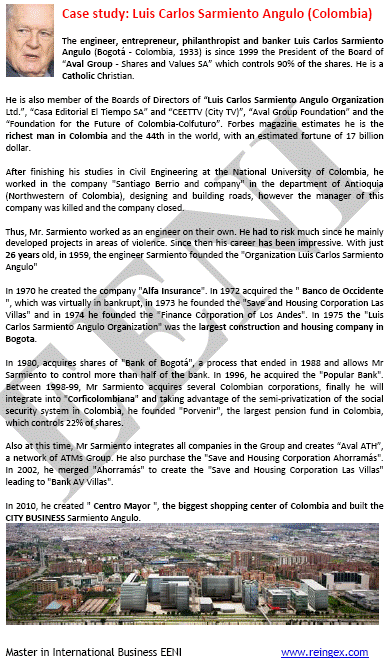
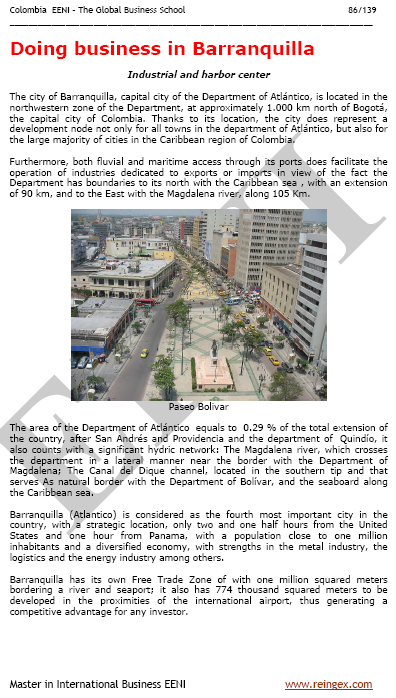
Barranquilla is the industrial and harbour centre.
- Barranquilla is the fourth-largest city in the Colombia
- Barranquilla has a strategic location, only two and one-half hours from the U.S. and one hour from Panama, with a population of 1 Million people and a diversified economy, with strengths in the metal industry, Logistics and energy industry among others
- Barranquilla has near twenty-five maritime, fluvial and air ports with facilities for transportation of all types of cargo through several highways (Road Transport) connecting the rest of Colombia and the world
Medellín (the second largest city in Colombia) is the responsible for 8% of the Colombian GDP and 25% of the non-traditional exports in Colombia. Medellin has third best quality of life in Latin America.
- The Medellín Metropolitan Area produces 67% of the Department of Antioquian GDP and 11% of the economy of Colombia
- One of the largest group in Colombia is the Antioquian Companies Group
Group Suramericana Inversions is a holding company, listed on the Colombian Stock Exchange and registered with the ADR-Level I programme in the U.S., which holds a significant portfolio of investments in leading Colombian companies as well as other important stakes in other American Countries. This portfolio is mainly concentrated in strategic investments in financial, insurance and social security sectors and is complemented by other investments in services, food, and cement sectors.
Colombian Foreign Trade.
- Colombian exports were 30,580 million dollars
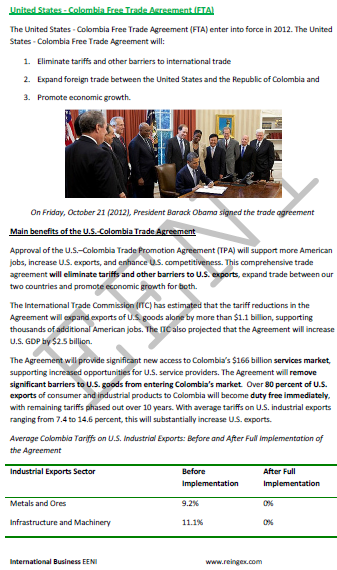
- Main Colombian export markets: Venezuela, Ecuador, and the U.S. (the largest trading partner, 35% of the total exports, FTA in force)
- Colombian imports were 31,170 million dollars
- Colombia imported mainly from the U.S., Brazil, Mexico, China, Venezuela, and Japan
- Main Colombian export products: coffee, flowers, and tropical fruits
Proexport took the mission of giving assistance to potential foreign investors in Colombia, by promoting the International Trade and foreign direct investment opportunities and identifying obstacles in investment mood always aiming to improvement; tasks that until that moment had been performed by “Convertir.”
FDI in Colombia.
- Invest in Bogota is the investment promotion agency for Bogota, Colombia, founded by the City Government and the Bogota Chamber of Commerce. Their mission is to supply assistance for investors who wish to locate in the Greater Bogota
- FDI has grown considerably. 700 multinational companies have investments in Colombia
- Colombia provides to the investors with the chance of entering into 3- to 20-year legal stability agreements which guarantee that rules related to investment determinants will remain unchanged and will continue to apply for the duration of the agreement
(c) EENI Global Business School (1995-2024)
We do not use cookies
Top of this page