

Latin American Integration Association (ALADI)

Economic Profile of LAIA (Latin-American integration ALADI) Brazil
- Introduction to the Latin American Integration Association (ALADI/LAIA)
- Montevideo Treaty 1980
- Institutional organization of the Latin American Integration Association
- Agreement on Reciprocal Payments and Credits
- Payment System in local currencies
- Economic Profile of the Latin American Countries
- Partial Scope Agreement of the ALADI
- Customs Procedures in the Latin American Countries
- Nomenclature of the Latin American Integration Association
- Latin American Free Trade Association
- Latin American Common Market
Latin American Integration Association (ALADI):
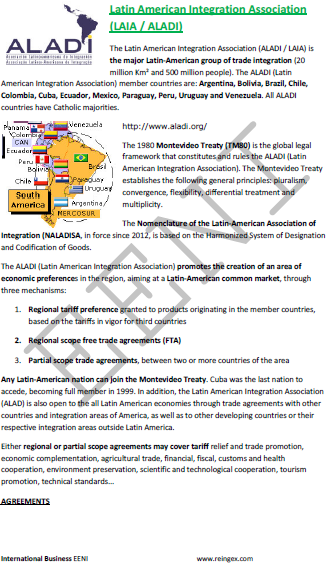
The objectives of the subject “Latin American Integration Association (ALADI)” are the following:
- To understand the purposes and functions of the ALADI
- To analyze the economic integration process: the Latin American Common Market
- To explore foreign trade the ALADI countries
- To know the reciprocal payments and credits system in local currencies
- To assess the benefits for the member countries of the ALADI
- To understand the customs procedures and the customs nomenclature of the Latin American Integration Association

The Subject “ALADI (Latin American Integration Association)” belongs to the following Online Programs taught by EENI Global Business School:
Masters: International Business, Foreign Trade.

Doctorate: American Business, World Trade.

Languages:  or
or  Asociacion Latinoamericana Integracion
 Associação Latino-Americana de Integração
  Association latino-américaine d'intégration.
- Credits of the Subject “Latin American Integration Association (ALADI)”: 1

- Duration: one week
The mission of the Latin American Integration Association (ALADI/LAIA) is to achieve the Latin American Common Market.
The Latin American Integration Association (ALADI/LAIA) is the largest Latin-American trade and economic integration block (20 million km² and 500 million people).

The member countries of the ALADI (Latin American Integration Association) are Argentina, Bolivia, Brazil, Chile, Colombia, Cuba, Ecuador, Mexico, Paraguay, Peru, Uruguay, and Venezuela.
The observer countries of the Latin American Integration Association (ALADI) are Dominican Republic, Costa Rica, China, El Salvador, Honduras, Guatemala, Japan, Nicaragua, Italy, Panama, Pakistan, Portugal, Spain, Switzerland, Russia, Romania, San Marino, South Korea, and Ukraine.
- All the ALADI countries have Catholic majorities
- The 1980 Montevideo Treaty (TM80) is the global legal framework that constitutes and rules the ALADI (Latin American Integration Association)
- The Montevideo Treaty establishes the following general principles:
- Pluralism
- Convergence
- Flexibility
- Differential treatment
- Multiplicity
- Any Latin-American nation can join the Montevideo Treaty
- Cuba was the last nation to accede, becoming a full member in 1999
Furthermore, the Latin American Integration Association (ALAD) is also open to all the Latin American economies through Trade Agreements with other countries and integration areas of America, as well as other developing countries or their respective integration areas outside Latin America.
Observer Organizations:
- ECLAC
- OEA
- Inter-American Development Bank
- United Nations Programme for Development
- European Commission
- SELA
- American Institute for Cooperation on Agriculture
- Pan American Health Organization
The ALADI (Latin American Integration Association) promotes the creation of a preferential trading area in the region, aiming at a Latin-American Common Market, through three mechanisms:
- Regional tariff preference granted to the products originating in the member countries, based on the tariffs for the third countries
- Regional Scope Trade Agreements
- Partial Scope Trade Agreements, between two or more countries of the trading area
Either regional or partial scope agreements may cover tariff reduction and trade promotion, economic complementation, agricultural trade, financial, fiscal, customs and health cooperation, environment preservation, scientific and technological cooperation, tourism promotion, and technical standards.
The ALADI belongs to the Latin American Economic Area.

(c) EENI Global Business School (1995-2024)
We do not use cookies
Top of this page