
U.S.-Colombia Agreement


United States-Colombia Free Trade Agreement
- Introduction to the U.S.-Colombia Agreement
- Main benefits of the U.S.-Colombia Trade Agreement
- The U.S.-Colombia trade relations
- Business Opportunities for the U.S. Exporters in Colombia. Strategic sectors
- Access to the Colombian market. Steps for importing to Colombia
- Chapter on Trade in Services and Investment
- Calculation of the import duties

The Subject “United States-Chile Free Trade Agreement” belongs to the following Online Programs taught by EENI Global Business School:
Masters: International Business, Foreign Trade.

Doctorate: American Business, World Trade.

Languages:  or
or  USA Colombia
  Etats-Unis.



US-Colombia Free Trade Agreement.
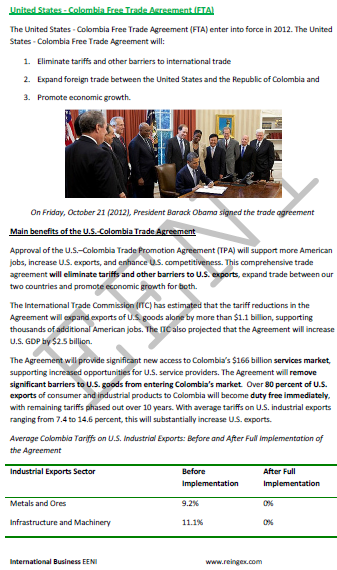
The U.S.-Colombia Free Trade Agreement (FTA) enter into force in 2012.
The U.S.-Colombia Free Trade Agreement will:
- Eliminates the tariffs and other Technical Barriers to Trade
- Expand the foreign trade between the U.S. and Colombia and
- Promote the economic growth
The U.S.-Colombia Free Trade Agreement will remove the important external barriers to trade to the U.S. export products from entering into the Colombian market.
- 80% of the U.S. exports of consumer and industrial products to Colombia will become duty-free instantly (remaining tariffs eliminated over ten years)
- Tariff reductions in the U.S.-Colombia Free Trade Agreement is estimated that will expand the exports of the U.S. products alone by 1.1 billion dollars (source: International Trade Commission)
- The Commission also projected that the U.S.-Colombia Free Trade Agreement would increase the U.S. GDP by 2.5 billion dollars
- The U.S.-Colombia Free Trade Agreement will provide important new access to services market of Colombia (166 billion dollars)
International trade United States-Colombia.
- The Republic of Colombia is the third largest market for the U.S. exports in Latin America (Iberian America)
- The U.S. exported products to Colombia: 12 billion dollars
- Colombia is a large grain importer from the U.S.
- Colombia exports tropical fruits to the U.S. Market
US-Colombia Free Trade Agreement (FTA)
The Free Trade Agreement between Colombia and the U.S. operates in the Latin American and the North American economic area.
(c) EENI Global Business School (1995-2024)
We do not use cookies
Top of this page