Andean Community (Bolivia, Colombia, Ecuador, Peru)


Common Market of the Andean Community. Ecuador. Trade in Goods
- Introduction to the Andean Community
- Economic Profile of Bolivia, Colombia, Ecuador and Peru
- Trade in Goods, Services, and Investments
- Transport in the Andean Region
- Andean Integration System
- Andean Customs Union
- Free-Trade Area of the Andean Community
- Common Market of the Andean Community
- NANDINA Nomenclature
- Common External Tariff (ARIAN)
- Andean Community: Productive and commercial development
Andean Community common foreign policy.
- Relationships with the MERCOSUR, the U.S., China, India, and Russia
- Andean Community Trade Agreements
- Trade Agreement between Colombia, Peru, and the EU
- MERCOSUR (Associated)
- Andean Community-Chile Agreement
- Andean Community-Mexico Agreement
- Andean Community-Panama Agreement
- Andean Community-India Agreement
- Andean Community-China Agreement
- EU-Andean Community
- Andean Community-Russia
- Andean Development Corporation
The objectives of the subject “Andean Community” are to:
- Understand the purposes and functions of the Andean Community
- Assess the benefits for the members of the Andean Community and the areas of cooperation
- Know the economic profile of the Andean Countries
- Analyze the economic integration process (free-trade area and customs union) and the foreign trade among the member countries of the Andean Community
- Analyze the Andean Integration System and the Andean Community Customs
- Explore the international relations of the Andean Community (Trade Agreements)
- Know the role of the Andean Development Corporation

The Subject “Andean Community” belongs to the following Online Programs taught by EENI Global Business School:
Masters: International Business, Foreign Trade.

Doctorate: American Business, World Trade.

Languages:  or
or  Comunidad Andina
  Comunidade Andina
  Communaute Andine.
- Credits of the Subject “Andean Community”: 3

- Duration: three weeks

The Andean Community is a regional economic organization endowed with an international legal status. The member economies of the Andean Community are Bolivia, Colombia, Ecuador and Peru.
- The Associated countries of the Andean Community are Argentina, Brazil, Chile, Paraguay, and Uruguay
- The observer countries of the Andean Community are Spain, and Morocco
The bodies and institutions of the Andean Community form the Andean Integration System.
The objectives of the Andean Community are to:
- Promote a balanced and harmonious development under right circumstances through the Foreign Trade integration and economic and social cooperation between the member economies
- Boost economic growth and job creation
- Facilitate their participation in the regional integration process
- Reduce the external vulnerability of the member countries
- Reinforce the subregional solidarity
- Seek continuing improvement of Standard of living of people
The Andean region is located in South America (Bolivia, Colombia, Ecuador, and Peru).
- Total population: 103 million people
- Area: 4,700,000 km²
- GDP: 407,000 million dollars
The Andean Integration System is a set of bodies and institutions forming part of the Andean Community, intended to allow for an efficient coordination between them to maximize the Andean subregional integration, promoting their external projection and strengthen the actions related to the integration process.
Andean Community Trade Agreements.
Andean Community Agreements in America: MERCOSUR (ACE), Chile, Mexico, and Panama.
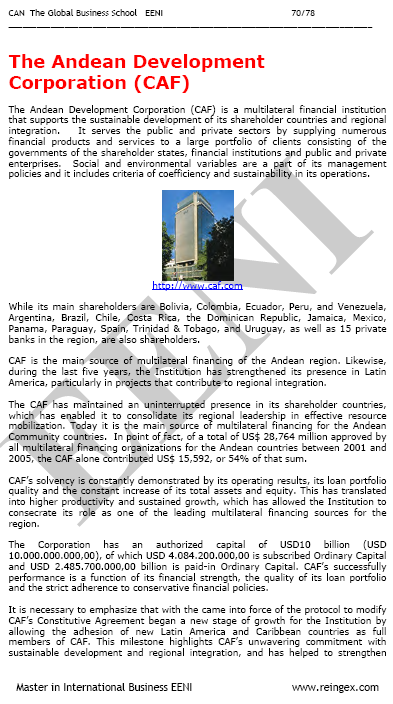
The Andean Development Corporation is a multilateral financial institution that encourages the sustainable development of its shareholder countries and regional integration. While its main shareholders are Bolivia, Colombia, Ecuador, Peru, and Venezuela.
Argentina, Brazil, Chile, Costa Rica, the Dominican Republic, Jamaica, Mexico, Panama, Paraguay, Spain, Trinidad and Tobago, and Uruguay, as well as fifteen private banks in the region, are also shareholders.
The Andean Community belongs to the Latin American Economic Area.
(c) EENI Global Business School (1995-2024)
We do not use cookies
Top of this page