
Colombia-EFTA Free Trade Agreement


Colombia-European Free Trade Association Agreement Services
- Introduction to the EFTA-Colombia Agreement
- Benefits of the Colombia-EFTA Agreement
- Calculation of import duties
- Certificate of Origin
- International Trade between the EFTA States and Colombia

The Subject “Colombia-European Free Trade Association Free Trade Agreement” belongs to the following Online Programs taught by EENI Global Business School:

Masters: International Business, Foreign Trade.

Languages:  or
or  Colombia-AELC
  Colombie
  Colombia.
Masters adapted to the EFTA States:
 Liechtenstein,
 Norway,
 Iceland,
 Switzerland

Sample - Colombia-European Free Trade Association (FTA)
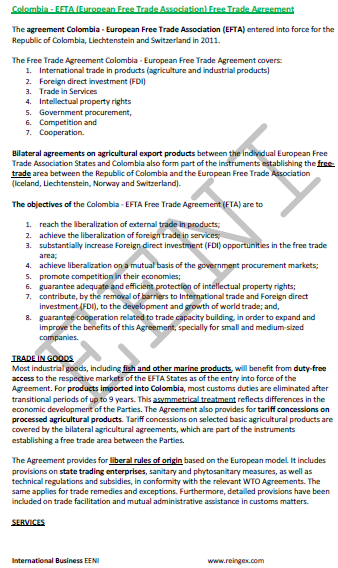
The agreement between Colombia and the European Free Trade Association (EFTA) entered into force for Colombia, Liechtenstein, and Switzerland in 2011.
The Colombia-EFTA Free Trade Agreement covers:
- International trade in goods (agriculture and industrial goods)
- FDI
- Trade in services
- IPR
- Government Procurement
- Competition
- Cooperation
Bilateral agreements on agricultural products between the European Free Trade Association States and Colombia also form part of the instruments for establishing the free-trade area between Colombia and the European Free Trade Association (Iceland, Liechtenstein, Norway, and Switzerland).
The objectives of the Colombia-EFTA Free Trade Agreement are to:
- Reach the Foreign Trade Liberalization in products and services
- Substantially increase the foreign direct investment opportunities in the free-trade area
- Achieve the liberalization on a mutual basis of Government procurement markets
- Promote the fair competition in their economies
- Guarantee an adequate and efficient protection of the intellectual property rights
- Contribute, by trade and foreign direct investment Barriers removal, to the world's trade development and growth; and
- Guarantee the cooperation related to trade capacity building, to expand and improve the benefits of this agreement, especially for the small and medium-sized companies
The Free Trade Agreement between Colombia and the EFTA consists of 145 Articles and 20 Annexes covering:
- Trade in products and services
- FDI
- IPR
- Government Procurement
- Competition
- Cooperation
- Administration and Dispute Settlement
Foreign Trade between the EFTA States and Colombia.
- International Trade between the EFTA and Colombia was USD 525 million, and between the European Free Trade Association and Peru: 392 million dollars
- The EFTA top imports from Colombia were precious stones and metals, coffee, tea, spices, fruits, and nuts
(c) EENI Global Business School (1995-2024)
We do not use cookies
Top of this page