
Course: European Single Market






 WhatsApp
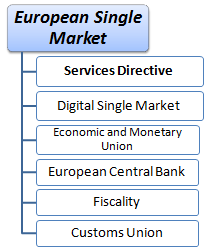
Services Directive of EU Single Market. Economic and Monetary Union (e-learning, 4 ECTS,  )
)
The main objective of the Professional Course “European Single Market” offered by EENI Global Business School, is to analyze the complex functioning of the European Single Market so that enterprises can take full advantage of the enormous opportunities that the single market offers both to trade in products and services.
The Single market completion (free movement of people, services, capital and goods) is one of the major achievements of EU, although the Europe 2020 Strategy has been designed to achieve it fully. For trade in goods, the single market is a reality, but it is not so much for Trade in Services, where many Technical Barriers to Trade persist.
Services Directive was introduced precisely to remove all trade barriers in intra-European services.

- Credits: 4

- Duration: 1 month It is recommended to dedicate about twelve hours of study per week following a flexible schedule. It is possible to reduce the duration dedicating more hours a week
- Download the syllabus of the Module (PDF)
Module intended for all those who need to understand the advantages of the European Single Market for their business.
Learning materials : .
- Also available in For improving international communication skills, student has free access to the learning materials in these languages (free multilingual training).
 Curso Mercado Unico UE
  Cours marché unique européen
  Curso Mercado Único de UE

Students who have taken this course can validate and register for a Master or Doctorate at EENI.
This Module belongs to the following Higher Education Programs offered by EENI:
Masters: International Business, Foreign Trade.


Masters for Students from the  European Union.

1- European Single Market: principle of free movement of persons, services, capital and goods.
2- Services Directive of EU Single Market: elimination of all barriers to the intra-European Trade in Services and restrictive requirements in the Single Market.
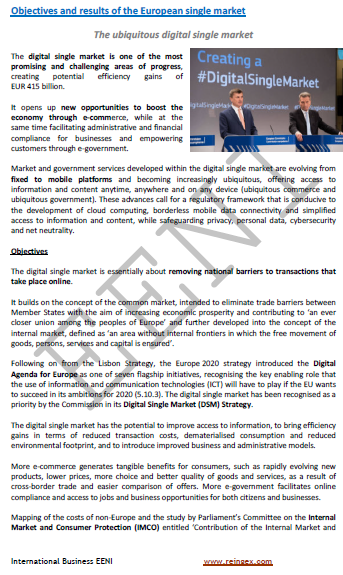
3- Digital Agenda for Europe: towards a safe and free European Digital Single Market.
4- Economic and Monetary Union: the Monetary Policy of EU
5- Role of the European Central Bank (ECB): the central bank of the second largest world economy and issuer of the Euro
6- Customs Union of the European Union: a common policy on imports from third countries.
7- Taxation in the Single Market: the Fiscal Policy of EU and taxes in the single market.
Trans-European Transport Corridors.
- Atlantic Logistics Corridor
- Baltic-Adriatic Logistics Corridor
- North Sea-Baltic Logistics Corridor
- North Sea-Mediterranean Logistics Corridor
- Mediterranean Transport Corridor
- Eastern Europe-Eastern Mediterranean Transport Corridor
- Scandinavian-Mediterranean Transport Corridor
- Rhine-Alpine Transport Corridor
- Rhine-Danube Transport Corridor
- Strasbourg-Danube Transport Corridor
- Pan-European Transport Corridor II
- Pan-European Transport Corridor IX
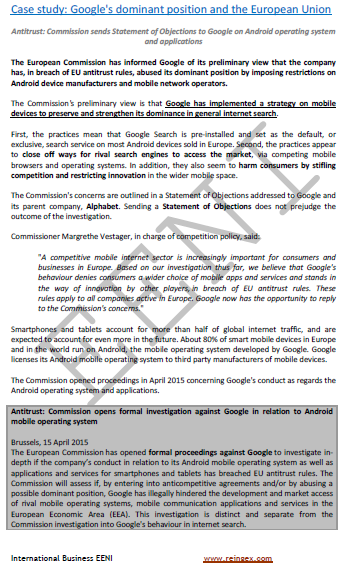
The specific objectives of the Module are the following:
- To understand the importance and functioning of the European Single Market
- To analyze the principles of free movement of people, services, capitals and goods within the EU Single Market
- To understand the Competition Policy that the EU applies within the single market
- To understand the importance of EU Services Directive in the functioning of the Single Market and how to take advantage of this directive
- To identify the Barriers to Trade in Services in the European Union
- To analyze the EU Electronic Commerce Directive
- To understand the concept of the European Digital Single Market
- To analyze the benefits to the EU, countries, businesses and citizens of EU single digital market
- To understand the pillars of the European Economic and Monetary Union and the role of the related institutions
- To understand the key role of the European Central Bank
- To understand the importance of the Eurozone
- To understand the principles of EU Monetary Policy as well as the financial assistance mechanisms
- To learn about functioning of the supervision of the Eurozone
- To learn the convergence criteria
- To analyze the pillars and functioning of the Customs Union of the European Union
- To learn about new Customs Code of the European Union
- To learn about principles of the Fiscal Policy of EU, Taxation in the Single Market and general rules on VAT in the European Union
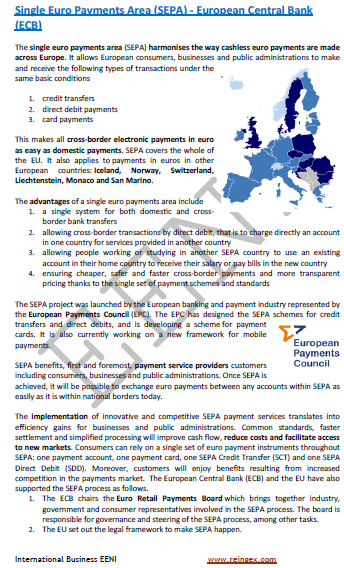
With the purpose of facilitating the online access to products and services and relaunching the European economy, the European Commission published the Strategy for the creation of a European Digital Market.
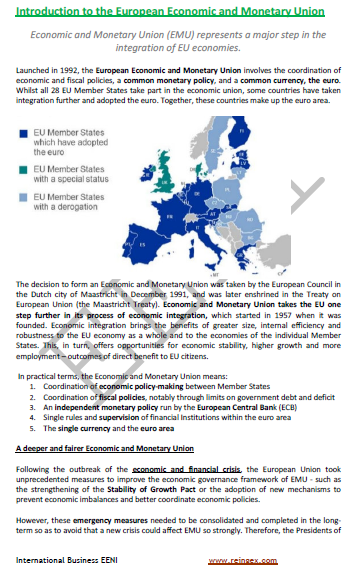
One of the European Single Market foundations is the Economic and Monetary Union. Five European institutions, led by the European Central Bank, define the EU Monetary Policy, issue of the euro as well as the price stabilization mechanisms in the euro area.
Any company wishing to do business in EU countries must know the implications of the Customs Union, especially to analyze the competitiveness of its product related to third countries.
Notes:
- Germany, Austria, Belgium, Bulgaria, Croatia, Cyprus, Denmark, France, Slovakia, Slovenia, Spain, Estonia, Finland, Greece, Hungary, Ireland, Italy, Latvia, Lithuania, Luxembourg, Malta, the Netherlands, Poland, Portugal, the Czech Republic, Romania and Sweden are members of the European Single Market
- Germany, Austria, Belgium, Cyprus, the Czech Republic, Estonia, Finland, France, Germany, Greece, Ireland, Italy, Latvia, Lithuania, Luxembourg, Malta, the Netherlands, Portugal and Slovenia are part of the euro area
Knowledge Area: Europe.
(c) EENI Global Business School (1995-2025)
Top of this page
