
North Sea-Baltic Corridor, Finland Belgium





 WhatsApp
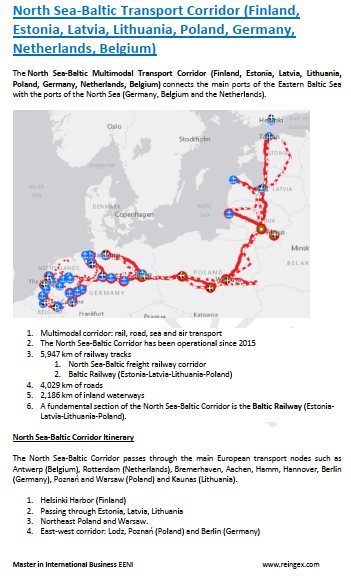
North Sea-Baltic Transport Corridor (Finland, Estonia, Latvia, Lithuania, Poland, Germany, Netherlands, Belgium)
Trans-European Transport Corridors
The North Sea-Baltic Multimodal Transport Corridor (Finland, Estonia, Latvia, Lithuania, Poland, Germany, the Netherlands, Belgium) connects the main ports of the Eastern Baltic Sea with the ports of the North Sea (Germany, Belgium and the Netherlands).
- Introduction to the North Sea-Baltic Transport Corridor (Trans-European Transport Corridors)
- Member countries of the Corridor: Finland, Estonia, Latvia, Lithuania, Poland, Germany, Netherlands, Belgium
- Main features of the North Sea-Baltic Transport Corridor
- North Sea-Baltic freight railway corridor
- Baltic Railway (Estonia-Latvia-Lithuania-Poland)
- Links of the North Sea-Baltic Transport Corridor with the Transport Network Corridors of EU
- Atlantic Corridor (Portugal-Germany)
- Baltic-Adriatic Corridor (Poland, Slovenia)
- North Sea-Mediterranean Corridor (Ireland, France)
- Eastern Europe-Eastern Mediterranean Corridor
- Rhine-Danube Corridor
- Mediterranean Corridor
- Scandinavian-Mediterranean Corridor
- Countries in the influence area of the Transport Corridor North Sea-Baltic: Belarus, Ukraine, Russia, Sweden, Denmark, France, Czech Republic and Slovakia
- Links of the North Sea-Baltic Transport Corridor with the followings Pan-European Corridors:
- Pan-European Transport Corridor II (Russia-Germany)
- Pan-European Transport Corridor IX (Finland-Greece)
- Europe-Caucasus-Asia Logistics Corridor
- Access to the Trans-Siberian Railway (Russia, North Korea)
- Access to the China-Mongolia-Russia Economic Corridor
Sample - North Sea-Baltic Transport Corridor

The Subject “North Sea-Baltic Transport Corridor” is included within the curriculum of the following academic programs at EENI Global Business School:
Logistics Courses: Road Transport, Railway, maritime, Air, Multimodal.
Certificate in International Transport
Masters: International Transport International Business.
Doctorate: Global Logistics, World Trade.

Languages:  .
Summary in
.
Summary in  Corredor Mar del Norte-Báltico
 Corridor Mer du Nord-Baltique
  Corredor do Mar do Norte-Báltico.

North Sea-Baltic Transport Corridor.
- Multimodal corridor: rail, road, sea and air transport
- The North Sea-Baltic Corridor has been operational since 2015
- 5,947 km of railway tracks
- North Sea-Baltic freight railway corridor
- Baltic Railway (Estonia-Latvia-Lithuania-Poland)
- 4,029 km of roads
- 2,186 km of inland waterways
- A fundamental section of the North Sea-Baltic Corridor is the Baltic Railway (Estonia-Latvia-Lithuania-Poland)
North Sea-Baltic Corridor Itinerary
The North Sea-Baltic Corridor passes through the main European transport nodes such as Antwerp (Belgium), Rotterdam (Netherlands), Bremerhaven, Aachen, Hamm, Hannover, Berlin (Germany), Poznań and Warsaw (Poland) and Kaunas (Lithuania).
- Helsinki Harbor (Finland)
- Passing through Estonia, Latvia, Lithuania
- Northeast Poland and Warsaw
- East-west corridor: Lodz, Poznań (Poland) and Berlin (Germany)
- Ports on the west coast of the North Sea: Hamburg, Bremen, Bremerhaven (Germany), Amsterdam, Rotterdam, Moerdijk and Antwerp (Netherlands)
Branches of the North Baltic Sea Corridor.
- To Ventspils (Latvia)
- To Klaipeda and Vilnius (Lithuania)
- To Terespol on the Poland-Belarus border
Countries in the influence area of the North Sea-Baltic Corridor: Belarus, Ukraine, Russia, Sweden, Denmark, France, Czech Republic and Slovakia.
European regional economic communities related to the North Sea-Baltic Transport Corridor.
- European Union
- European Single Market
- Economic and Monetary Union
- EU Services Directive
- European Digital Single Market
- European Customs Union
- As a members of the UE, Finland, Estonia, Latvia, Lithuania, Poland, Germany, Netherlands and Belgium are beneficiaries of EU trade agreements with Algeria, Ivory Coast, South Africa, South Korea, India, Mexico, MERCOSUR, Chile, Egypt, Jordan, Lebanon, Ukraine, Moldova, Georgia etc. besides the Customs Union with Turkey
- Council of the Baltic Sea States
- Central European Initiative
- Organization for Cooperation between Railways (OSJD)
- Economic Commission for Europe (UNECE)
- Regional Cooperation Council
The main religion of the region of the North Sea-Baltic Transport Corridor (Finland, Estonia, Latvia, Lithuania, Poland, Germany, Netherlands, Belgium) is Christianity (Catholicism and Protestantism)
The North Sea-Baltic Transport Corridor (Finland, Estonia, Latvia, Lithuania, Poland, Germany, Netherlands, Belgium) belongs to the European Economic Area.
Corridors related to the New Silk Route
- Bangladesh-Myanmar Logistics Corridor
- Asia-Africa Logistics Corridor
- Almaty-Bishkek Logistics Corridor
- Afghanistan-Turkey Logistics Corridor
- China-Central Asia-Western-Asia Logistics Corridor
- Kyrgyzstan-Iran Logistics Corridor
- Islamabad-Istanbul Logistics Corridor
- China-Pakistan Logistics Corridor
- Trans-Caspian Logistics Corridor
- Nanning-Singapore Logistics Corridor
- India-Afghanistan Logistics Corridor
- International North-South Logistics Corridor
- Corridor of the Ashgabat Agreement
(c) EENI Global Business School (1995-2025)
Top of this page
