
EU International Relations (Online Course)







 WhatsApp
Foreign Policy of EU. Trade Agreements with third countries (8 ECTS,  )
)
Two modules compose the Module “EU International Economic Relations” offered by EENI Global Business School:
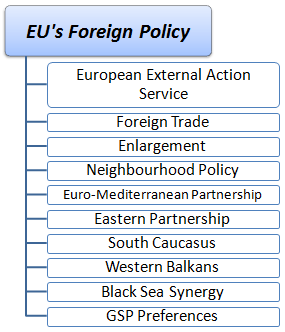
1- Foreign Policy of EU
2- EU Association and Trade Agreements with third countries

- Credits: 8

- Duration: 2 months It is recommended to dedicate about twelve hours of study per week following a flexible schedule. It is possible to reduce the duration dedicating more hours a week
- Download the syllabus of the Module (PDF)
Languages: .
- Also available in For improving international communication skills, student has free access to the learning materials in these languages (free multilingual training).
 Curso Relaciones UE
  Cours relations internationales de l’UE
  Relações Internacionais da UE
The main objective of the Module “International Economic Relations of the European Union” (8 ECTS) is to understand the complex Foreign Policy of EU and to know the fifty trade agreements with third countries.
The goals of EU Foreign Policy are to increase its influence globally, promote peace, democracy or human rights, as well as boost the European Foreign Trade.
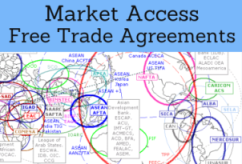
With the purpose of reducing trade barriers and facilitating market access for the European exports to third countries, the EU has trade agreements and association agreements with several countries and regions. These trade agreements offer significant advantages and business opportunities for exporters and importers.
Knowing the characteristics and functioning of these agreements is vital for any exporting or importing company.
Sample: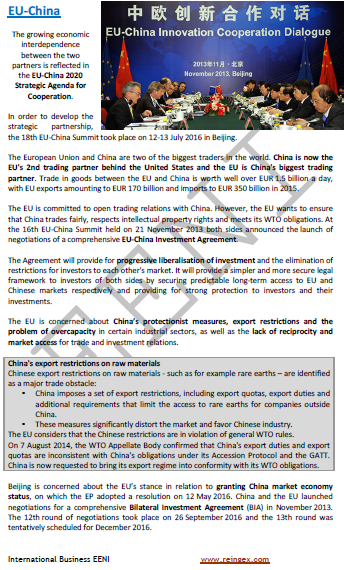
Module intended for all those wishing to understand the EU complex Foreign Policy and EU trade agreements.
Students who have taken this course can validate and register for a Master or Doctorate at EENI.
This Module belongs to the following Higher Education Programs offered by EENI:

Masters: International Business, Foreign Trade;
Masters for Students from the
 European Union.
Subjects and objectives
- EU Foreign Policy: External Relations and Trade Policy of the European Union
- European External Action Service: the EU diplomatic corps
- Foreign Trade of the European Union: 19% of the world trade
- Generalized System of Preferences (GSP) of the European Union: tariff preferences for Developing Countries
- EU Enlargement: the European Countries that are candidates to enter the European Union
- European Neighborhood Policy: relations with neighboring countries of Eastern Europe and Southern Mediterranean
- Euro-Mediterranean Partnership: towards an Euro-Mediterranean Free Trade Area
- Eastern Partnership of the European Union: Free Trade Areas with South Caucasus and Eastern Europe
- South Caucasus: association agreements
- Western Balkans: EU-Balkans Free Trade Area
- Black Sea Synergy
- Adriatic-Ionian Initiative
- European Union-CELAC Summit
- Asia-European Union (ASEM)
- Central European Initiative
- OSCE
- Council of the Baltic Sea States
- Regional Cooperation Council
- Indian Ocean Commission (observer)
Sample: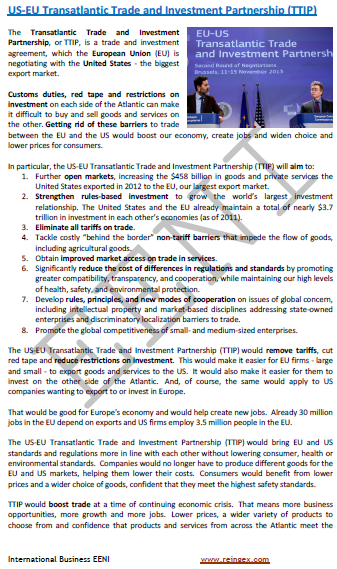
The specific objectives of the module one “Foreign Policy of the European Union” are:
- To learn about pillars of the European Foreign Policy and its strategies by regions
- To understand the role of the European External Action Service (EEAS) as the EU diplomatic corps and know its programs
- To analyze external trade and investment flows (FDI) of the European Union
- To understand trade Regimes of EU applicable to Developing Countries
- To learn about the new Generalized System of Preferences (GSP), GSP+ and EU Everything but Arms provision
- To know which countries and under what conditions they are beneficiaries of the GSP and how to use the Rules of Origin
- To learn about EU enlargement process for Macedonia, Albania, Bosnia and Herzegovina, Montenegro, Serbia, Kosovo and Turkey
- To understand the strategic importance of the European Neighborhood Policy with neighboring countries of the Mediterranean and Eastern Europe
- To learn about pillars of the Euro-Mediterranean Partnership (EUROMED) and EU partnership agreements with the Southern Mediterranean countries: Algeria, Egypt, Israel, Jordan, Lebanon, Libya, Morocco, Palestine, Syria, Tunisia, and Turkey
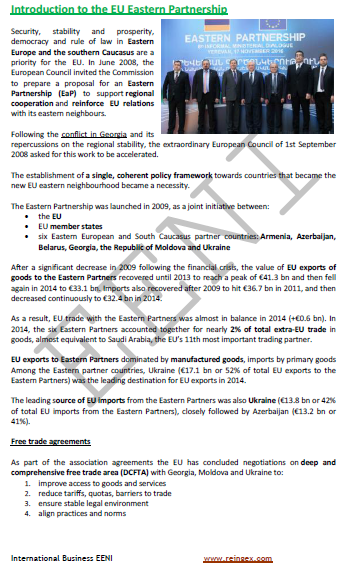
- To learn about pillars of the Eastern Partnership with Armenia, Azerbaijan, Belarus, Georgia, Moldova and Ukraine, as well as the Association Agreements and the Free Trade Areas of EU with these markets
- To analyze the EU partnership agreements with the South Caucasus: Armenia, Azerbaijan and Georgia
- To know partnership agreements with the Western Balkans: Albania, Bosnia and Herzegovina, Macedonia, Montenegro, Serbia and Kosovo
- To learn about initiative of the Black Sea Synergy of the European Union
Module two- EU Association and Trade Agreements with third countries.
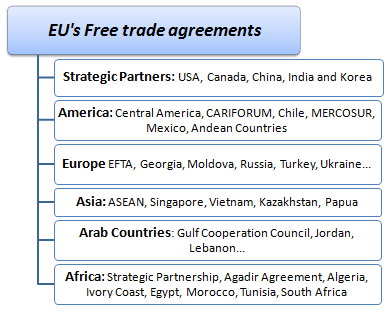
1- Free trade agreements (FTA) of the European Union.
2- EU relations with the strategic partners:
- United States
- The future Transatlantic Trade and Investment Partnership (TTIP)
- Canada (CETA Trade Agreement)
- China
- India
- South Korea (Free Trade Agreement, 2015)
- European Union-United Kingdom Free Trade and Economic Integration Agreement
3- EU Agreements with the American Countries:
- Andean Countries (2012)
- European Union-Peru-Colombia Agreement
- MERCOSUR
- Mexico (Economic Partnership Agreement, Political Coordination and Cooperation, 2000)
- Economic Association Agreements with Central America (2012), Chile (2005)
- Trade Agreement provisionally applied with Ecuador (2017)
- European Union-CARIFORUM Economic Partnership Agreement
4- EU Agreements with other European Countries:
- European Free Trade Association (EFTA) (European Economic Area)
- European Union-Russia Partnership and Cooperation Agreement
- Stabilization and Association Agreements with Albania (2006), Bosnia and Herzegovina (2015), Kosovo (2016), Macedonia (2004)
- European Union-Montenegro Stabilization and Accession Agreement (2010)
- European Union-Serbia Stabilization and Association Agreement
- European Union-Bosnia and Herzegovina Stabilization and Accession Agreement (2015)
- Association Agreement with Moldova (2016)
- European Union-Georgia Free Trade and Agreement
- The European Union has a Deep and Comprehensive Free Trade Agreement (2016) and Association Agreement (2014) with Ukraine
- Trade Agreement with the Faroe Islands (1997)
- Collaboration and Cooperation Agreements with Armenia (1999) and Azerbaijan (1999)
- Customs Union with Andorra (1991), San Marino (1992) and Turkey
5- EU Agreements with the Asian Countries:
- ASEAN (Association Agreement)
- European Union-Singapore Agreement
- European Union-Vietnam Agreement
- European Union-Japan Agreement
- Partnership and Cooperation Agreement with Kazakhstan (2016)
- Provisional Association Agreements with Papua New Guinea (2011) and Fiji
6- EU Agreements with the Arab Countries:
- Gulf Cooperation Council (GCC)
- Association Agreements with Israel (2000), Jordan (2002), Lebanon (2003), the Palestinian Authority (1997) and Syria (1977)
- Partnership and Cooperation Agreement with Iraq (2012)
7- EU Agreements with African Countries:
- European Union-Africa Strategic Partnership (Cotonou Agreement)
- Agadir Agreement
- Economic Partnership Agreements with Algeria (2005), Ivory Coast (2016), Egypt (2004), Morocco (2000), Tunisia (1998), Cameroon, Ghana (pendent)
- Economic Partnership Agreement in negotiation with the West African Countries (ECOWAS, UEMOA)
- Trade, Development and Cooperation Agreement with South Africa (2000)
- Economic Partnership Agreements Interim with Cameroon (2009) and with the East African Community (EAC) (negotiation)
- Economic Partnership Agreements provisionally applied with Ghana (2016)
- European Union-Southern African Development Community (SADC) Free Trade Agreement (FTA)
- Economic Partnership Agreement with Madagascar, Mauricio, the Seychelles and Zimbabwe (2009)
- Free Trade Agreement EU-Eastern and Southern African States (Madagascar, Mauritius, Seychelles, Zimbabwe)
8- Tools for exporters and importers:
- Market Access Database (MADB) for the European exports to third countries
- The European Union Export Helpdesk: EU export/import tariffs with the Developing Countries
The specific objectives of the module two “FTAs of EU with third countries” of the Professional Course are:
- To learn about pillars and objectives of EU trade agreements
- To analyze the different types of agreements of EU: economic partnership agreements, Trade Agreements, Free Trade Areas, customs unions and the so-called autonomous trade regimes
- To know how to apply the rules of origin of different trade agreements
- To analyze the EU Agreements with the strategic partners: United States, Canada, China, India and South Korea
- To analyze the EU trade agreements with America, Africa, Europe, Asia and the Arab countries
- The explore the Market Access Database and the Export Helpdesk tool of the European Union
Sample: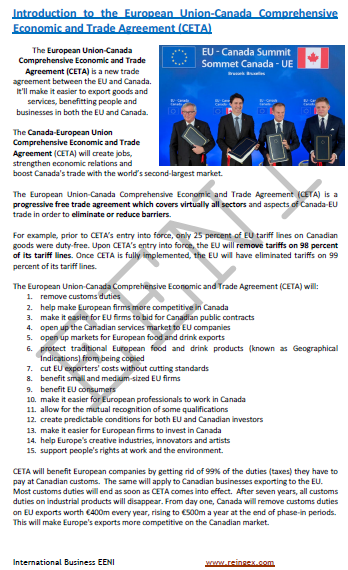
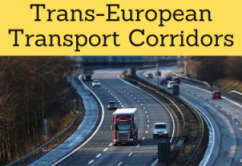
Trans-European Transport Corridors.
- Atlantic Logistics Corridor
- Baltic-Adriatic Logistics Corridor
- North Sea-Baltic Logistics Corridor
- North Sea-Mediterranean Logistics Corridor
- Mediterranean Transport Corridor
- Eastern Europe-Eastern Mediterranean Transport Corridor
- Scandinavian-Mediterranean Transport Corridor
- Rhine-Alpine Transport Corridor
- Rhine-Danube Transport Corridor
- Strasbourg-Danube Transport Corridor
- Pan-European Transport Corridor II
- Pan-European Transport Corridor IX
(c) EENI Global Business School (1995-2025)
Top of this page
