
European Union-Western Balkans Bosnia






 WhatsApp
EU's policy for the Western Balkans, Albania, Bosnia, Macedonia, Serbia
- Introduction to the Western Balkans region: Albania, Bosnia and Herzegovina, Macedonia, Montenegro, Serbia and Kosovo
- European Foreign Policy for the Balkans
- Stability Pact for South-Eastern Europe
- Stabilization and Association Agreements
- Baltic-Adriatic Corridor (Poland, Slovenia)
- Free Trade Area between the EU and the Western Balkans
- Foreign Trade Relations between the EU and the Western Balkans

Sample - EU-Western Balkans Trade Relations
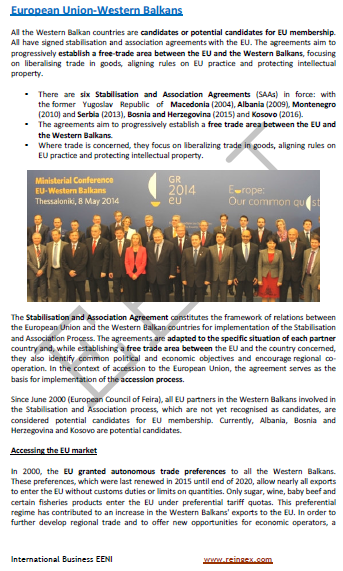
The objectives of the subject “EU-Western Balkans” are the following:
- To learn about EU Trade Policy for the Western Balkans region
- To analyze the association agreements and trade relations of EU with the Western Balkans countries

The Subject “European Union-Western Balkans” is included within the curriculum of the following academic programs at EENI Global Business School:

Masters: International Business, Foreign Trade.


Languages:  or
or  UE-Balcanes Occidentales
  UE-Balkans occidentaux
  UE-Balcãs Ocidentais.
The Trade relations of EU with the Balkans states (Albania, Bosnia and Herzegovina, Croatia (*), Macedonia, Montenegro, Serbia, and Kosovo) are governed by the Stabilization and Association Process.
(*) Croatia is a member of EU since 2013.
- All the Western Balkans countries have been offered a Stabilization and Association Agreements and have a clear European Union perspective
- Albania, Bosnia and Herzegovina, Macedonia, Montenegro, Serbia and Kosovo are candidates for the EU membership
- The European Union Strategy includes massive financial assistance, making it by far the largest donor in the region
- The European Union will continue providing technical and financial assistance to the Central European Free Trade Agreement (CEFTA)
Foreign Trade plays a major role in the efforts of EU to promote peace, stability, freedom, and economic welfare in the Western Balkans.
(c) EENI Global Business School (1995-2025)
Top of this page
