
Generalized System of Preferences GSP EU






 WhatsApp
New Generalized System of Preferences GSP. Everything But Arms (EU)
- Introduction to the EU's Generalized System of Preferences (GSP)
- New GSP preferences
- Revised EU trade scheme to help the Developing Countries
- Beneficiary countries under the current GSP
- Products enjoying preferences in the reformed Generalized System of Preferences
- Practical guide to the new GSP trade regimes for Developing Countries
- New EU Customs Code and the GSP
- The three EU import regimes
- European Union's Foreign Trade with GSP countries
- GSP+ scheme
- Background of the GSP+
- Everything But Arms arrangement (EBA)
- Duty-free and quota-free treatment for all least-developed countries
- GSP
Rules of Origin
- Tolerance or De Minimis
- Types of accumulation (Bilateral, Regional, Extended)
Sample - EU Generalized System of Preferences

The educational aims of the Subject “Generalized System of Preferences (GSP)” are the following:
- To understand the characteristics of the new EU's Generalized System of Preferences (GSP)
- To analyze the SPG + scheme and Everything but Arms arrangement
- To know which countries and under what conditions are beneficiaries of the GSP
- To know how to use the rules of origin under the Generalized System of Preferences

The Subject “Generalized System of Preferences (GSP)” is included within the curriculum of the following academic programs at EENI Global Business School:
Doctorate: African Business, World Trade.

Masters: Africa, International Business, Foreign Trade.

Module: International Relations of Africa.
Languages:  or
or  Sistema Preferencias Generalizadas (SPG)
  Système préférences généralisées SGP
  Sistema de preferências generalizadas SPG.
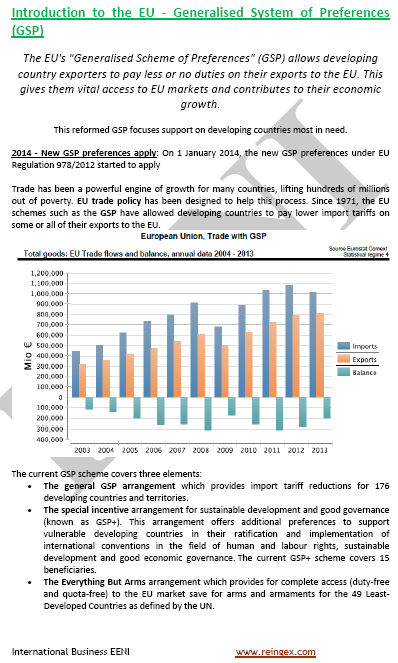
Since 1971, the EU schemes like the Generalized System of Preferences (GSP) have allowed to Developing Countries to pay lower import Tariffs.
Under the revised scheme of the GSP (Generalized System of Preferences), imports that will receive the Generalized System of Preferences are estimated at EUR 37.7 billion.
The actual Generalized System of Preferences scheme covers three factors:
- The General Generalized System of Preferences Arrangement (import tariff reductions)
- The Special incentive arrangement for sustainable development and good governance (GSP+). GSP+ offers additional preferences to support vulnerable Developing Countries in their ratification and implementation of international conventions in the field of human and labour rights, sustainable development and good economic governance
- The Everything But Arms Arrangement, which provides for the complete access (duty-free and Quota-free) to the EU's market except for arms and armaments for Least-Developed Countries (as defined by the UN)
In 2001, the Council adopted the “Everything But Arms Regulation,” granting duty-free access to imports of all products from the Least-Developed Countries, except arms and ammunitions.
Least-Developed Countries benefiting from “Everything But Arms” arrangement (40 countries):
- Africa (34 countries): Angola, Burkina Faso, Burundi, Benin, Chad, the Democratic Republic of the Congo, the Central African Republic, Djibouti, Eritrea, Ethiopia, the Gambia, Guinea, Equatorial Guinea, Guinea-Bissau, the Comoros, Liberia, Lesotho, Madagascar, Mali, Mauritania, Malawi, Mozambique, Niger, Rwanda, São Tomé, Sudan, South Sudan, Sierra Leone, Senegal, Somalia, Togo, Tanzania, Uganda, Zambia, Kenya, and Cape Verde
- Asia-Pacific (9): Afghanistan, Bangladesh, Bhutan, Cambodia, Laos, Myanmar, Nepal, East Timor, Yemen, Kiribati, Samoa, Solomon Islands, Tuvalu, and Vanuatu
- The Caribbean: Haiti
GSP+ beneficiaries (13): Armenia, Bolivia, Cape Verde, Costa Rica, Ecuador, El Salvador, Georgia, Guatemala, Mongolia, Pakistan, Panama, Paraguay, and Peru.
GSP Beneficiaries until 31 December 2015: Colombia, Costa Rica, Guatemala, Ecuador, El Salvador, Honduras, Nicaragua, Panama, Peru, China, Ecuador, Maldives, Turkmenistan, and Thailand.
Countries that are no longer on the GSP beneficiary list (current scheme).
- All the EU members, the United States, Australia, and New Zealand are not beneficiaries
- Mediterranean Partnership (EUROMED): Algeria, Egypt, Jordan, Lebanon, Morocco, and Tunisia
- CARIFORUM members
- Latin America: Argentina, Brazil, Cuba, Mexico, Uruguay, and Venezuela
- Russia, Azerbaijan, Belarus, and Kazakhstan
- Africa: Gabon, Libya, Mauritius, the Seychelles, South Africa, and Zimbabwe
- The Middle East: Saudi Arabia, Kuwait, Bahrain, Qatar, the United Arab Emirates (UAE), and Oman
- Asia: Brunei, Iran, Macau, Maldives, Malaysia, and Papua New Guinea
(c) EENI Global Business School (1995-2025)
Top of this page
