
European Union Free Trade Agreements






 WhatsApp
EU's Preferential Agreements (Customs Unions, Economic Integration)
- Introduction to the EU Trade Agreements
- Rules of origin applicable to the EU preferential agreements
- EU's preferential rules of origin
- Completely obtained / sufficiently transformed goods
- Minimal Operations
- Accumulation
- Tolerance or de minimis
- Direct Transport or non-handling standard
- Duty drawback
- Non-preferential rules of origin
- Proof of origin: Form A (SPG), EUR MED, EUR 1
- EU's Generalized System of Preferences (EU GSP)
- The European Union Economic Partnership Agreements (EPAs)
- European Union Trade Agreements
- The European Union Autonomous Trade Regimes
- Customs Unions
- Bilateral and regional negotiations in progress.
- Transatlantic Trade and Investment Treaty (TTIP) with the United States
Sample: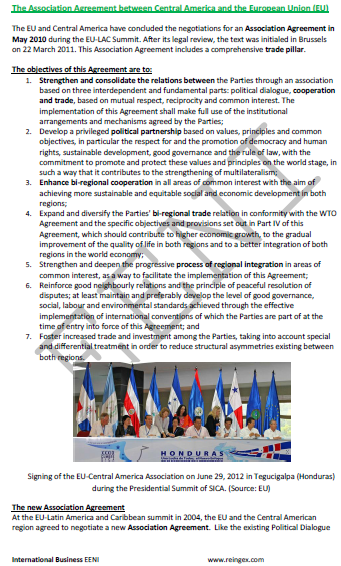
The educational aims of the Subject “European Union Free trade agreements (FTAs)” are the following:
- To understand the EU's preferential trade agreements with third countries
- To know how to apply the Rules of Origin of the agreements
- To analyze the different existing agreements: free trade agreements, economic association agreements, customs unions, etc

The Subject “European Union's Agreements (FTA)” is included within the curriculum of the following academic programs at EENI Global Business School:

Masters: International Business, Foreign Trade.
Languages:  or
or  Acuerdos de la UE
  Accords de l’UE
  Acordos da UE.
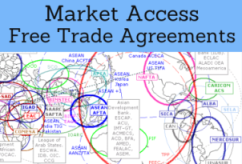

EU Trade Agreements:
- European Union-Andean Community (2012)
- European Union-Peru-Colombia Agreement
- European Union-MERCOSUR
- European Union-Chile (Association Agreement, 2005)
- Mexico-European Union (Economic Partnership Agreement, 2000)
- European Union-Central America
- European Economic Area (European Union-European Free Trade Association)
- European Union-South Korea (2015)
- ASEAN-European Union
- European Union-Gulf Cooperation Council
- Turkey-EU Customs Union
- India-European Union
- Albania: Stabilization and Association Agreement (2006)
- Andorra: Customs Union (1991)
- Bosnia and Herzegovina: Stabilization and Association Agreement (2015)
- Faroe Islands: Trade Agreement (1997)
- Georgia: Free Trade and Association Agreement (2016)
- Kosovo: Stabilization and Association Agreement (2016)
- Macedonia: Stabilization and Association Agreement (2004)
- Moldova: Association Agreement (2016)
- Montenegro: Stabilization and Association Agreement (2010)
- San Marino: Customs Union (1992)
- Serbia: Stabilization and Association Agreement (2013)
- Ukraine: Deep and Comprehensive Free Trade Agreement (2016) and Association Agreement (2014)
- Armenia: Partnership and Cooperation Agreement (1999)
- Azerbaijan: Partnership and Cooperation Agreement (1999)
- Cameroon: Economic Partnership Agreement Interim (2009)
- Ghana: Economic Partnership Agreement provisionally applied (2016)
- Canada: Comprehensive Economic and Trade Agreement (CETA) (2016)
- Ecuador: Trade Agreement provisionally applied (2017)
- Iraq: Partnership and Cooperation Agreement (2012)
- Kazakhstan: Partnership and Cooperation Agreement reinforced (2016)
- Papua New Guinea (2011) and Fiji: Provisional Association Agreement
- South Africa: Trade, Development and Cooperation Agreement (2000)
- Madagascar, Mauricio, the Seychelles and Zimbabwe: Economic Partnership Agreement (2009)
- Southern African Development Community (SADC): Economic Partnership Agreement provisionally applied (2016)
- European Union-Ivory Coast Economic Partnership Agreement provisionally applied (2016)
- European Union-CARIFORUM (Economic Partnership Agreement)
- Association Agreement with Algeria (2005)
- Association Agreement with Egypt (2004)
- Association Agreement with Israel (2000)
- Association Agreement with Jordan (2002)
- Association Agreement interim with Lebanon (2003)
- Association Agreement with Morocco (2000)
- Association Agreement with the Palestinian Authority (1997)
- Cooperation Agreement with Syria (1977)
- Association Agreement with Tunisia (1998)
- European Union-Vietnam Agreement
- European Union-Singapore Agreement
- European Union-Japan Agreement
- European Union-Southern African Development Community (SADC) Free Trade Agreement (FTA)
- European Union-Bosnia and Herzegovina Stabilization and Accession Agreement (2015)
- European Union-Montenegro Stabilization and Accession Agreement
- European Union-CARIFORUM States Economic Partnership Agreement
- Free Trade Agreement EU-Eastern and Southern African States (Madagascar, Mauritius, Seychelles, Zimbabwe)
- European Union-United Kingdom Free Trade and Economic Integration Agreement
The European Union is the largest global trade player: 20% of global trade.
China is the second-largest trading partners of EU after the United States.
The objectives of EU Free Trade Agreements are:
- To open new international markets for products and services
- To increase Foreign Direct Investment (FDI) flows
- To make International Trade cheaper (eliminating customs duties)
- To make the external trade faster
- To make the policy environment more predictable
Each Free Trade Agreement negotiated by the EU is adapted to the situation of each nation.
Normally:
“The more ambitious the Free Trade Agreement is, more benefits are to be gained from the agreement.”
The European Union has granted duty-free access for most of imports from Developing Countries (Generalized system of preferences).
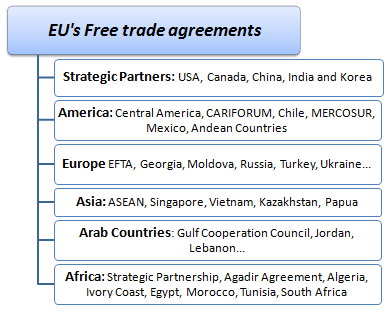
The European Union Trade Agreements: Egypt, Jordan, Syria, Tunisia, Palestine, EFTA, South Korea, ASEAN, GGC, Central America, Andean Community, MERCOSUR, Chile, Mexico, Turkey, India, China, Lebanon, Algeria, CARIFORUM, Ivory Coast, and Georgia.
(c) EENI Global Business School (1995-2025)
Top of this page
