

Mekong Economic Cooperation (ACMECS)

ACMECS Mekong (Ayeyawady Chao Economic Cooperation Strategy) Cambodia Laos Myanmar
- Introduction to the Mekong Economic Cooperation Strategy (ACMECS) - Southeast Asia
- Member countries of the Mekong Economic Cooperation Strategy (ACMECS): Cambodia, Laos, Myanmar, Thailand, and Vietnam
- Strategic Plan of Action of the Mekong Economic Cooperation Strategy
- International Trade and foreign direct investment (FDI) facilitation

The Subject “Mekong Economic Cooperation Strategy (ACMECS)” belongs to the following Online Programs taught by EENI Global Business School:
Doctorate: Ethics, Religion & Business, Asian Business, World Trade.

Masters: International Business, Foreign Trade.
Course: Buddhism and Business.
Languages:  or (
or ( Estrategia de Cooperación del Mekong
  Coopération économique du Mékong
  ASEAN.
Masters adapted to the Students of the Mekong Economic Cooperation Strategy (ACMECS):  Brunei,
  Cambodia,
  Laos,
Laos,
 Myanmar,
 Thailand, and
  Vietnam.
Sample - Mekong Economic Cooperation Strategy (ACMECS)
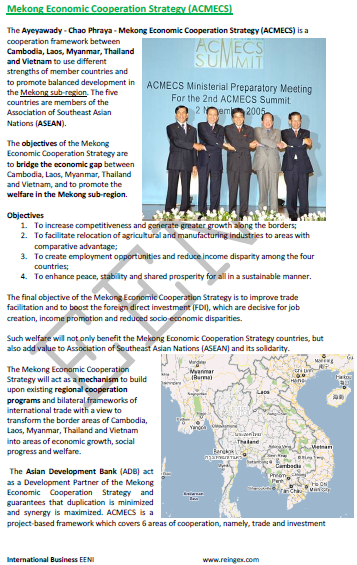
The Ayeyawady - Chao Phraya - Mekong Economic Cooperation Strategy (ACMECS) is a cooperation framework agreement between Cambodia, Laos, Myanmar, Thailand, and Vietnam to use the different strengths of the member countries and to promote a balanced development in the Mekong sub-region.
The five countries of the Mekong Economic Cooperation Strategy (ACMECS) are members of the ASEAN.
The objectives of the Mekong Economic Cooperation Strategy (ACMECS) are to bridge the economic gap between Cambodia, Laos, Myanmar, Thailand, and Vietnam, and to promote the welfare in the Mekong sub-region.
Such welfare will not only benefit to the Mekong Economic Cooperation Strategy (ACMECS) countries but also add value to the ASEAN and its solidarity.
The Mekong Economic Cooperation Strategy will act as a mechanism to build upon existing regional cooperation programs and bilateral frameworks of Foreign Trade to transforming the border areas of Cambodia, Laos, Myanmar, Thailand, and Vietnam into areas of economic, social progress, and welfare growth.
The Asian Development Bank act as a development partner of the Mekong Economic Cooperation Strategy (ACMECS) and guarantees that duplication is minimized and synergy is maximized.
The Mekong Economic Cooperation Strategy (ACMECS) should benefit from the comparative advantages of the ASEAN CLMT Countries (Cambodia, Laos, Myanmar, and Thailand) to establish a successful and greatly competitive sub-region.
The final objective of the Mekong Economic Cooperation Strategy is to improve Trade Facilitation and boost Foreign direct investment (FDI), which are decisive for job creation, income promotion, and socio-economic disparities' reduction.
Cambodia, Laos, Myanmar, and Thailand (Asia) should reinforce and improve the cooperative efforts in agriculture and industry through establishing or improving the infrastructure facilities, joint production, international marketing, purchasing agreements, market research, and information development and exchange.
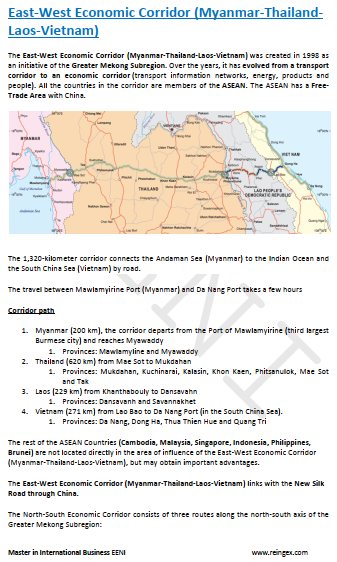
Transport Corridors:
- East-West Corridor (Myanmar-Vietnam)
- Nanning-Singapore Corridor
- Asia-Africa Corridor
- Bangladesh-Myanmar Corridor
All the countries of the Mekong Economic Cooperation Strategy (ACMECS) has a Buddhist majority and belong to the Buddhist Civilization.
ASEAN Trade Agreements: ASEAN Free-Trade Area, Indonesia-Malaysia-Thailand Growth Triangle, East ASEAN Growth Area, China, Canada, Australia-New Zealand, India, the EU, South Korea, Russia, the U.S., Pakistan, Japan...

(c) EENI Global Business School (1995-2024)
We do not use cookies
Top of this page