Business in Thailand. Thai Economy


Thai International Trade (Import, Export). Thailand, Bangkok, automotive, electronics
- Introduction to the Kingdom of Thailand (South East Asia)
- Thai Economy
- Thai Advantages
- International Relations of Thailand
- International Trade of Thailand
- Investment in Thailand
- Case Study:
- Thai automotive industry
- Electronics Industry
- Stars Microelectronics
- Charoen Pokphand Group
- Thaksin Shinawatra
- Business in Bangkok
- Access to the Thai market
- Business Plan for Thailand
The objectives of the subject “International Trade and Business in the Kingdom of Thailand” are the following:
- To analyze the Thai Economy and Foreign Trade
- To know the trade opportunities in the Kingdom of Thailand
- To explore the Thai trade relations with the country of the student
- To know the Thai Trade Agreements
- To examine the profile of Thai companies
- To develop a business plan for the Thai market

The Subject “Foreign Trade and Business in Thailand” belongs to the following Online Programs taught by EENI Global Business School:

Masters: International Business, Foreign Trade.
Languages:  or
or  Tailandia
  Thailande.
- Credits of the subject “Doing Business in Thailand”: 2

- Duration: two weeks
Masters
adapted to  Thai Students.
International Trade and Business in Thailand
Thai Market Access and Trade Agreements.
- Thailand and the Buddhist Economic Area
- ASEAN (Association of Southeast Asian Nations)
- ASEAN Free-Trade Area
- ASEAN Economic Community
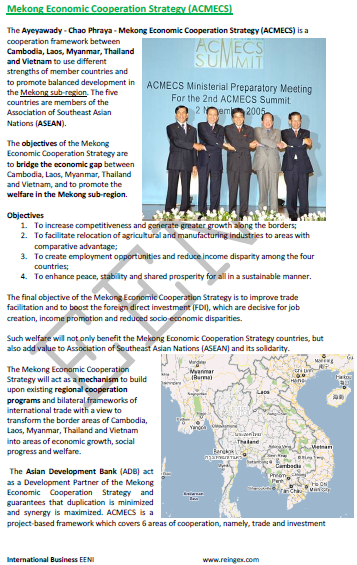
- Mekong Economic Cooperation
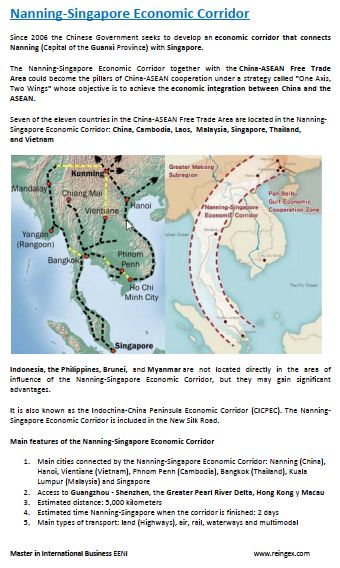
- Indonesia-Malaysia-Thailand Growth Triangle
- Thailand has trade agreements (as a member of the ASEAN) with China, India, the EU, Japan, Korea, Russia, and the U.S.
- ASEAN-Australia-New Zealand (Free-Trade Area)
- Mekong River Commission
- APEC
- Indian-Ocean Rim Association
- Bay of Bengal Initiative
- Greater Mekong Subregion
- Regional Comprehensive Economic Association
- Global System of Trade Preferences
- Thailand has Trade Agreements in force with the GCC and China
- India-Thailand Agreement
- EU-Thailand Partnership and Cooperation Agreement (not ratified)
- Japan-Thailand Agreement
- Chile-Thailand Agreement
- Thailand-New Zealand Agreement
- Thailand-Australia Agreement
- Laos-Thailand Preferential Trading Arrangement
- Trans-Pacific Partnership (CPTPP) - Candidate Country
- WTO
- Agreement on Sanitary and Phytosanitary Measures
- GATS
- Agreement on Technical Barriers to Trade
- Agreement on Preshipment Inspection
- Agreement on Safeguards
- Trade Facilitation Agreement
- WCO
- BIC (Containers)
- Chicago Convention (ICAO)
- IMO
- Convention for Safe Containers
- Istanbul Convention
- Customs Convention on Containers - not a member
- Asian Development Bank
- Colombo Plan
- Africa-Asia Strategic Partnership
- Boao Forum for Asia
- Asia Cooperation Dialogue
- ESCAP
- Asia-Middle East Dialogue
- Forum for East Asia-Latin America Cooperation
- Asia-Europe Meeting
- OIC - Observer State
- WTO
- IMF
- UN
- WB
- PEEC
The Kingdom of Thailand.
- Thailand enjoys a strategic location in the centre of the ASEAN region, in the Greater Mekong sub-region (Asia)
- Population of Thailand: 67.2 million people
- Thai Capital: Bangkok
- Official language of Thailand: Thai
- 75% of the population are Thai
- Type of Government: Constitutional monarchy (military junta)
- Thai Area: 513,120 km²
- Borders of Thailand: Cambodia, Laos, Malaysia, and Myanmar
- Maritime boundaries: Vietnam, Indonesia, and India
The main religion of Thailand: Theravada Buddhism (95% of the population, 64 million).
- Islam (4%)
Thailand belongs to the Buddhist Civilization

Thai Economy
- Thailand is one of the founding members of the APEC
- Thailand is located in one of the largest growing economic regions in the World
- Thailand is a newly industrialized country
- Thailand is a gateway to the ASEAN Continental Markets (Laos, Myanmar, and Cambodia)
- All the global car makers, assemblers, and components producers are established in Thailand: Ford, General Motors, BMW, Daimler Chrysler, Mitsubishi, Mazda, Toyota, Isuzu, Honda, and Nissan (1.4 million vehicles produced)
- The Kingdom of Thailand is the largest one-ton pickup lorries manufacturer in the World and the seventh largest automotive exporter
- Thai electronics industry is another pillar of the Thai economy (30 billion dollars, 30% of export revenues of Thailand)
- Thailand is the largest production base for electrical appliance industry in the ASEAN (Association of Southeast Asian Nations) region
- Thai Currency: Baht (THB)
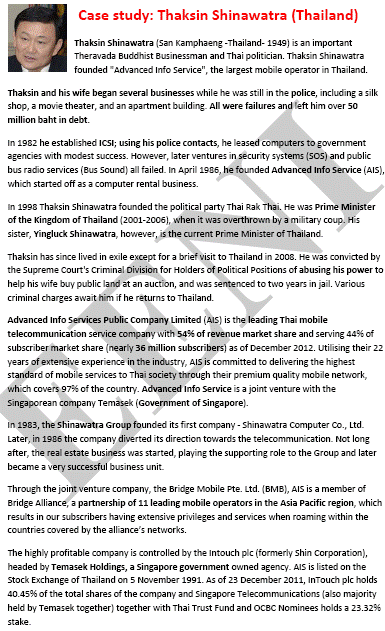
Sample - Thaksin Shinawatra
The Economic activities in Bangkok (20% of the population of the Kingdom of Thailand) represents 60% of the GDP of Thailand.
- Bangkok is competing with Singapore to become a regional hub for Air transport within the Southeast Asia region
- Bangkok is a first-class health care centre in the ASEAN Region
International Trade of Thailand.
- Top export products of Thailand: processed and frozen food, agricultural export products, electronics, electrical appliances, furniture, fashion garments and textiles, and auto parts and accessories
- Top Thai electronics exports are hard-disk and integrated circuits (54% and 29% of total electronic exports)
- Thailand is the second largest hard-disk drive exporter in the World
- The main export markets of the Kingdom of Thailand are the U.S., Japan, the EU, ASEAN (Indonesia, Malaysia, the Philippines, Singapore, Brunei, Vietnam, Laos, Myanmar, and Cambodia), India, and China
(c) EENI Global Business School (1995-2024)
We do not use cookies
Top of this page