
Economic Commission for Latin America







 WhatsApp
Brazil, Canada, Economic Commission for Latin America and the Caribbean ECLAC
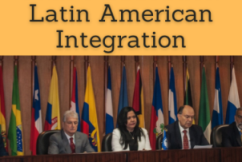
The objectives of the Economic Commission for Latin America and the Caribbean (ECLAC) are to:
- Contribute to the Latin American economic and social development
- Coordinate actions directed towards economic development and integration in Hispanic America (Iberian America)
- Reinforce the economic and International Trade relationships among Latin American economies with other nations in the World

- Introduction to the Economic Commission for Latin America and the Caribbean (ECLAC / CEPAL)
- History of the Economic Commission for Latin America and the Caribbean (ECLAC)
- Objectives of ECLAC
- ECLAC Economic Work Areas
- Economic development
- International Trade and integration
- Production, productivity and management
- Economic statistics
- ECLAC Subsidiary Bodies
- Caribbean Development and Cooperation Committee
- Committee on South-South Cooperation
- Regional Conference on Social Development in Hispanic America and the Caribbean
- Regional Conference on Women in Hispanic America and the Caribbean
- Regional Conference on Population and Development in Hispanic America and the Caribbean
- Economic reports of the Economic Commission, Statistical Yearbook, and CEPALSTAT
- The Economies of Latin America and the Caribbean
- Economic profile of the member countries of the Economic Commission for Latin America and the Caribbean
- ECLAC Country Profiles
- Statistical Yearbook of Latin America and the Caribbean of ECLAC
- Economic Survey of the Caribbean
- Economic Development in Hispanic America (Iberian America)
- Capital Flows to Latin America and the Caribbean
- International Trade and Economic Integration
- International Trade Outlook for Latin America and the Caribbean
- Trade Relations between the United States and the Hispanic America Countries
- The New United States-Mexico-Canada free trade agreement (USMCA)
- Latin America and the Caribbean and China: towards a new era in economic cooperation
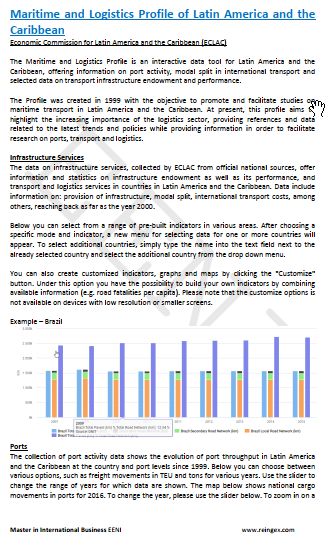
- Maritime and Logistics Profile of Latin America and the Caribbean
- Port activity report of Latin America and the Caribbean
- Main Hispanic American Airports
- Logistics of Natural Resources
- ECLAC Project Cycle Planning - Programme - Evaluation
- Strategy and legal framework
- Programme and budgeting
- Accountability and evaluation
- Procurement: Vendor registration and Expression of Interest
Sample - Economic Commission for Latin America and the Caribbean (ECLAC):

The educational aims of the Subject “Economic Commission for Latin America (ECLAC)” are:
- To understand the goals (regional integration, Latin American economic development.) and the structure of the Economic Commission for Latin America of the UN
- To learn about economic reports of the Economic Commission for Latin America and the Caribbean (ECLAC)
- To learn about Economic Development and International Trade Outlook for Latin America and the Caribbean
- To know Maritime and Logistics Profile of Hispanic America Countries
- To understand ECLAC Project Cycle

The Subject “Economic Commission for Latin America and the Caribbean (ECLAC)” is included within the curriculum of the following academic programs at EENI Global Business School:
Masters: International Business, Foreign Trade.


Languages:  or
or  Comisión Económica para América Latina Caribe CEPAL
  Comissão Económica para a América Latina
  Commission économique pour l’Amérique latine.
- Subject Credits “Economic Commission for Latin America and the Caribbean”: 2

Economic Commission for Latin America and the Caribbean ECLAC
In 1948 was founded the Economic Commission for Latin America and the Caribbean (ECLAC) by the ECOSOC (Economic and Social Council of the UN).
The members of the Economic Commission for Latin America and the Caribbean (ECLAC) are Antigua and Barbuda, Argentina, Bahamas, Barbados, Belize, Bolivia, Brazil, Canada, Chile, Colombia, Costa Rica, Cuba, Dominica, Dominican Republic, Ecuador, El Salvador, France, Germany, Grenada, Guatemala, Guyana, Haiti, Honduras, Italy, Jamaica, Japan, Mexico, Netherlands, Nicaragua, Panama, Paraguay, Peru, Portugal, South Korea, Saint Kitts and Nevis, Saint Lucia, Saint Vincent and the Grenadines, Spain, Suriname, Trinidad and Tobago, United Kingdom, U.S., Uruguay, and Venezuela.
The associate members (Economic Commission for Latin America and the Caribbean) are Anguilla, Aruba, Bermuda British Virgin Islands, Cayman Islands, Curaçao, Guadeloupe (France), French Guiana, Martinique, Montserrat, Netherlands Antilles, Puerto Rico, Saint-Martin (Pays-Bas), Turks and Caicos Islands, United States Virgin Islands
Headquarters of the Economic Commission for Latin America and the Caribbean (ECLAC): Santiago, Chile.
The UN Economic Commission for Latin America and the Caribbean (ECLAC) is one of the five regional commissions of the UN:
- Economic Commission for Europe
- Economic Commission for Asia (ESCAP)
- Economic Commission for Africa
- Economic Commission for Western Asia (ESCWA)
(c) EENI Global Business School (1995-2025)
Top of this page
