
Business in Panama, Canal. Panamanian Economy





 WhatsApp
Foreign Trade and Logistics in Panama: Panamanian market access, Colon Free Zone. Panama Canal
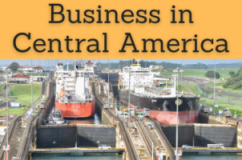
Main pillars of the Panamanian economy are the Panama Canal, banking, and financial services and Colon Free Trade Zone (the largest duty-free zone in the Americas)
The Balboa and U.S. Dollar (USD) are the official currencies of Panama
Panama has no central Bank; it does not have a devaluation Risk, having total freedom to transfer capitals
The International Banking centre of Panama, with more than seventy international banks, is governed by the Basel Convention principles

- Introduction to Panama (Central America)
- Panamanian Economy
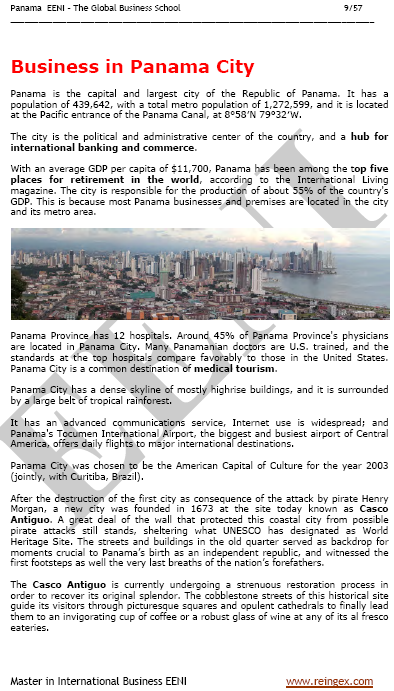
- Doing Business in Panama City
- International Trade of Panama
- Transport and Logistics
- Panama Canal
- Cases study:
- City of Knowledge
- Colon Free Zone
- Set-up a Company in Panama
- Clusters of Investment:
- Services
- Tourism
- Information Technologies
- Energy
- Agribusiness
- Investing in Panama
- Legal Framework for foreign investment (FDI) in Panama
- Foreign enterprises in Panama
- Access to the Panamanian Market
- Business Plan for Panama
International Trade and Business in Panama

The purposes of the subject “Foreign Trade, Logistics and Business in Panama” are:
- To analyze the Panamanian Economy, Logistics and Global Trade
- To conduct research on business opportunities in Panama
- To explore the Panamanian trade relations with the student's country
- To learn about Panamanian Trade Agreements
- To understand the role of the Panama Canal and the Colon Free Zone
- To develop a business plan for the Panamanian Market

The Subject “Foreign Trade, Logistics and Business in Panama” is included within the curriculum of the following academic programs at EENI Global Business School:
Masters: International Business, Foreign Trade.

Languages:  or
or  Panamá
  Panama
  Panamá.
- Subject Credits “Doing Business in Panama”: 1

International Trade, Logistics and Business in Panama.
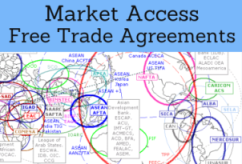
- Panama and the Hispanic American Economic Area
- Central American Integration System
- Central American Common Market - Integrated with SICA -
- Association of Caribbean States
- Latin American and Caribbean Economic System
- Mesoamerica Project
- Panama has Trade Agreements with the EU, Andean Community, and EFTA
- Panama-Costa Rica Agreement
- Singapore-Panama Agreement
- U.S.-Panama Agreement
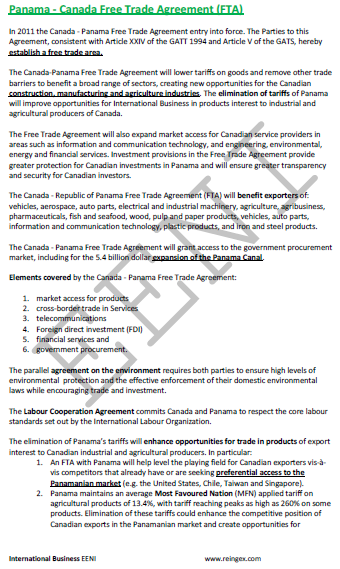
- Canada-Panama Agreement
- Panama-Taiwan Agreement
- Panama-Chile Agreement
- Central America-Panama Agreement
- Panama-Dominican Republic Partial Scope Agreement
- Mexico-Panama Agreement
- South Korea-Central America Agreement
- Panama-Guatemala Agreement
- Panama-Honduras Agreement
- Panama-Nicaragua Agreement
- Panama-El Salvador Agreement
- UK-Central America Free Trade and Economic Integration Agreement
- ALADI (observer country)
- UNASUR (observer country)
- World Trade Organization (WTO)
- Agreement on Trade in Services (GATS)
- Agreement on Sanitary Measures
- Agreement on Technical Barriers to Trade
- Agreement on Preshipment Inspection
- Agreement on Safeguards
- Trade Facilitation Agreement
- World Customs Organization (WCO)
- Kyoto Convention
- Hamburg Rules (Maritime Transport)
- BIC (Containers)
- Chicago Convention (ICAO)
- International Maritime Organization (IMO)
- Istanbul Convention - not a member
- Customs Convention on Containers - not a member
- Inter-American Development Bank
- Organization of American States (OAS)
- Economic Commission for Latin America (ECLAC)
- East Asia-Latin America Cooperation
- Community of Latin American and Caribbean States (CELAC)
- European Union-CELAC Summit
- United Nations
- World Bank
- International Monetary Fund
- Capital of Panama: Panama City
- Panamanian Population: 4 million people
- Panamanian Area: 75,517 km²
- Borders of Panama: Costa Rica and Colombia
- Panamanian official language: Spanish
- Panama became independent from Spain in 1821
- Abolition of Slavery in Panama: 1824
- African Diaspora in Panama: 0.4 million people (14% of the Panamanian population)
Main religion in Panama: Christianity - Catholicism (3 million) and Protestants.
Panama belongs to Western Civilization - Hispanic American Economic Area.
Panamanian Economy.
- The City of Knowledge is an international complex for education, R & D, organized to promote and facilitate the synergy between universities, scientific research centers, and international Organizations
- In Panama, they were installed five submarine fiber optic cables communicating North America and South America and the Caribbean with the world, making it the ideal location for telecommunications enterprises and data centers. Leading enterprises (MCI, Cable & Wireless and Movistar) have been implemented in Panama
- Panama has been selected by largest multinational enterprises such as Samsung Electronics, Inc., DHL, DELL (Call centre), Hutchinson Port Holding Group, HSBC, BICSA, Scotiabank, Assicurazioni Generali, or American Life Insurance Company as headquarters for their regional operations
- Main international Organizations such as UNICEF, United Nations Development Programme, Organization of American States, Spanish International Cooperation Agency (AECI) and Bladex, among others, have chosen Panama to establish their regional headquarters
International Trade of Panama.
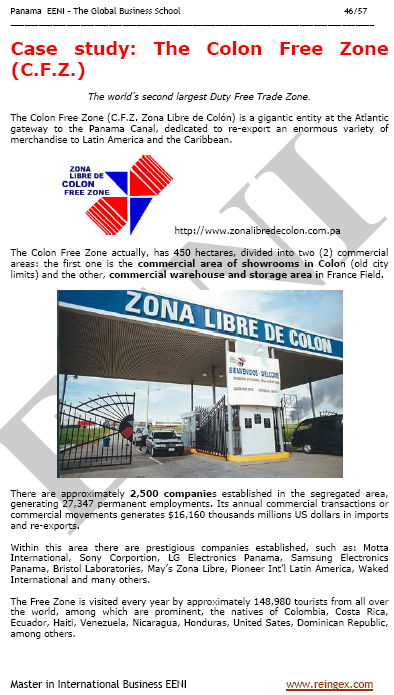
- The Colon Free Zone is the second largest duty-free Trade Zone in the World (2,500 enterprises, 27,347 employments, 16,160 million dollars in imports and re-exports (International Trade)
- Panamanian exports: 821 million dollars
- Main Panamanian export products are salmon, tuna, beef, watermelon, shrimp, and pineapples
- Top export partners of Panama (as% of total export value) are the United States 42% and Taiwan 5.3%, Costa Rica 7.3%, Sweden 5.4%, the Netherlands 6.5%, and Spain 6.2%
- Top import partners of Panama: the United States 29%, Costa Rica 5.2%, Mexico 4.5%, China 4.2%, and Japan 3.6%
- The Republic of Panama has a privileged geostrategic position that makes it one of the largest logistics centers in the World; with the Panama Canal as a major axis, the Panama Canal over 190 million metric tones of cargo (container, Bulk) are transported, serving more than 120 Maritime routes to eighty countries
- 80 kilometers between the Pacific and Atlantic Oceans, 8 to 10 hours to transit
- 14,000 ships pass through the Panama Canal every year
- International transportation activities through the Panama Canal representing 5% of global International Trade
- Foreign Trade increase, especially between Asia and the United States, continues to have a significant impact on demand for services
- The Panama Canal seeks to increase both the number of Panamax transits and the UMS tonnage (Tonnage System Channel)
- The Expansion project of the Panama Canal (1 billion dollars) offers significant business opportunities for enterprises around the world
(c) EENI Global Business School (1995-2025)
Top of this page
