
Business in Chile, Santiago, APEC, Logistics





 WhatsApp
Chilean Economy and Foreign Trade. Business in Santiago, Chile

The modern Chilean telecommunications systems, competitive banking sector, good public infrastructure, high-quality services, and skilled workers accessibility are top factors to attract Foreign Direct Investment
- Main Chilean economic sectors are mining, manufacturing, fisheries, and construction
- 40% of Chilean Foreign Trade is made with Asia

- Introduction to Chile (South America)
- Chilean Economy
- Economic Profile of the regions of Chile
- Chilean International Trade
- Transport and Logistics
- Doing Business in Santiago
- Investment in Chile
- Case Study: Cencosud
- Access to the Chilean Market
- Business Plan for Chile
Business in Chile

The objectives of the subject “Foreign Trade, Logistics and Business in Chile” are:
- To analyze the Chilean Economy, Logistics and Global Trade
- To conduct research on business opportunities in Chile
- To explore the Chilean trade relations with the student's country
- To learn about Chilean Trade Agreements
- To examine the profile of the Chilean companies
- To develop a business plan for the Chilean Market

The Subject “Foreign Trade, Logistics and Business in Chile” is included within the curriculum of the following academic programs at EENI Global Business School:
Masters: International Business, Foreign Trade.

Languages:  or
or  Chile
Chile  Chile
Chile  Chili.
- Subject Credits “Doing Business in Chile”: 2

International Trade, Logistics and Business in Chile
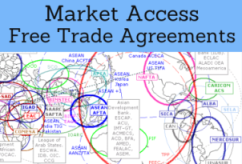
Chilean Market Access and Agreements.
- Chile and the Hispanic American Economic Area
- APEC
- Latin American Integration Association (ALADI)
- Union of South American Nations (UNASUR)
- Latin American and Caribbean Economic System
- Pacific Alliance
- Agreement for Trans-Pacific Partnership
- Trade Negotiations Among Developing Countries
- U.S.-Chile Agreement
- India-Chile Preferential Agreement
- European Union-Chile Agreement
- South Korea-Chile Agreement
- Chile-Japan Strategic Economic Agreement
- Colombia-Chile Agreement
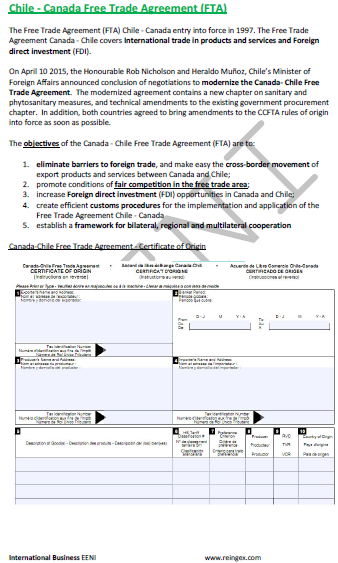
- Chile-Canada Agreement
- Panama-Chile Agreement
- Chile-MERCOSUR Association Agreement
- UK-Chile Free Trade and Economic Integration Agreement
- Mexico-Chile Agreement
- Chile-China Agreement
- Chile-Hong Kong China Agreement
- Chile-Indonesia Agreement
- Chile-Vietnam Agreement
- Trade Agreements with the Costa Rica, Honduras, Guatemala, El Salvador, European Free Trade Association (EFTA), Central America, Nicaragua, Malaysia, Andean Community, Panama, Peru, Australia, Thailand and Turkey
- Global System of Trade Preferences
- Andean Community (associate member)
- MERCOSUR (associate member)
- SICA (observer country)
- World Trade Organization (WTO)
- Agreement on Trade in Services (GATS)
- Agreement on the Application of Sanitary Measures
- Agreement on Technical Barriers to Trade
- Agreement on Preshipment Inspection
- Agreement on Safeguards
- Trade Facilitation Agreement
- World Customs Organization (WCO)
- Kyoto Convention
- BIC
- Chicago Convention (ICAO)
- International Maritime Organization (IMO)
- Convention for Safe Containers
- Istanbul Convention
- Hamburg Rules (Maritime Transport)
- International Road Transport Union (IRU)
- TIR Convention
- Guidelines on Safe Load Securing for Road Transport
- International Chamber of Shipping
- Customs Convention on Containers - not a member

- Inter-American Development Bank
- Organization of American States (OAS)
- Economic Commission for Latin America (ECLAC)
- Africa-South America Summit
- East Asia-Latin America Cooperation
- Summit South American-Arab Countries
- Community of Latin American and Caribbean States (CELAC)
- CPLP (observer country)
- Pacific Economic Cooperation Council
- Organization for Economic Cooperation and Development (OECD)
- United Nations
- World Bank
- World Trade Organization (WTO)
- International Monetary Fund
The Republic of Chile is the regional leader in Hispanic America, mainly due to its democratic stability that ensures an excellent environment for business and Foreign Direct Investment (FDI).
- Chile has a population of 17 million people
- Chilean official language is Spanish
- Capital of Chile: Santiago de Chile
- Area of Chile: 756,102 km²
- Chilean currency: Peso
- Chile has borders with Peru (160 kilometers, Concordia Line), Argentina and Bolivia
- Chile gained the independence from Spain in 1810
- Abolition of Slavery in Chile: (1823)
Religion in Chile: Christianity.
- Catholicism (15 million)
- Protestants (Chile has 2 million Methodists)
Chile belongs to Western Civilization - Hispanic American Economic Area.
Chilean Economy.
- If anything characterizes the economy of Chile is the continuous path of economic growth, placing it among the thirty most dynamic economies
- Chile is one of the lowest-Risk countries in the World
- Chile ranks first in Hispanic America among the most competitive economies in information technology (IT) and communications (World Economic Forum)
- Chile ranks fifteenth among the most interesting countries for doing business and Foreign Direct Investment
- In the Global Competitiveness Index, Chile took the 28th position out of 134 economies
- Chile holds the third place among the ten most successful Latin American and Caribbean Countries in attracting Foreign Direct Investment (UNCTAD)
- Since 1990, the Government of Chile has implemented public policies to promote and consolidate businesslike and responsible macroeconomics management, economic openness, and international integration, steady institutions and equitable society in which all the Chilean can enjoy the benefits of economic development
- The Economic Growth of Chile has been followed by a severe drop in the public debt, stabilization of the Chilean foreign accounts and the increase of the Chilean international reserves
- These competitive advantages of Chile are reinforced by his open economy that has meant greater competitiveness, growing International Trade and fast integration into global markets
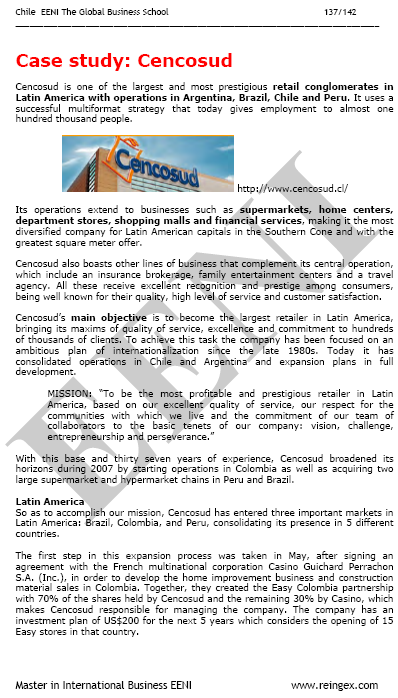
CENCOSUD is one of the largest Distribution enterprises in Hispanic America, being present in Argentina, Brazil, Chile, and Peru, where the firm has developed a successful multi-strategy.
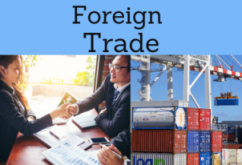
Chilean International Trade.
- Main trading partners of Chile are China, Argentina, Brazil, U.S., Japan, and South Korea
- Top Chilean export products are copper, molybdenum, ferromolybdenum; pulp, salmon, and wine (these products represent 64% of the total Chilean exports)
- Fall in international prices of copper (6.9%)
- Increase of the agro-food exports
- In the last fifteen years, the Chilean services industry has generated more than 50% of GDP of Chile
- Chile is a member of APEC, TPP, Pacific Alliance
(c) EENI Global Business School (1995-2025)
Top of this page
