Business in Bolivia. Bolivian Economy




 WhatsApp
Bolivian Foreign Trade, Logistics, Business in La Paz (Bolivia)
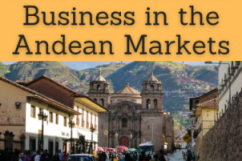
The Plurinational State of Bolivia has significant natural resources: mining and gas
Through the Bioceanic Logistics Corridor, the Plurinational State of Bolivia has positioned itself as a regional distribution hub between the largest markets of the Pacific and the South Atlantic region of South America

- Introduction to the Plurinational State of Bolivia
- Bolivian Economy
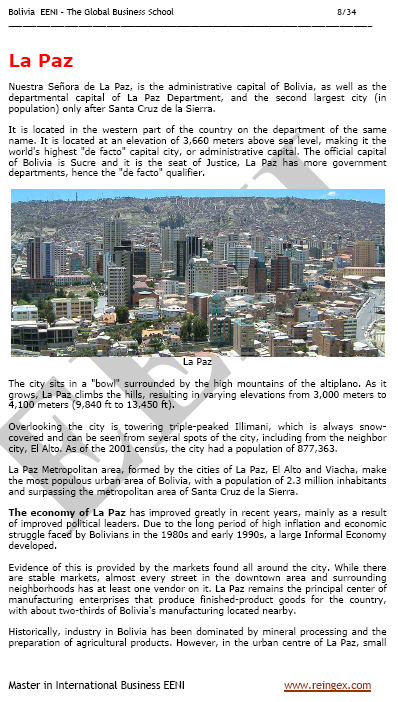
- Doing Business in La Paz
- International Trade of Bolivia
- Investment in Bolivia
- Case Study: Business Opportunities in Bolivia
- Petrol
- Gas
- Manufacturing
- Telecommunications
- Agriculture
- Services
- Transport and Logistics
- Case Study:
- Bolivian integration corridors
- ENTEL Telecommunications
- Access to the Bolivian Market
- Business Plan for Bolivia

The objectives of the subject “Foreign Trade, Logistics and Business in Bolivia” are:
- To analyze the Bolivian Economy, Logistics and Global Trade
- To conduct research on business opportunities in Bolivia
- To explore the Bolivian trade relations with the student's country
- To learn about Bolivian Trade Agreements
- To examine the profile of the Bolivian companies
- To develop a business plan for the Bolivian Market

The Subject “Foreign Trade, Logistics and Business in Bolivia” is included within the curriculum of the following academic programs at EENI Global Business School:
Masters: International Business, Foreign Trade.

Languages:  (or
(or  Bolivia
  Bolivia
  Bolivie).
- Subject Credits “Doing Business in Bolivia”: 1

International Trade, Logistics and Business in Bolivia
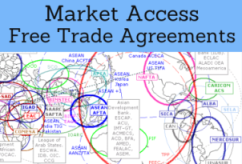
Bolivian Market Access and Agreements.
- Bolivia and the Hispanic American Economic Area
- Andean Community
- Andean Community Agreements: MERCOSUR, Mexico, the EU, Chile, Panama, India, China, Russia
- Bolivia-MERCOSUR (Associate). Protocol of accession to MERCOSUR
- Latin American Integration Association (ALADI)
- Mexico-Bolivia Economic Complementation Agreement
- Latin American and Caribbean Economic System
- Union of South American Nations (UNASUR)
- Global System of Trade Preferences
- SICA (observer country)
- Bolivia retired from the Bolivarian Alliance for the Peoples of Our America (ALBA) in 2019
- World Trade Organization (WTO)
- Agreement on Trade in Services (GATS)
- Agreement on the Application of Sanitary Measures
- Agreement on Technical Barriers to Trade
- Agreement on Preshipment Inspection
- Agreement on Safeguards
- Trade Facilitation Agreement
- World Customs Organization (WCO)
- Kyoto Convention
- Inter-American Development Bank
- Organization of American States (OAS)
- Economic Commission for Latin America (ECLAC)
- CELAC
- East Asia-Latin America Cooperation
- Summit South American-Arab Countries
- Africa-South America Summit
- United Nations
- World Bank
- World Trade Organization (WTO)
- International Monetary Fund
Plurinational State of Bolivia (America).
- Bolivia has nine departments (Beni, Cochabamba, Chuquisaca, La Paz, Oruro, Pando, Potosi, Tarija, and Santa Cruz) and 112 provinces
- Borders of Bolivia: Brazil, Argentina, Peru, Paraguay, and Chile
- Bolivian population: 10 million people
- Bolivian Area: 1,098,581 km²
- Official languages of Bolivia: Spanish, Quechua, Aymara, Guarani, and thirty-three local languages
- According to the Bolivian Government: “Bolivia is a Social Unitary State of Plurinational Communitarian Law decentralized and autonomous”
- Abolition of Slavery in Bolivia: 1826
- African Diaspora in Bolivia: 0.5% of the Bolivian population
- Independence of Bolivia: 1825 (from Spain), recognized in 1847
Religion in Bolivia: Christianity (9.5 million).
- Catholicism (7 million)
- Protestants
Bolivia belongs to the Hispanic American Economic Area of Western Civilization.
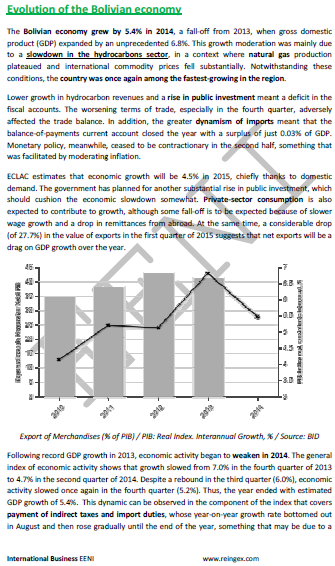
Bolivian Economy.
- According to the Central Bank of Bolivia, the balance of payments showed a surplus of 325 million dollars
- Bolivian GDP: 34,175 million dollars
- In 2009, the Bolivian Government signed a debt cancellation with the Government of Spain
- Nationalizations have taken place since 2006 in the hydrocarbons, mining, and telecommunications sectors; business opportunities in these areas for Foreign Direct Investment have become more limited
- FDI flows received in Bolivia were 687 million dollars, mainly in the hydrocarbons sector
- Currency: Bolivian (BOB)
- Entel holds a Leadership position in both fixed and mobile telephony, as in the various telecommunications value-added services
International Trade and Business in Bolivia:
International Trade of Bolivia:
- Total Bolivian exports products reached 4.848 million dollars FOB (28% of the Bolivian GDP)
- Export flows were characterized by low levels (average of USD 1.919 million)
- Total petrol exports were lower
- Regarding the non-traditional exports, their value was higher by 1.4%
- Non-traditional export products that showed increases in value were: soybean meal (52%), sugar (41%), soybean oil (31%), soya beans (23%), flour soy (20%), and coffee (5%)
- Capital products imports stand for 28% of the total
Foreign Trade flows of Bolivia with the rest of the World (data in dollars).
- Trade with MERCOSUR fell to 708 million, mainly owing to lower natural gas exports to Brazil
- With the Andean Community, there was an increase of positive balance of 158 million due primarily to the higher exports to Colombia and Ecuador
- With the Central American Common Market - Central American Integration System (SICA), ran an International Trade deficit of 0.2 million to an extra of 2.7 million
- With the United States-Mexico-Canada Agreement (USMCA/NAFTA 2.0), the deficit augmented to 131 million due both to the decline in exports as the largest imports
- With EFTA augmented extra owing to augmented to 6 million dollars extra with Switzerland
- In Asia, the positive balance of 130 million mainly explained by the favorable balance with South Korea
(c) EENI Global Business School (1995-2025)
Top of this page
