Commonwealth of Independent States

Commonwealth of Independent States (CIS) Free-Trade Area
- Introduction to the Commonwealth of Independent States (CIS)
- Economic Profile of the countries of the Commonwealth of Independent States: Armenia, Azerbaijan, Belarus, Kazakhstan, Kyrgyz Republic, Moldova, Russia, Tajikistan, and Uzbekistan
- Economic and Customs Union of the Commonwealth of Independent States
- Free-Trade Area of the Commonwealth of Independent States (CISFTA)
- Trade Agreement with the Eurasian Economic Union (EAEU)
- Shanghai Cooperation Organization (Guest Attendance)
The aims of the subject “Commonwealth of Independent States (CIS)” are the following:
- To understand the objectives and functions of the Commonwealth of Independent States
- To know the economic profile of the Commonwealth of Independent States member countries
- To evaluate the benefits for the member countries and the areas of cooperation
- To understand the economic and customs union and the free-trade area (CIS-FTA) of the Commonwealth of Independent States
Commonwealth of Independent States (CIS):

The Subject “Commonwealth of Independent States (CIS)” belongs to the following Online Programs taught by EENI Global Business School:
Masters: International Business, Foreign Trade.

Doctorate: Islamic Business, World Trade.

Course: Orthodoxy and Business.
Languages:  or
or  Comunidad Estados Independientes
  Communauté des États indépendants.
CIS (Commonwealth of Independent States).
The Commonwealth of Independent States (CIS) was created in 1991, by the heads of state of Russia, Belarus, and Ukraine. Between December 8 - 21, the three original signatories were joined by Armenia, Azerbaijan, Kazakhstan, Kyrgyzstan, Moldova, Tajikistan, Turkmenistan, and Uzbekistan.
The Headquarters of the Commonwealth of Independent States are in Minsk (Europe).
The member countries of the Commonwealth of Independent States (CIS) are Armenia, Azerbaijan, Belarus, Kazakhstan, Kyrgyz Republic, Moldova, Tajikistan, and Uzbekistan.
- Associate state: Turkmenistan
- Observer states: Afghanistan, Mongolia
(* associated states/not ratified).
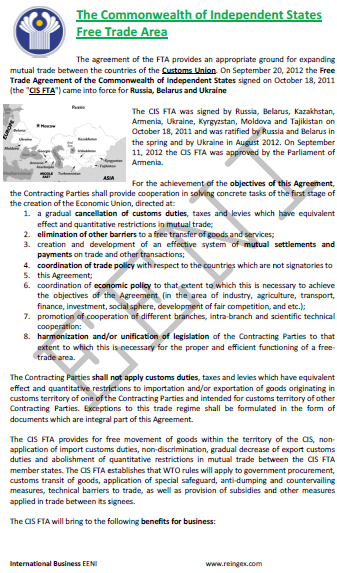
The Free-Trade Area of the Commonwealth of Independent States (CIS) was created in 1994. In 2009, a new agreement created the CISFTA. Today, Armenia, Belarus, Moldova, Russia, and Ukraine are full members of the Free-Trade Area of the Commonwealth of Independent States (CISFTA).
The Commonwealth of Independent States (CIS) Region.
- Area: 22 million km²
- Population: 282 million people
- Vast mineral resources and raw materials: gas, Petrol, coal, potassium, manganese
- Mineral resources
- Water resources (second in the World)
When Georgia joined in 1993, all the former Republics of the U.S.SR excluding the Baltic States had become members of the Commonwealth of Independent States (or Russian Commonwealth).
The Commonwealth of Independent States (CIS) belongs to:
- Central Eurasian Economic Area (Islamic Civilization)
- Orthodox Civilization
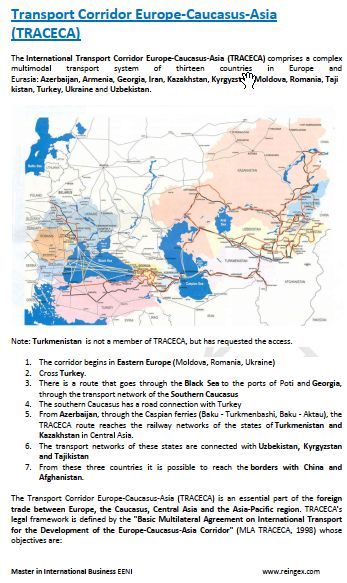
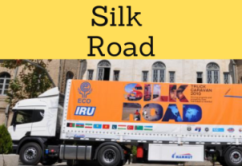
- Almaty-Bishkek Corridor
- China-Pakistan Corridor
- China-Central-West Asia Corridor
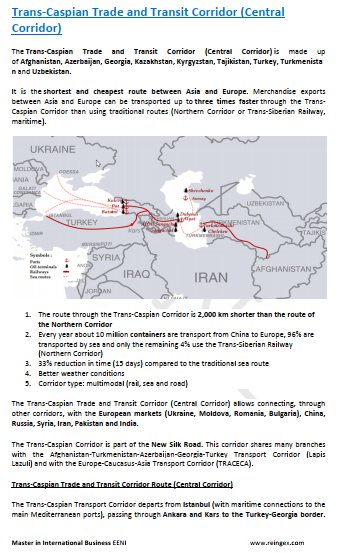
- Trans-Caspian Corridor
- Trans-Siberian Railway (Russia, North Korea)
- Kyrgyzstan-Iran Corridor
- Afghanistan-Turkey Corridor
- Europe-Caucasus-Asia Corridor
- Bangladesh-Myanmar Corridor
- North-South Corridor (India-Russia)
- China-Russia Corridor
- Pan-European Corridor IX (Finland-Greece)
- Corridor of the Ashgabat Agreement
- Pan-European Corridor II (Russia-Germany)