Eurasian EurAsEC)


Eurasian Economic Community (EurAsEC). Customs Union with Russia
- Introduction to the Eurasian Economic Community (EurAsEC)
- Dissolution in 2015
- Succeeded by the Eurasian Economic Union in 2014
- Economic Profile of the Eurasian region: Belarus, Kazakhstan, Kyrgyzstan, Russia, and Tajikistan
- Customs Union of the Eurasian Economic Community
- Common Economic Space of the Eurasian Economic Community
- Eurasian Business Council
The objectives of the subject “Eurasian Economic Community (EurAsEC)” are the following:
- To understand the purposes and the areas of cooperation of the Eurasian Economic Community (EurAsEC)
- To assess the benefits for the EU Member Countriesrasian Economic Community (Customs Union)
- To understand the concept of “EurAsEC Common Economic Space”
The Subject “Eurasian Economic Community (EurAsEC)” belongs to the following Online Programs taught by EENI Global Business School:
- Masters: International Business, Foreign Trade
- Doctorate: Asian Business, Islamic Business, European Business, World Trade
- Course: Orthodoxy and Business
Languages:  (or
(or  Unión Económica Euroasiática
 Union économique eurasiatique
  União Econômica da Eurásia).
Why study “Orthodoxy and Business”?.

Credits of the Subject “Eurasian Economic Community”: 1 
Sample - Eurasian Economic Community (EurAsEC):
Eurasian Economic Community (EurAsEC).
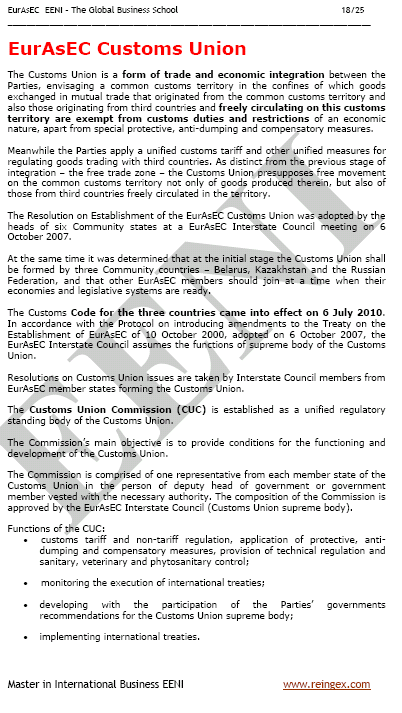
The Eurasian Economic Community (EurAsEC) is a regional economic bloc created in 2007 with the objective to establish a Customs Union (Belarus, Kazakhstan, the Kyrgyz Republic, Tajikistan, and Uzbekistan) and a Common Economic Space (Belarus, Kazakhstan, Russian Federation). In 2015 was dissolved (Creation of the Eurasian Economic Union (EAEU)).
The Customs Union between Belarus, Kazakhstan, and the Russian Federation came into effect in 2010.
- The observer countries of the Eurasian Economic Community (EurAsEC) are Armenia, Moldova, and Ukraine (Europe)
- Uzbekistan was suspended in 2008
- Origin: Commonwealth of Independent States , 1996
- Area of the Eurasian Economic Community (EurAsEC): 20,300 km²
- Population of the Eurasian region: 181 million people (2.7% of the world's population)
- The International Trade turnover of the Eurasian Economic Community economies has augmented three times since 2002 (in 2007 exceeded 90 billion dollars)
- The Eurasian Economic Community (EurAsEC) region produces 3.5% of the World's GDP
- The Eurasian Community has huge resources of minerals and raw materials
- Recently the EurAsEC's member economies haves 9% of prospected petroleum resources worldwide, 25% of petroleum and 23% of coal; their share in the generation of electrical energy amounted to 5.5% globally; steel production was 5.4% and grain production 5.7%
Sample: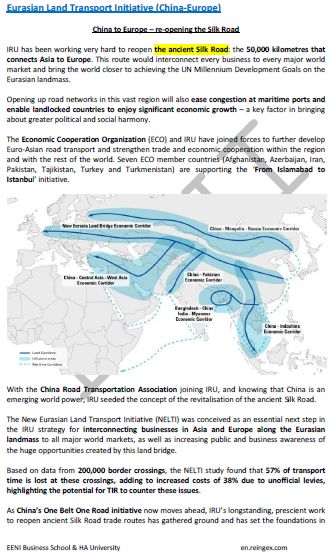
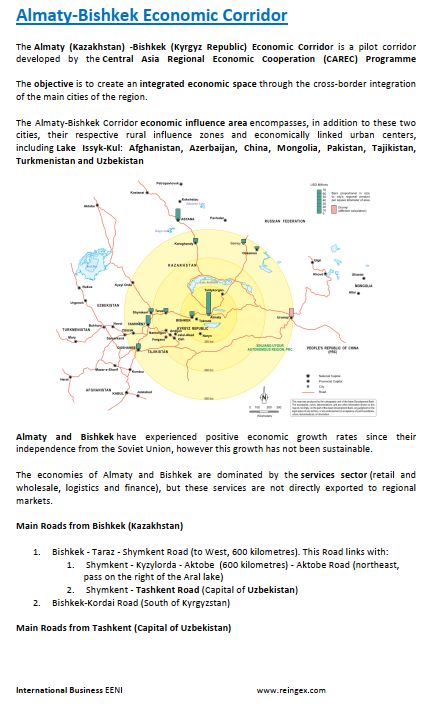
- Almaty-Bishkek Corridor
- North-South Corridor (India-Russia)
- China-Central-West Asia Corridor
- Corridor of the Ashgabat Agreement
- Europe-Caucasus-Asia Corridor
- China-Pakistan Corridor
- Bangladesh-Myanmar Corridor
- Kyrgyzstan-Iran Corridor
- China-Russia Corridor
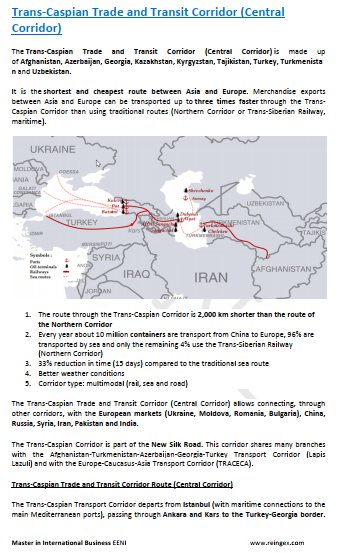
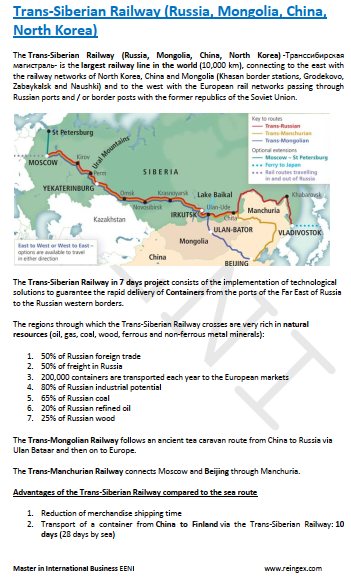
- Trans-Siberian Railway (Russia, North Korea)
- Trans-Caspian Corridor
- Pan-European Corridor II (Russia-Germany)
- Pan-European Corridor IX (Finland-Greece)
Sample:
The Eurasian Economic Community (EurAsEC) is an organization formed by Muslim and Orthodox countries.
The Eurasian Economic Community (EurAsEC) is an inter-civilization institution (Islamic and Orthodox Civilization).
(c) EENI Global Business School (1995-2024)
We do not use cookies
Top of this page