
Arab Economic Area, Saudi Arabia, Qatar







 WhatsApp
Islamic Civilization. Arab Economic Area. Gulf Cooperation Council (Module)

The Arab Economic Area (Middle East) consists of twelve Arab Countries:
- The six countries of the Gulf Cooperation Council (GCC): Bahrain, Kuwait, Oman, Qatar, Saudi Arabia, and the Emirates
- The six Arab Countries not members of GCC: Iraq, Jordan, Lebanon, Palestine, Syria, and Yemen

- Introduction to the Arab Economic Area as a part of Islamic Civilization
- Islam as the unifying factor of the Arab Economic Area
- Greater Arab Free Trade Area (GAFTA)
- Economic Profile of the Arab Countries
- Businesspeople in the Arab Economic Area
- Interactions of the Arab Economic Area with other economic areas and civilizations
- Economic institutions related to the Arab Economic Area
Sample: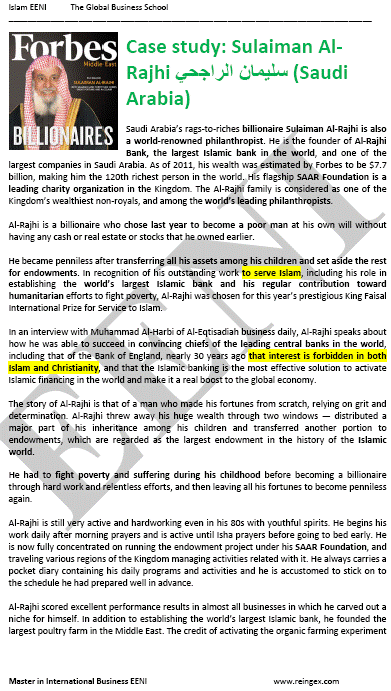
Religions and Global Business -
Religious diversity
The goals of the Module “Arab Economic Area” are the following:
- To define the economic characteristics of the Arab Economic Area
- To understand the influence of Islam on the Arab Economic Area
- To learn about economic profile of the Arab Countries
- To understand the economic integration process in the Arab Economic Area
- To analyze the main Arab Businesspeople
- To explore the economic relationships with others economic areas
- To analyze the main Economic Organizations related to the Arab Economic Area

Module “Arab Economic Area” is included within the curriculum of the following academic programs at EENI Global Business School:
Doctorate: Ethics, Religions & Business, World Trade.

Master: Religions & International Business, International Business.

Languages:  or
or  Espace Arabe
  Espaço Árabe
  Espacio Árabe.
Download the Syllabus of the Module “Arab Economic Area” (PDF).
- Credits of the Module “Arab Economic Area”: 1

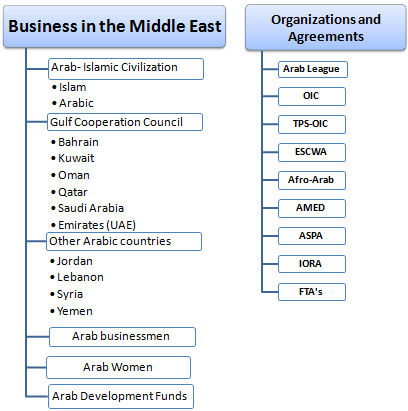
- Islam is the main religion of the Arab Economic Area
- There are Christian minorities in the region: The Eastern Catholic Churches (Chaldeans, Maronites)
- Arab is the main language in the region
- The largest economy (GDP) is Saudi Arabia and the Central State
- All Arab countries were former colonies (United Kingdom, Turkey, and France)
- Absolute instability in Syria
EENI delivers to HRH Prince Alwaleed bin Talal a Master Honoris Causa
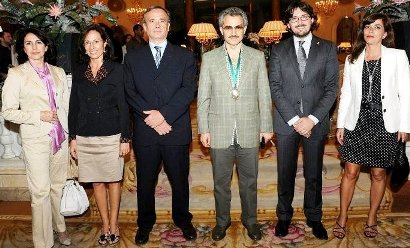
The main Arab Businesspeople in the Arab Economic Area are HRH Prince Alwaleed bin Talal, Mohamed Bin Issa Al Jaber, Mohammed Hussein Ali Al-Amoudi, Yusuf Bin Ahmed Kanoo, Mohammed Al-Barwani, Jawad Ahmed Bukhamseen, Abdul Aziz Ghurair, Sulaiman Al-Rajhi, Majid Al Futtaim, Nasser Al Kharafi, and Nadhmi Shakir Auchi.
The main Arab Businesswomen of the Arab Economic Area are Lubna Olayan, Shaikha Al Bahar, Amina Al Rustamani, Shaikha Al Maskari, Maha Al-Ghunaim, Randa Ayoubi, Nayla Hayek, and Ayah Bdeir.
Arab Personalities: Lubna Bint Khalid Al Qasimi, Tawakkol Karman, Haifa Al-Mansour, Hayat Sindi, Reem Ebrahim Al-Hashimi, and Hanan Al Kuwari.
Economic Integration of the Arab Economic Area.
The main Arab integration project is the Gulf Cooperation Council (GCC).
- All Arab countries are members of the Greater Arab Free Trade Area
- All Arab countries are members of the Economic Commission for Western Asia (ESCWA)
The main integration agreements with others Islamic Economic Areas are:
- Trade Preferential System (OIC-TPS)
- The Arab Countries that have signed the Trade Preferential System (Framework Agreement + PRETAS + Rules of origin) are Bahrain, Jordan, Kuwait, Oman, Qatar, Saudi Arabia, Syria, and the Emirates
- Palestine only has signed the Framework Agreement + PRETAS
- Yemen is not a member of the Trade Preferential System
- Jordan is part of the Arab Mediterranean Agreement (with Egypt, Morocco, and Tunisia)
- Jordan has trade agreements with Algeria, Libya, Malaysia, Turkey, and Tunisia
Economic Organizations related to the Arab Economic Area.
- Organization of Islamic Cooperation (OIC)
- Islamic Development Bank
- Arab League
- Arab Fund for Economic and Social Development
- Arab Monetary Fund
- Arab Trade Financing Programme
- Saudi Fund for Development
- Arab Gulf Programme (AGFUND)
- Kuwait Fund for Arab Economic Development
- OPEC Fund for International Development
- Abu Dhabi Fund for Development
Interactions of the Arab Islamic Economic Area with Western Civilization.
With the European Economic Area.
- European Union
- The European Union has trade agreements with the Gulf Cooperation Council (GCC), Jordan, Lebanon, Palestine, and Syria
- Jordan, Lebanon, Palestine and Syria are members of the European Neighborhood Policy of the European Union
- Yemen is a beneficiary of the Generalized System of Preferences and the European Investment Bank of the European Union
- Palestine, Jordan, Lebanon, and Syria are members of the Euro-Mediterranean Partnership
- The European Free Trade Association has trade agreements with GCC, Jordan, Lebanon
With the American Economic Area.
- North American
- The United States has trade agreements with Oman, Bahrain, and Jordan
- Canada has a Trade Agreement with Jordan
- Latin American
- All Countries of the Arab League are part of the Summit of South American-Arab Countries
- The Gulf Cooperation Council plans to sign an agreement with MERCOSUR
- No Arab Country has Trade Agreements with the Caribbean Countries
With the Economic Area of Oceania.
- Australia has a Trade Agreement with the Gulf Cooperation Council (GCC)
Interactions of the Arab Islamic Economic Area with African Civilization.
- All Arab countries are part of the Afro-Arab Cooperation and therefore of the Arab Bank for Africa (BADEA)
- Jordan has a Trade Agreement with Egypt
Interactions of the Arab Islamic Economic Area with Hindu Civilization.
- India has a trade agreement with GCC
Interactions of the Arab Islamic Economic Area with Orthodox Civilization.
- There is not an trade agreement of the Arab Countries with this Civilization
Interactions of the Arab Islamic Economic Area with Buddhist Civilization.
- Singapore has a free trade agreements with GCC and Jordan
Interactions of the Arab Islamic Economic Area with Sinic Civilization.
- There is not a free trade agreement of the Arab Countries with Sinic Civilization
Inter-civilizations Agreements of the Arab Economic Area.
- Oman, the Emirates, and Yemen are part of the Indian-Ocean Rim Association
- Asia-Middle East Dialogue
- Saudi Arabia, Bahrain, the UAE, Kuwait, Oman, and Qatar are members of the Asia Cooperation Dialogue
- Corridor of the Ashgabat Agreement
(c) EENI Global Business School (1995-2025)
Top of this page
