Business in Kuwait, Economy, Oil, Transport




 WhatsApp
Kuwaiti Economy, Logistics and Foreign Trade. Business in Kuwait City. Petroleum. Businessman

Kuwaiti Economy is as small, wealthy, and open (GDP was 149,000 dollars);
The vast petroleum reserves are the pillar of the Kuwaiti economy (petroleum and its derivatives generate 95% of exports of the State of Kuwait)
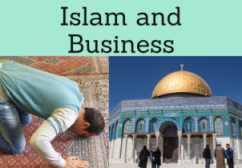
- Introduction to the State of Kuwait (Middle East)
- Kuwaiti Economy
- Doing Business in Kuwait City
- Business Opportunities in Kuwait
- Foreign Trade of Kuwait
- Transport and Logistics
- Access to the China-Pakistan Corridor
- Investment in Kuwait
- Case Study: Kuwaiti Petroleum industry diversification
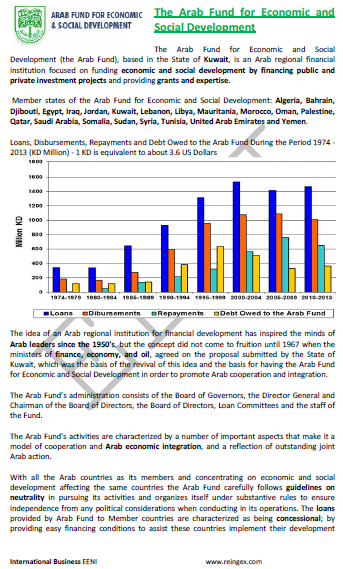
- Arab Fund for Economic and Social Development
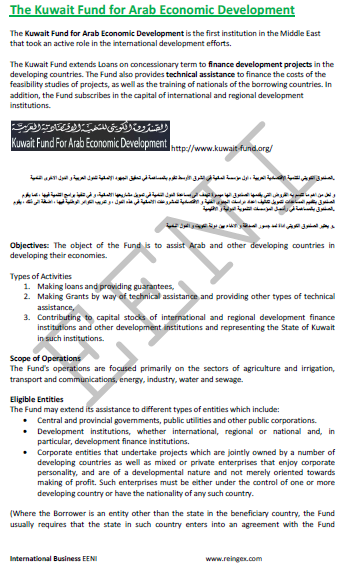
- Kuwait Fund for Arab Economic Development
- Access to the Kuwaiti market
- Business Plan for Kuwait
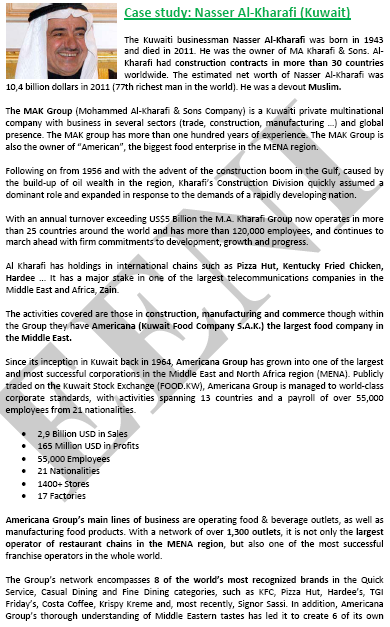
Kuwaiti Businessman.
International Trade and Business in Kuwait:

The educational aims of the Subject “Foreign Trade, Logistics and Business in the State of Kuwait” are:
- To analyze the Kuwaiti Economy, Logistics and Foreign Trade
- To conduct research on business opportunities in the State of Kuwait
- To explore the Kuwaiti trade relations with the student's country
- To learn about Kuwaiti Trade Agreements
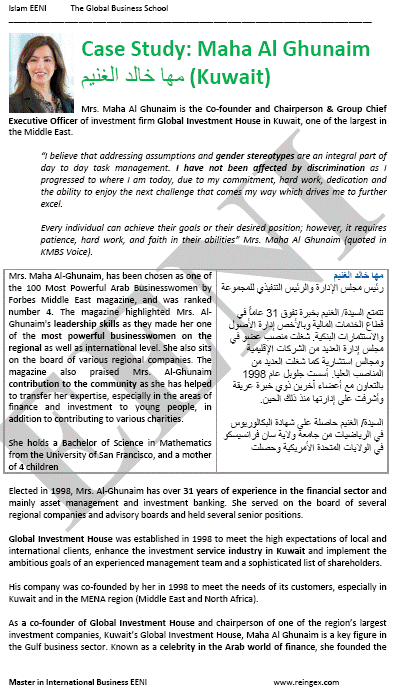
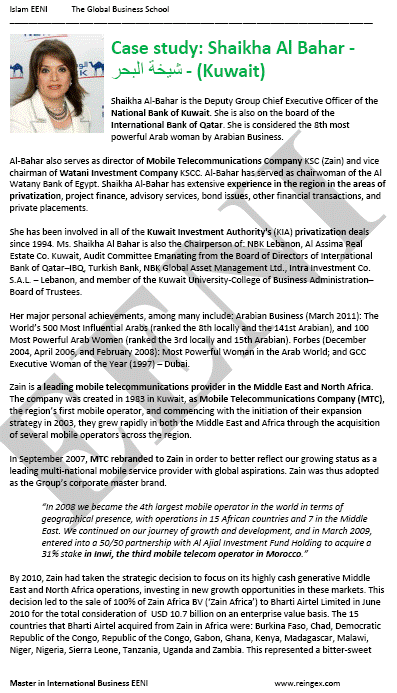
- To examine the profile of Kuwaiti Businesspeople
- To learn about importance of the Kuwaiti funds for development
- To develop a business plan for the Kuwaiti market

The Subject “Foreign Trade, Logistics and Business in Kuwait” is included within the curriculum of the following academic programs at EENI Global Business School:

Masters: International Business, Foreign Trade.

 or
or 

- Subject Credits “Doing Business in Kuwait”: 1

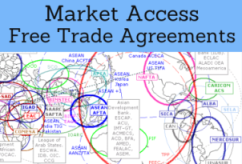
Kuwaiti Preferential Access and Trade Agreements:
- Kuwait and the Arab Economic Area
- Gulf Cooperation Council
- European Union-Gulf Cooperation Council
- India-Gulf Cooperation Council
- Australia-GCC Agreement
- Trade Agreements (as a member of GCC with China, Singapore, South Korea, EFTA, New Zealand, Thailand, and MERCOSUR
- Islamic Trade Preferential System
- Greater Arab Free Trade Area (GAFTA)
- World Trade Organization (WTO)
- Agreement on Trade in Services (GATS)
- Agreement on Sanitary Measures
- Agreement on Technical Barriers to Trade
- Agreement on Preshipment Inspection
- Agreement on Safeguards
- Trade Facilitation Agreement
- World Customs Organization (WCO)
- Kyoto Convention
- BIC
- Chicago Convention (ICAO)
- International Maritime Organization
- Istanbul Convention
- International Chamber of Shipping
- International Road Transport Union (IRU)
- TIR Convention
- Guidelines on Safe Load Securing for Road Transport
- Customs Convention on Containers - not a member
Islamic Organizations (Kuwait).
- Arab League
- Summit of South American-Arab Countries
- Asia-Middle East Dialogue
- Islamic Development Bank
- Economic Commission for Western Asia (ESCWA)
- Organization of Islamic Cooperation (OIC)
- Committee for Economic Cooperation
- Islamic Chamber of Commerce
- Islamic Centre for Development of Trade
- Economic Centre for Islamic Countries
- Arab Gulf Programme
- OPEC Fund for International Development
- Afro-Arab Cooperation
- Arab Bank for Africa (BADEA)
- United Nations
- Conference on Trade and Development (UNCTAD)
- International Trade Centre
- Commission on International Trade Law (UNCITRAL)
- World Intellectual Property Organization (WIPO)
- Asia Cooperation Dialogue
- World Bank
- World Trade Organization (WTO)
- African Development Bank
- International Monetary Fund
The State of Kuwait:
- The most populated Kuwaiti region is the capital, Kuwait City
- Besides being the economic and commercial centre of Kuwait, Kuwait City is a major oil and petroleum products production port
- Borders of Kuwait: Iraq and Saudi Arabia
- Population of Kuwait: 4 million people
- Area of Kuwait: 17,820 km²
- Kuwaiti official language: Arabic
- Abolition of Slavery in Kuwait: 1949
- Independence from the United Kingdom: 1961
Religion in Kuwait.
- Islam Sunni is the main religion of Kuwait
- Main school of Islamic Jurisprudence is Maliki
Kuwait belongs to the Arab Economic Area.
- The State of Kuwait produces an average of 2.6 million barrels a day
- Proven natural gas reserves of the State of Kuwait: 1% of the world reserves
- In the non-Oil sector, the main activities are desalination, food processing, building materials, plastics, cement, and metal products
- The Kuwaiti services sector represents 34% of GDP
- The Kuwait Stock Exchange is the third largest in the Middle East (behind Egypt and Saudi Arabia)
- Commercial distribution sector has grown significantly in recent years (malls)
- Currency of Kuwait: Kuwaiti Dinar (KWD)
International Trade of Kuwait.
- Main products of the Kuwaiti Exports are petroleum, oil products and fertilizers
- Main Kuwaiti export destination are Japan 19.9%, South Korea 17%, Taiwan 11.2%, Singapore 9.9%, U.S. 8.4%, the Netherlands 4.8%, and China 4.4%
- Main products imported from the State of Kuwait products are food, building materials, cars and parts, and clothes
- Main origins of the Kuwaiti imports are the United States (12.7%), Japan (8.5%), Germany (7.3%), China (6.8%), South Korea, Saudi Arabia, Italy, and the UK
Kuwait has trade agreements (FTA) as a member of GCC with China, South Korea, Australia, EFTA, New Zealand, Thailand, and MERCOSUR.
Sample
(c) EENI Global Business School (1995-2025)
Top of this page
