Business in Oman, Muscat. Omani Economy




 WhatsApp
Omani Foreign Trade and Logistics. Economy of the Sultanate of Oman. Muscat

Main natural resources of Oman are petroleum and natural gas
Main products manufactured in Oman are textiles, cement, furniture, fertilizers, and fiberglass products
The Mina Sultan Qaboos is the largest commercial port. The port is also a vital Foreign Trade centre between the Persian Gulf, Indian subcontinent, and Far East with an annual volume of 1.6 million tones.
The creation of the Jebel Ali Free Zone in Dubai - the United Arab Emirates, has made increasingly diminish its importance in the region.
- Introduction to the Sultanate of Oman (Middle East)
- Doing Business in Muscat
- Economy of Oman
- Omani International Trade
- Transport and Logistics
- Cases of Omani companies
- Mohammed Al-Barwani
- Access to the Omani Market
- Business Plan for Oman
International Trade and Business in Oman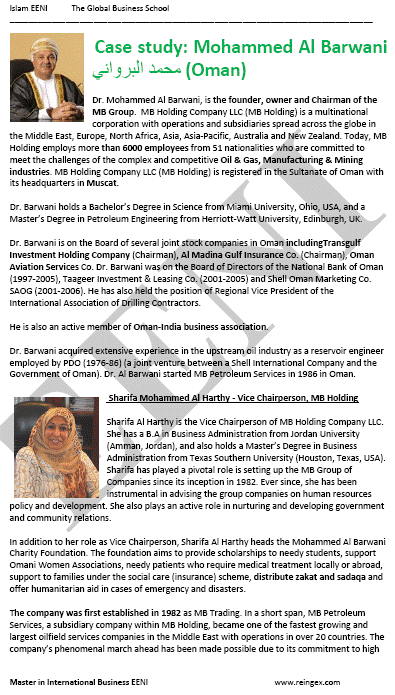

The educational aims of the Subject “Foreign Trade, Logistics and Business in the Sultanate of Oman” are:
- To analyze the Omani Economy, Logistics and Foreign Trade
- To conduct research on business opportunities in the Sultanate of Oman
- To explore the Omani trade relations with the student's country
- To learn about Omani Trade Agreements
- To examine the profile of Omani businesspeople and companies
- To develop a business plan for the Omani market

The Subject “Foreign Trade, Logistics and Business in Oman” is included within the curriculum of the following academic programs at EENI Global Business School:

Masters: International Business, Foreign Trade.
 Masters adapted to Omani Students.
 or
or 

- Subject Credits “Doing Business in Oman”: 1

International Trade, Logistics and Business in Oman
- Corridor of the Ashgabat Agreement
- North-South Corridor (India-Russia)
- Access to the:
- China-Pakistan Economic Corridor
- India-Chabahar (Iran)-Afghanistan Economic Corridor
- Kyrgyzstan-Iran Corridor
Omani Preferential Access and Trade Agreements:
- Oman and the Arab Economic Area
- Gulf Cooperation Council (GCC)
- Greater Arab Free Trade Area (GAFTA)
- Indian-Ocean Rim Association
- Islamic Trade Preferential System
- Arab Bank for Africa (BADEA)
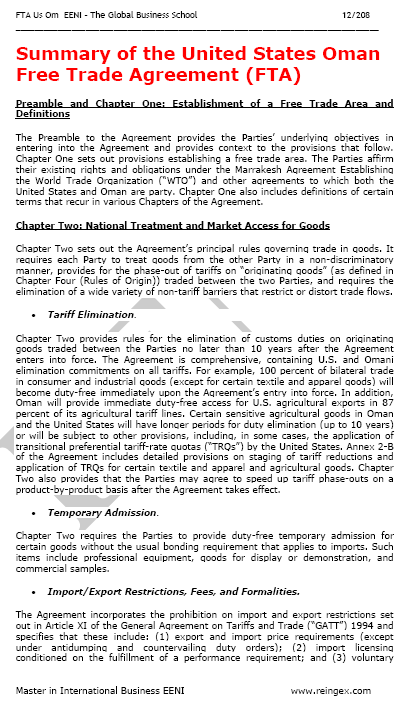
- U.S.-Oman Free Agreement
- Oman has Free Trade Agreements with India, China, South Korea, Singapore, Australia, EFTA, New Zealand, Thailand, the United States, the EU and MERCOSUR
- World Trade Organization (WTO)
- Agreement on Trade in Services (GATS)
- Agreement on Sanitary Measures
- Agreement on Technical Barriers to Trade
- Agreement on Preshipment Inspection
- Agreement on Safeguards
- Trade Facilitation Agreement
- World Customs Organization (WCO)
- Kyoto Convention
- International Road Transport Union (IRU)
- TIR Convention
- Guidelines on Safe Load Securing for Road Transport
- BIC (Containers)
- Chicago Convention (ICAO)
- International Maritime Organization
- Istanbul Convention - not a member
- Customs Convention on Containers - not a member
- Arab League
- Summit of South American-Arab Countries
- Asia-Middle East Dialogue
- Islamic Development Bank
- Economic Commission for Western Asia (ESCWA)
- Organization of Islamic Cooperation (OIC)
- Committee for Economic Cooperation
- Islamic Chamber of Commerce
- Islamic Centre for Development of Trade
- Statistical Economic Centre for Islamic Countries
- Arab Gulf Programme
- Arab Trade Financing Programme
- Arab Development Funds
- Afro-Arab Cooperation
- Arab Bank for Africa (BADEA)
- Asia Cooperation Dialogue
- United Nations
- Conference on Trade and Development (UNCTAD)
- International Trade Centre
- World Intellectual Property Organization (WIPO)
- World Bank
- World Trade Organization (WTO)
- International Monetary Fund
- The capital of the Sultanate of Oman is Muscat (1.2 million people)
- Oman is a Monarchy
- Thanks to its strategic location at the Persian Gulf entrance, Oman is considered as a country of significant geostrategic value
- Oman shares borders with Yemen, Saudi Arabia, and the Emirates
- Abolition of Slavery in Oman: 1970
- Official language of Oman: Arabic
- Area of Oman: 309,500 km²
- Omani Population: 4.3 million people
Religion in Oman.
- Islam Sunni is the main religion in Oman
- Maliki is the main school of Islamic Jurisprudence
Economy of Oman
- The proven petroleum reserve (4 billion barrels) are not crucial, so the Omani Government wants to make Oman one of the leading natural gas Exporter
- Main suppliers are the United Arab Emirates (UAE), Japan, and the UK
- Main Omani export markets are China, Japan, and South Korea
- The currency of Oman: Rial (OMR)
The largest Omani enterprises are located In Muscat:
- Suhail Bahwan, retail partner for firms such as Toshiba, Subaru, Seiko, Hewlett-Packard, General Motors, RAK Ceramics
- Saud Bahwan Group: Toyota regional Distributor, Daihatsu and Hertz Rent-a -Car
- Zubair Automotive, Mitsubishi distributor, Chrysler, or Dodge
Hasan Juma Backer Trading & Contracting has invested 700 million dollars in the dry port project of the Port of Abidjan.
Oman is a member of the UN, IMF, WTO, Group WB, GCC, Greater Arab Free Trade Area...
US-Oman Free Trade Agreement:
(c) EENI Global Business School (1995-2025)
Top of this page
