
International Marketing - Master / Doctorate



 WhatsApp
Master in International Business - Marketing: Distribution, export prices, AI, promotion

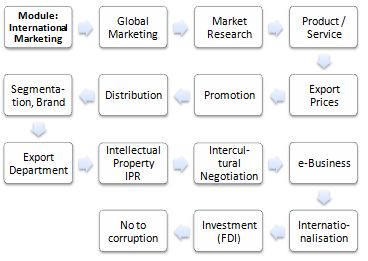
Module “International Marketing and Internationalization Strategies” (32 ECTS) is part of the following Higher Education Programs offered by EENI Global Business School:


Module “International Marketing and Internationalization Strategies” covers the analysis of the global marketing strategies.
The objective of the module aims to provide comprehensive knowledge, tools, and techniques necessary to manage all technical aspects related to global marketing of an exporting company: International Pricing, product, promotion, brand, segmentation, distribution, Internationalization Strategies.
The Subjects of the Module “International Marketing and Internationalization Strategies”
Between [] number of ECTS
- International Marketing [1]
- Market Research [2]
- International Product / Service Policy [2]
- Global Pricing Policy [1]
- Global Promotion Policy [4]
- International Distribution [4]
- International Segmentation, Brand, and Positioning [3]
- Export Department [1]
- Intellectual Property
Rights (TRIPS) [2]
- World Intellectual Property Organization (WIPO)
- Cross-Cultural Management [2]
- e-Business [2]
- Internationalization Strategies for exporting enterprises [2]
- Foreign Direct Investment (FDI) [2]
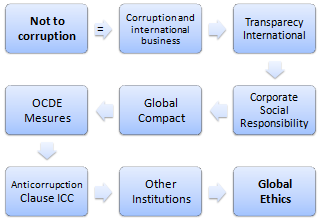
- No to Corruption in International Business
[4]
- Transparency International
- Corporate Social Responsibility
- United Nations Global Compact
- OECD Anti-corruption Measures
- Anti-corruption Clause (International Chamber of Commerce)
- AU Convention on Combating Corruption
- Other institutions related to fight against international corruption
- Introduction to Global Ethics (PDF), the two fundamental principles:
- Harmony of Religions
- Ahimsa (Non-Violence)
 (PDF).

Download the Syllabus of International Marketing Related Subjects (PDF).
Anyone who wishes to do International Business should be primarily a strategist, capable of designing global strategies tailored to each target market. In this module, we will analyze the main concepts of Internationalization Strategies for exporting enterprises as well as several success stories of different enterprises.
Anyone involved in Global Business (export, Subsidiaries, or displaced workers) negotiates with people from different cultures and languages. With the knowledge of culture of other countries, it is possible to avoid intercultural conflicts.
The study of Intercultural Management will allow us to know to manage this important aspect of International Business.
The final step in an strategy of internationalization is usually the implantation abroad (subsidiaries sales, production sites, or Joint Venturess).
Foreign Direct Investment (FDI) reflects the objective of obtaining a lasting interest by a resident entity in one economy (direct investor) in an entity resident in another country different from the investor (direct investment enterprise).
The organization and functions of the Export Department and the role of the Conference on Trade and Development (UNCTAD) will also be considered.
Finally, the principles of a Global Ethics for International Business will also be analyzed.


The company wishing to invest abroad will find in this module all the information necessary for a safe investment in another market.
 Enrol / Request for Information

The goals of the module “International Marketing and Internationalization Strategies” are:
- To learn about the key concepts
of International Marketing
- The student will analyze the purpose of International Marketing, explore the concepts of price and value to the customer, examine the marketing mix in the context of the export marketing and discuss the key elements of an export marketing plan
- To understand the key tools and concepts of Global Market Research and how best to apply them.
- A PESTEL Analysis (Political, Economic, Social, Technological, Environmental, and Legal) is an analysis of the external macro-environment that affects all the firms
- To learn international product policy key areas, importance of a product adaptation to local requirements when entering new export markets and analyze the product characteristics that typically need to be modified for different markets
- To understand the importance of an appropriate International Pricing Strategy when entering new export markets
- To examine pricing options available to the exporter and outline the criteria to be used when establishing a pricing strategy
- The criteria defined in pricing under Incoterms
- To learn the importance of an appropriate International Promotion Strategy when entering new export markets, examine promotion options available to the exporter, outline the key points to note when designing a company brochure and analyze the available tools when implementing a promotion campaign
- To understand the influence of a country's brand on its export performance
- To understand the fundamentals of international fairs, the appropriate preparation and attendance and its related follow-up activity
- To understand how to plan and prepare a business trip to a prospective export market and the follow-up, which will then be required
- To learn the importance of planning an appropriate International Distribution Strategy when entering new export markets, examine distribution options available to the exporter, outline the criteria to be used when selecting a distribution option and analyze the strategies that can be implemented for the consumer and/or industrial products
- To learn about channel options, that may be used when entering a new export market
- We are going to examine direct and indirect export channels available to the exporter, analyze the functions of importers and representatives, discuss the use of a company personnel and sales or production subsidiaries as well as explore franchising, Licensing and other channels of international distribution
- To examine the process of evaluating, recruiting and managing international sales representatives and the mechanism involved in selling into department stores and hypermarkets
- To understand the importance of international segmentation in global marketing and Internationalization Strategies
- To know Targeting strategies: concentrated, differentiated, product specialization, market specialization, full market coverage
- To learn about main brand strategies: global, regional or local
- To understand the process of brand value creation in global markets
- To learn about strategies of positioning a brand in international markets
- To understand the concepts of e-business and digital business models that a company can deploy, as well as the importance of strategy, marketing and technology in an e-business project
- To analyze the goals of an export department and how to benchmark them
- To offer a global vision on Foreign Direct Investment (FDI)
- To learn the different strategies to establish a company abroad
- To examine how diversity of cultures can influence the outcome of an International Marketing Plan
- To understand the key concepts related to Trade-Related Aspects of Intellectual Property Rights
- To learn about the tools that a company can implement to fight against corruption
- To understand the pillars of a Model of Global Ethics for the International Business
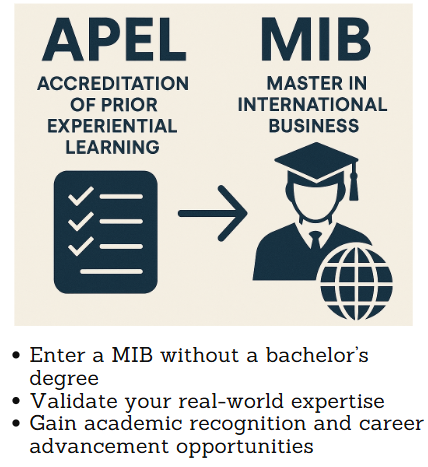
Master in International Business: Globalization, World Economic Areas, Foreign Trade, Transportation, International Marketing, Adaptation to the student's country (Africa, Asia, Middle East, Europe), AI for Global Business, Thesis, Career Opportunities.
 Master Negocios Internacionales
  Master en affaires internationales
  Mestrado em Negócios Internacionais.
(c) EENI Global Business School (1995-2025)
Top of this page
