
Global Market Segmentation. Brand Positioning






 WhatsApp
Global Segmentation, Brand, Positioning. Strategies (Marketing)

Segmentation, Targeting, and Brand Positioning (STP) is a strategic marketing framework used to identify and prioritize customer segments, select the most valuable ones to target, and effectively position a product or service to appeal to those segments.
- Importance of Global Market Segmentation
- Criteria for market segmentation
- Steps of an international segmentation process
- Niche markets
- Worldwide segmentation strategy
- Targeting strategies:
- Concentrated
- Differentiated
- Product Specialization
- Market Specialization
- Full Market Coverage
- Religious influencers and business
- Case Study:
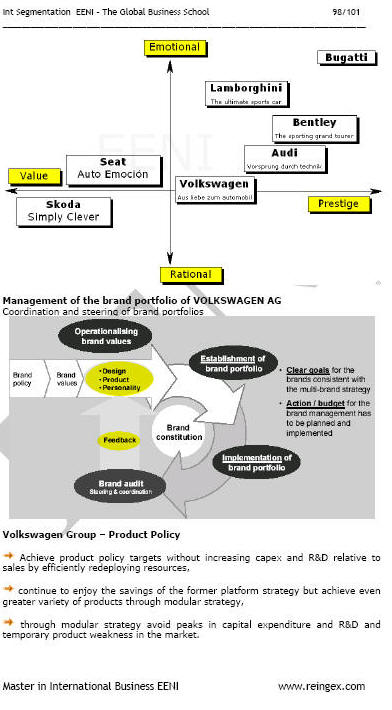
- Segmentation strategy of the Volkswagen Group
- Matsushita Electric (Panasonic)
- United Airlines
- BECEL/FLORA (Unilever)
- VALS reports
The main objective is to learn about Global Market Segmentation, Brand, and Positioning and its importance in International Marketing strategies:
- To understand the importance of international segmentation in International Marketing and Internationalization Strategies
- To learn about targeting strategies: concentrated, differentiated, product specialization, market specialization, and full market coverage
- To learn about main brand international strategies: global, regional, or local
- To understand the process of brand value creation in global markets
- To know strategies of positioning a brand in international markets

The Subject “International Segmentation, Brand and Positioning” is included within the curriculum of the following academic programs at EENI Global Business School:
Masters: Foreign Trade, International Business.


Postgraduate Certificate in Global Marketing.

Languages:  or
or  Segmentation, Marque, Positionnement
  Segmentación, marca, posicionamiento internacional
  Segmentaçao, Marca e Posicionamento.
- Subject Credits “International Segmentation, Brand and Positioning”: 4 ECTS
- Duration: four weeks
International Segmentation, Brand, and Positioning
Without a doubt, it would be ideal for an export enterprise to offer a tailored (or adapted) product or service to each of its clients (Importers). As this is impossible, the exporter need to develop goods and/or services tailored to the different market segments.
Global Market Segmentation is a key element of International Marketing Plan. The global market segmentation will require a strong effort to focus the strategy in each market niche.
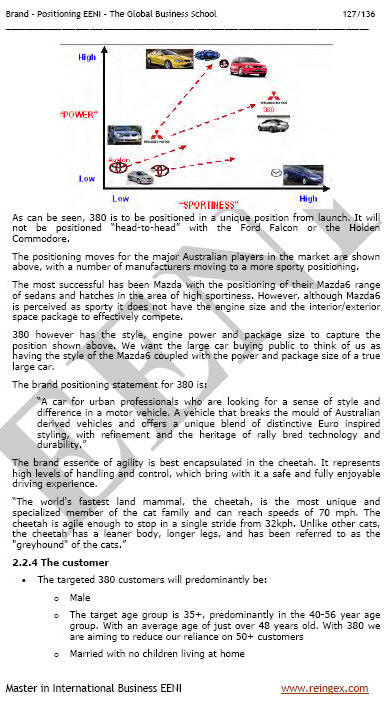
The main objective of international segmentation is to improve the brand position of the product or service.
Sample - International Segmentation, Brand and Positioning:
Global Market Segmentation allows the exporter:
- Product or service differentiation
- To manage local, regional, or international distribution
- To improve communication and promotion policy for each segment
International Targeting Strategies:
- Concentrated strategy
- Differentiated strategy
- Product specialization
- Market specialization
- Full market coverage
Coca-Cola exemplifies effective global marketing by maintaining a consistent brand image while tailoring its strategies to local markets. Operating in over 200 countries, the company balances global brand consistency with localized campaigns that reflect regional tastes, cultural values, and consumer preferences.
Founded in 1964 as Blue Ribbon Sports, Nike has evolved into a global powerhouse through its innovative marketing strategies. The company’s success lies in its ability to maintain a strong, standardized global brand—anchored by the iconic “Swoosh” and “Just Do It” slogan—while executing localized campaigns that resonate with regional audiences. This balance has positioned Nike as a benchmark in the evolution of global marketing.
Tesla segments the automotive market using a combination of demographic, psychographic, behavioral, and geographic factors to identify distinct customer groups with specific needs, values, and preferences.
Nike has increasingly integrated artificial intelligence (AI) into its global marketing efforts, using it to drive personalization, optimize content delivery across channels, and develop immersive, data-driven consumer experiences.
(c) EENI Global Business School (1995-2025)
Top of this page
