
Export Department. Director of International Business







 WhatsApp
Organization of the export department. Director of Global Business

An Export Department is responsible for overseeing and facilitating a company’s sales and Distribution activities in international markets. Its core function is to ensure that Product or services are effectively marketed, sold, and delivered beyond the domestic market while maintaining full compliance with Foreign Trade regulations, documentation requirements, and logistical standards.
- Introduction to the export department/international department
- Set up and run the export department
- Functions, goals, and organization of the export department
- Case Study: Apex Manufacturing’s Export Department Expansion into Southeast Asia
- Resources needed
- Director of International Business, export manager, and country area manager
- Director of International Business and Global Ethics
- Case Study: Director of Export Department at Horizon Manufacturing
- Case Study: Director of Export Department at SunTech Solutions, Nigeria
- Foreign Trade Back Office
- Foreign Trade Assistant
- Secretary of the department of International Trade
- Case Study:
- Analysis of the differences between the Export Department in Spain and Latin America (Iberian America)
- Sales areas assignment in international department
Sample - Export Department:
The educational aims of the Subject “Export Department” are:
- To analyze how to set up and run an export department
- To discuss the functions and goals of the export department
- To define the profile of the Export Director
This will be achieved by:
- Examining the characteristics of an export manager
- Outlining the most important functions of an export department
- Analyzing the goals of an export department and how to benchmark them
- Detailing how to best support the export department works

The Subject “Export Department” is included within the curriculum of the following academic programs at EENI Global Business School:
Masters: International Business, Foreign Trade.


Languages:  or
or  Département
  Departamento Export
  Departamento Expor.
Credits of the Subject “Export Department”: 1 
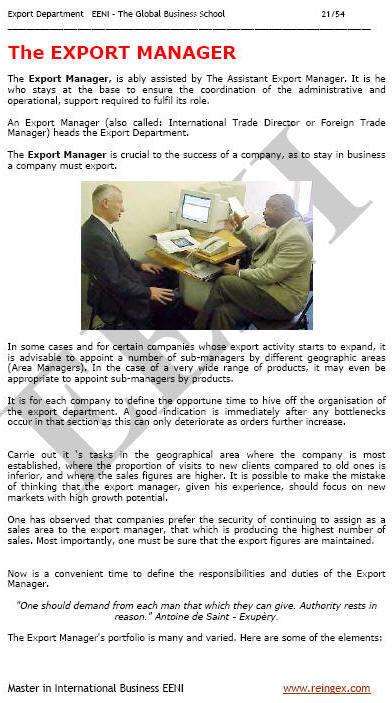
Every company wishing to consolidate its export activity has to create its Foreign Trade department so it can handle the different tasks that enable its continued presence in international markets.
As sales are solely the result of a marketing policy, the export department might be described as an instrument that carries out all the tasks generated by International Marketing policies of the company.
The export department has concrete goals: to perform all tasks related to International sales.
Upon analyzing the export activities of enterprises that have experienced a stable growth in their exports, one observes that, historically, their international contacts started out sporadically and only later began to consolidate.
That was when they made the decision to expand their international trading staff to penetrate other markets to a greater extent and better.
When interviewing enterprises with consolidated foreign departments; we discover that their reasons for creating export structures have nothing to do with the academic reasoning. Instead, the reasons were:
- Excess of production
- Given the high stocks, the need to increase sales quickly, at all costs
This, in turn, resulted from an insufficient penetration of local market, product quality problems, pricing, even distribution problems or lack of promotion.
We note that enterprises, which are large regarding their sales, number of employees, or own resources, export greater volumes of products. There are many common elements in the paths taken by various enterprises to create an export department.
Case Example: Apex Manufacturing’s Export Strategy
Apex Manufacturing is a mid-sized U.S.-based company specializing in high-quality industrial tools. With a strong presence in the domestic market, the company identified Southeast Asia as a strategic region for expansion, driven by rising demand for industrial equipment amid rapid infrastructure development.
To support its international growth, Apex established a dedicated Export Department comprising:
- Export Manager – Oversees international sales strategy and manages key trade relationships.
- Logistics Coordinator – Handles shipping, documentation, and international Transport and Logistics.
- Compliance Officer – Ensures adherence to global trade laws, export regulations, and Customs requirements.
- Market Research Analyst – Monitors target markets, competitor activity, and demand trends.
The Export Department works closely with Apex’s sales, Marketing, and production teams to align international operations with overall business goals and to ensure smooth market entry and expansion.
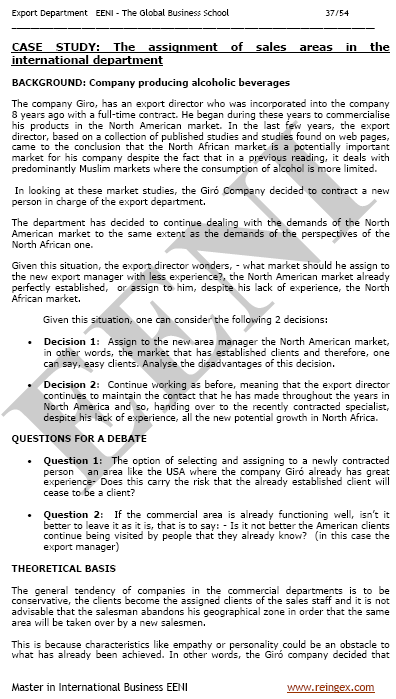
The Director of the Export Department is a senior-level executive responsible for leading and strategizing a company’s international sales and export operations. This position plays a critical role in expanding global market reach, ensuring regulatory compliance, and driving sustainable revenue growth from international markets.
Required Qualifications
- Bachelor’s degree in International Business (Master’s preferred).
- 8–10+ years of experience in export management or international sales, with proven leadership experience.
- In-depth knowledge of international trade laws, Incoterms, Letters of Credit and global logistics.
- Strong strategic thinking, communication, and negotiation skills.
- Familiarity with ERP systems and export compliance software.
Salary Expectations (as of 2025)
United States: Typically ranges between $110,000 – $160,000 annually, depending on industry, company size, and location.
Additional compensation may include bonuses, international travel allowances, and performance incentives.
Case example: SunTech Solutions – Expanding Intra-African Exports through African Continental Free Trade Area
SunTech Solutions is a mid-sized Nigerian company headquartered in Lagos,
specializing in solar energy equipment. SunTech holds a strong position in the
Nigerian market and is now poised to expand across Africa in response to the
continent’s growing demand for renewable energy solutions.
SunTech aims to increase its export sales by 30% within two years by expanding
into high-potential markets such as Kenya, Ghana, and South Africa.
In 2024, SunTech appointed Chinedu Okoye as the Director of the Export
Department to lead the company’s regional expansion strategy. His mandate
includes establishing new distribution channels, ensuring regulatory compliance,
and aligning the company’s trade strategy with emerging opportunities under the
African Continental Free Trade Area (AfCFTA).
SunTech's primary challenge was to effectively leverage the AfCFTA framework to
facilitate seamless intra-African trade. This involved navigating varying
national regulations, addressing logistical and infrastructure constraints, and
identifying reliable local partners while maintaining cost competitiveness.
(c) EENI Global Business School (1995-2025)
Top of this page
