
Export Prices. Global Pricing Policy







 WhatsApp
International prices and Incoterms. Pricing options available to the exporter

Global pricing strategies are essential for businesses entering international markets, requiring a careful balance between profitability, market competitiveness, and local consumer expectations
- Introduction to the Global Pricing Policy
- Product life cycle and Global Pricing Policy
- Case Study: Netflix’s Global Pricing Strategy
- Case Study: Apple’s Pricing Strategy in Asia
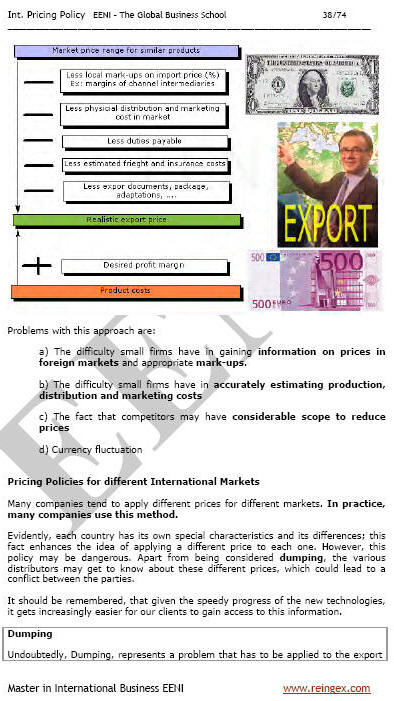
- Calculation of export prices
- Market-Based Pricing (Demand-Oriented Pricing)
- Uniform Pricing (Standardized Pricing)
- Differentiated Pricing
- Standardization vs. Adaptation. Glocalization Strategies
- International prices and Incoterms® 2020
- Case Study: TechTrend Innovations and Global Expansion (Logistics & Incoterms)
- Analysis of competitors' prices
- International Pricing Strategies
- Pricing strategy when entering new export markets
- Pricing options available to the exporter
- E-Business and pricing policy
- Religion and export prices
- Case Study:
- Pricing Policy and Inflation
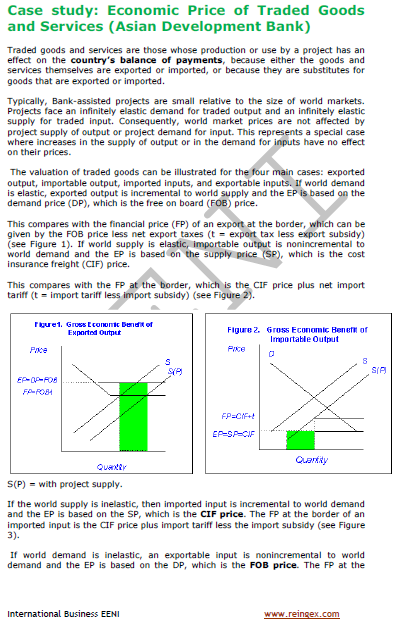
- Price of Traded Goods and Services in Asia
Sample - Global Pricing Policy:
The main objective of the Subject “Global Pricing Policy” is to understand the importance of an appropriate pricing strategy when entering new export markets.
- We are going to examine pricing options available to the exporter and outline the criteria to be used when establishing a pricing strategy
- We will also look at the criteria defined in pricing under Incoterms
This will be achieved by:
- Examining pricing options available to the exporter
- Outlining the criteria to be used when establishing a pricing strategy
- Analyzing the goals of a pricing policy
- Detailing how to calculate an export price
- Introducing the criteria defined in pricing under Incoterms® 2020

The Subject “Global Pricing Policy” is included within the curriculum of the following academic programs at EENI Global Business School:
Courses: Foreign Trade Assistant.

Masters: Foreign Trade, International Business.


Languages:  or
or  Prix exportation
  Precios exportación
  Preços de exportação.
- Subject Credits “Global Pricing Policy”: 1

- Duration: 1 week
One of the most complicated aspects of Foreign Trade is pricing policy. An incorrect pricing policy can lead to a total failure in international markets.
First of all; we should find out about prices in various foreign markets, this information will allow us to have some real criteria for setting our export prices.
However, we will meet the familiar dilemma: global or local prices?.
Effective global pricing strategies demand a nuanced understanding of local markets, consumer behavior, and competitive dynamics. Companies must strike a balance between standardization—for operational efficiency—and differentiation—for local relevance. Leveraging data-driven tools enables agility in adapting to market shifts. Whether adopting penetration pricing to gain market entry or premium pricing to enhance Brand Positioning, the ultimate goal is to align pricing with both customer expectations and strategic business objectives
From another point of view, price is attached to selected Incoterm. In more competitive markets; it is habitual to deliver the Product to client´s premises, thereby offering DDP prices. In some countries this is impossible, and it will cause us problems.
When designing Global Pricing Policy; we will have previously carried out a survey of our competitor's prices in our different target markets.
We will be able to act according to this information one-way or the other. It will be a basic reference when establishing international prices. In this respect, Internet is a valuable research tool for the exporter.
Pricing strategies to be followed in foreign markets are often closely linked to product life cycle. We must examine the pricing strategies for various stages of life cycle:
1- Introduction strategies:
- Setting low prices for penetration
- “Skimming” the market
2- Strategies for existing products:
- Maintaining a prestige prices
- Maintaining a given low price, when commercializing mass sale products
- Corrective actions
Global Pricing Strategies
- Market-Based Pricing (Demand-Oriented Pricing)
- Uniform Pricing (Standardized Pricing)
- Differentiated Pricing
- Premium Pricing
- Penetration Pricing
- Dynamic Pricing
- Value-Based Pricing
- Promotional Pricing
- Psychological Pricing
- Economy Pricing
To thrive in diverse markets characterized by varying economic conditions, consumer behaviors, and competitive landscapes, Netflix implemented a differentiated pricing strategy that incorporates elements of both penetration and value-based pricing. This multifaceted approach has enabled Netflix to grow its global paid subscriber base to 290 million by Q2 2025, with particularly strong expansion in emerging markets such as India, Brazil, and Nigeria
Apple holds a substantial presence in Asia, which accounts for roughly 30% of its global revenue in 2025. Key markets include China, Japan, India, and Southeast Asia—such as Singapore and Indonesia. Driven by flagship products like the iPhone, MacBook, and Apple Watch, Apple’s premium brand image necessitates a pricing strategy that balances exclusivity with market penetration across Asia’s diverse economies. To address varying purchasing power and consumer preferences, Apple employs a combination of premium and differentiated pricing strategies tailored to the region.
(c) EENI Global Business School (1995-2025)
Top of this page
