
International Distribution, Importers, Exporters





 WhatsApp
Global Distribution. Export Channels. Sales subsidiary. Franchises

Effective international distribution and entry strategies are crucial for companies aiming to succeed in global markets. They determine the mechanisms through which products or services reach international consumers and shape the firm's ability to establish and maintain a competitive presence abroad.
International distribution strategies encompass the methods by which companies ensure the delivery of their products or services to consumers in global markets. Choosing an appropriate strategy is vital for achieving market entry success, optimizing profitability, and meeting customer expectations.
The Subject “International Distribution” consists of three parts:
1- International Distribution.
- Introduction to Global Distribution Policy
- International Distribution Strategies
- Indirect exports. Exporting
- Consultancy
- Associated exports
- Export Consortia
- Trading companies
- Case Study: IKEA’s International Expansion
- Case Study: Distribution Strategy for a Food Product in India
- Case Study: Coca-Cola Partners with Christian and Muslim Clerics to Reach Rural Areas in Africa
- Distribution and e-commerce. Going international with e-business
- Case Study: Amazon – Global Distribution Powered by E-Business
- E-commerce and Digital Entry
- Case Study: Warby Parker — Digital Entry Disrupting the Eyewear Industry
- Case Study: Dell Technologies’ Hybrid Distribution Strategy
- Digital Distribution
- Case Study: Netflix and the Transformation of Digital Distribution in Entertainment
- Religion and global distribution
- Case Study: McDonald's in the Middle East
- Case Study: L'Oréal and Halal Cosmetics in Asia and the Middle East
- Case Study:
- Sogo Shoshas and Chaebols
- Toshiba
- The third Italy
- Mitsubishi Corporation
- Sanofi-aventis
2- Direct exports.
- Direct Distribution (Direct-to-consumer DTC model)
- Case Study: Tesla’s Direct Distribution Model
- Case Study: Nike’s Direct Distribution Strategy
- Importers and Distributors
- Case Study: UNIQLO’s Export and Distribution Strategy
- Case Study: Importer of Consumer Electronics – “TechWave Imports”
- Case Study: Distributor of FMCG Products (“FreshLink Distributors”, Mexico)
- Case Study: PanAfric Distributors Ltd.
- Case Study: AsiaTech Distributors Ltd.
- Case Study: Distributor in the Middle East – “DesertLink Distribution Co.”
- Representative
- Company personnel
- Hybrid Distribution (Multi-channel)
- Comparative Analysis: Place and Promotion in B2C vs. B2B Global Marketing
- Global Marketing & Trade Agreements
- Foreign subsidiaries
- Sales
- Production
- Internationalization
- Licensing and Franchising
- Case Study: General Electric (GE) and its International Expansion (Licensing Strategy)
- Foreign Direct Investment (FDI)
- Investments Abroad
- UNCTAD and Foreign Direct Investment
- Case Study: Toyota’s Foreign Direct Investment in the United States
- Case Study: Mining Industry and Resource-Seeking FDI in Africa (The Case of Rio Tinto in Guinea)
- Licensing and Franchising
- Strategic Alliances
- Case Study: Renault-Nissan Alliance
- Wholly Owned Subsidiaries
- Case Study: Tesla’s Wholly Owned Subsidiary in China — Gigafactory Shanghai
- Joint Ventures
- Case Study: Sony Ericsson Joint Venture
- Case Study: MTN and Vodafone Joint Venture in Africa
- Case Study:
- Set up a business in Costa Rica
- Sumitomo
- Itochu
- Rolls-Royce
- Renault-Nissan Alliance
- 7-Eleven
- Mango
- International Distribution networks in centralized economies
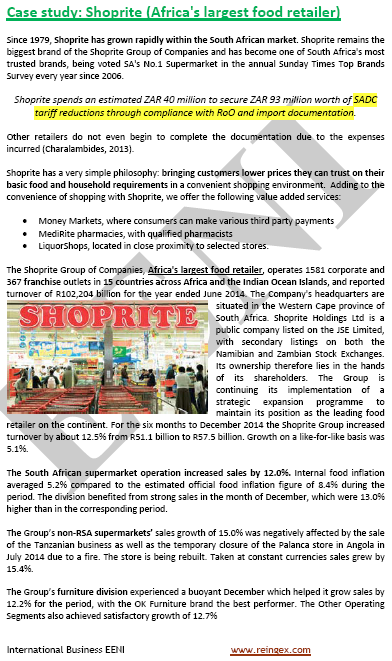
- Shoprite (African largest food retailer)
3- International Sales Network Management.
- Selection criteria for searching representatives and distributors
- Profile of representative/international distributor
- Export Department
- Director of International Business and Global Ethics
- Case Study: Apex Manufacturing’s Export Department Expansion into Southeast Asia
- Director of the Export Department
- Case Study: Director of Export Department at Horizon Manufacturing
- Case Study: Director of Export Department at SunTech Solutions, Nigeria
- Representation and distribution contracts
- Recruitment methods
- Control of work of representative
- International Sales:
- Purchasing departments
- Delegated agents
- Case Study: Sales Network Management in Africa
- Case Study: Exclusive agent in two markets.
- “Grey” Networks
- Electrolux India
Sample - International Distribution:
The educational aims of the Subject “International Distribution” are the following:
- To learn about the importance of planning an appropriate international distribution strategy when entering new export markets
- To identify distribution options available to the exporter
- To outline the criteria to be used when selecting a distribution channel
- To analyze strategies that can be implemented for consumer and/or industrial products
- To select channel options, that may be used when entering new export markets
- To examine direct and indirect export channels open to the exporter
- To analyze functions of importers and representatives
- To discuss use of a company personnel and sales or production subsidiaries
- To explore franchising, licensing, and other channels
- To analyze the process of evaluating, recruiting, and managing international sales representatives and the mechanism involved in selling into department stores and hypermarkets
This will be achieved by:
- Examining distribution options available to the exporter
- Outlining the criteria to be used when selecting a distribution option
- Introducing strategies that can be implemented for consumer and/or industrial products
- Examining the characteristics of a sales representative
- Outlining the most important functions of a sales representative
- Analyzing the process of recruiting a sales representative
- Detailing how best to manage the sales work of representative
In finishing this subject, student will know different possibilities that a company has for creating a network of international representatives and negotiation factors with possible agents at the time of signing a contract.

The Subject “International Distribution” is included within the curriculum of the following academic programs at EENI Global Business School:
Postgraduate Certificate in Global Marketing.

Masters: Foreign Trade, International Business.

Languages:  or
or  Distribution internationale
 Distribucion internacional
 Distribuiçao internacional.
- Subject Credits “International Distribution”: 5

- Duration: 5 weeks
In general; it would be ideal for an exporter to be able to sell directly to his customer with no need for intermediaries. In this way the exporter:
- Reduces the sales cost
- Increase product's competitiveness
- Is in direct contact with the market
- Obtain a continuous feedback of information
- He can control the company's marketing policy directly
However, the truth is that this is not always possible (due to costs involved parties or market idiosyncrasies) and in these cases, the company should seek an intermediary.
Direct distribution refers to the delivery of goods or services from the producer directly to the final consumer, bypassing all intermediaries such as agents, wholesalers, or retailers
Market entry strategies define how a company establishes operations or presence in a foreign market. The choice depends on risk tolerance, investment capacity, and market potential.
- Exporting
- Licensing and Franchising
- Joint Ventures
- Wholly Owned Subsidiaries
- Strategic Alliances
- E-commerce and Digital Entry
Hybrid distribution—also known as dual or multi-channel distribution—is a strategy in which a company utilizes both direct and indirect channels to deliver its products or services. Rather than depending exclusively on its own sales force or solely on intermediaries such as wholesalers, retailers, or agents, the company combines multiple distribution channels to enhance market reach, maintain greater control, and improve operational efficiency.
As a global leader in affordable flat-pack furniture and experiential retailing, IKEA exemplifies successful international distribution and market entry strategies. By 2025, the Swedish retailer has established a presence in over 60 countries, with more than 500 stores worldwide—offering a valuable case study in global expansion
UNIQLO adopts a hybrid internationalization approach, integrating direct export of its Japanese-designed products with the establishment of company-owned retail outlets, instead of partnering with third-party franchises or local retailers
Unlike traditional automakers, Tesla uses a direct-to-consumer (DTC) distribution model, bypassing franchised dealerships. Instead, the company manages the entire sales process through:
- Company-owned showrooms and galleries – where customers can learn about and experience Tesla vehicles firsthand.
- Online sales platforms – including its website and mobile app, allowing customers to configure and purchase vehicles directly.
- Direct delivery – vehicles are delivered either to customers' homes or to designated Tesla service centers.
Traditionally, Nike relied heavily on retailers and distributors—such as Foot Locker and department stores—to sell its products. However, over the past decade, the company has made a significant strategic shift toward a direct-to-consumer (DTC) model, prioritizing its own retail stores, e-commerce platforms, and digital engagement channels.
Successfully managing international sales networks requires a strategic blend of cultural adaptation, technological integration, and strong relationship-building. Companies can enhance performance by leveraging tools such as customer relationship management (CRM) systems and localization platforms, while also investing in hiring and training local talent and optimizing logistics operations. Regular analysis of network structures and evolving market dynamics is essential to ensure strategies remain agile, competitive, and aligned with long-term growth objectives.
Effectively managing an international sales network in Africa requires a strategic combination of localization, digital adoption, and alignment with regional initiatives such as the African Continental Free Trade Area (AfCFTA). To unlock the potential of Africa’s $2.1 trillion consumer market, businesses must address persistent infrastructure challenges, capitalize on high-growth sectors, and build resilient, data-driven sales networks. Success in this dynamic environment hinges on adapting to local market conditions while leveraging continent-wide integration efforts for scale and sustainability.
We will analyze the most appropriate profile of a Foreign Trade representative or agent, how to find him or how to apply a control mechanisms.
What we must keep in mind is that the representative or agent is only useful when he starts to sell. Finding the agent is not the end in itself, rather obtaining orders through him.
We will learn about selling into hypermarkets and department stores. Student will:
- Outlines the purchasing department organization
- Learn how to best approach to the department stores
- Examine the role of purchasing agents
To help overcome the difficulties encountered in international markets; it may often be in interests of small and medium size enterprises to resource a separate organization for promotion and/or sale of their products (services) abroad.
It is quite common in Europe. It consists of uniting export departments of several enterprises to form one common one for use by all.
The option “growing from zero” of the export department which can be seen as the most efficient, is the creation of shared structures between various enterprises; what we will call “export consortiums.”
Trading enterprises are enterprises that sell domestically products produced abroad.
- They play a major role in giving an impulse to Foreign Trade and operate as commission agents for the exporter
- The Trading Company usually operates by finding a client who wishes to purchase a certain product somewhere in the World
- These are clients who require a component that is almost unique and incorporated into their product so it can be difficult for them to find a vendor
- Japanese trading enterprises (Sogo Shoshas) or the corresponding in South Korea (Chaebols), are the ones that are furthest from the prototype of small enterprises described; they have a higher number of employees that allows them to specialize in specific products: cement, steel, heavy machinery and food
Sales Subsidiary.
This formula enables having much stricter control of marketing policy. For the company, creation of a subsidiary means a long-term investment. Thus, the company should make a series of really in-depth research studies, to prevent any mistakes. Alternatively, the company could create a sales subsidiary but only when sales potential is high.
Fully owned subsidiaries have been viewed as an international movement of capital. However, the capital transfers are accompanied by technological flow, managerial control, and access to input and output markets otherwise unattainable to receiving country.
The various formulae analyzed so far, correspond to what we could describe as a traditional distribution chain: from manufacturer to the importer, from the importer to the wholesaler, from the wholesaler to the representative, from the representative to the sales point and from the selling point to the end user.
Once necessary experience has been obtained; it cedes the opportunity to sell its products to those people or enterprises that wish to invest, creating a direct sales point similar to one already set up.
Finally, we will analyze how the e-business can influence international distribution. We believe that enterprises, nowadays, should look at digital distribution strategies.
We see a business environment changing, from consolidated multinational enterprises with established distribution channels selling “atoms” to pure Internet start-ups that only sell “bits.”
When we think about “bits” products we automatically think about digital distribution over the net, a global, flexible, instantaneous distribution that in many cases, will not be controlled by national customs controls.
What's more, implementing a digital distribution strategies can create tensions in our traditional distribution network if we cannot create synergies.
(c) EENI Global Business School (1995-2025)
Top of this page
