
AI in Global Strategy and Decision-Making




 WhatsApp
AI’s impact on International Trade, supply chains, and cross-border logistics
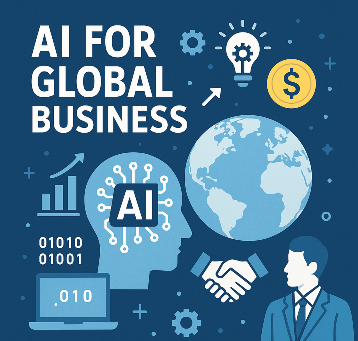
Course: AI for Global Business
AI Introduction, Technologies, Global Trade, Strategy, Supply Chain, Digital Trade, Marketing, Cross-Cultural, Finance, Ethical, Sustainability, Future Trends, Global Ethics
AI is transforming global strategy and decision-making across governments, corporations, and organizations by enabling data-driven insights, predictive modeling, and automation at unprecedented scales.
Artificial Intelligence (AI) is fundamentally reshaping global strategy and decision-making in business by enabling faster, data-driven, and precise choices across industries.
Syllabous
- AI’s impact on International Trade, supply chains, and cross-border logistics
- AI-driven strategic planning: Scenario analysis and predictive modeling.
- Competitive intelligence using AI in global markets. Using
AI for market entry and competitor intelligence
- Competitive Intelligence Applications by Unilever, Alibaba, and Tesla
- Case Study: Unilever’s Use of AI for Competitive Intelligence in global markets
- Case Study: Tesla’s Use of AI for Competitive Intelligence in Global Expansion
- AI in international financial decision-making
- Case Study: Applications of AI in Africa’s Financial Decision-Making
- Case Study: African Union’s Continental AI Strategy
- Risk mitigation in Global Business using AI-driven
forecasting
- Case Study: Walmart’s AI-Driven Supply Chain Risk Mitigation
- Localization and cultural adaptation in Global Business
using Natural language processing (NLP)
- Case studies related to NLP: Amazon (Localized e-commerce Product Listings), Netflix (Multilingual Content Recommendations and Subtitles), Airbnb (Localized Guest-Host Communication) and Coca-Cola (Culturally Tailored Marketing Campaigns)
- Standardization vs. Adaptation. Glocalization Strategies
- Case studies:
- Netflix’s global recommendation engine
- Spotify’s Use of AI for Global Market Entry
- Siemens AI Strategy
- Mercado Libre’s AI Strategy for Global Market Entry. Market-specific strategies (Mexico vs. Brazil)

The Subject “AI in Global Strategy and Decision-Making” is included within the curriculum of the following academic programs at EENI Global Business School:
Postgraduate Certificate in International Trade.

Certificate in International Transport.
Masters: International Business, Foreign Trade, International Transport, Logistics in Africa, Business in Africa.
Doctorate: World Trade, Global Logistics, African Business, Global Ethics, Religions, and International Business

Languages:  or
or
 IA en la estrategia
global
IA en la estrategia
global
 L'IA dans la stratégie
 IA na estratégia global.
Impact and Applications
- Enhanced Decision-Making: AI processes vast datasets in real-time, uncovering patterns and insights that humans might miss. For instance, predictive analytics helps businesses forecast market trends, customer behavior, and operational Risk, enabling proactive strategies. Examples include Walmart using AI to optimize inventory and Uber leveraging machine learning for demand forecasting.
- Strategic Planning: AI augments traditional strategic tools like Porter’s Five Forces by generating scenarios and evaluating strategies. It acts as a thought partner, challenging biases and simulating market scenarios to refine decisions.
- Global Operations: AI optimizes global supply chains, automates repetitive tasks, and enhances cross-cultural communication through natural language processing. For multinational enterprises, AI can inform entry mode choices and manage virtual teams across borders.
- Customer and Market Insights: AI personalizes customer experiences, improves marketing agility, and supports market expansion by analyzing local dynamics and cultural preferences.
- Geopolitical Risk Management: AI processes global risk data, detecting weak signals and simulating scenarios to help businesses navigate disruptions like supply chain issues or regulatory shifts.
By 2030, the global AI market is projected to reach $826.7 billion, with 90% of business leaders viewing AI as critical to strategy. As generative AI and decision intelligence evolve, businesses that integrate AI thoughtfully—balancing automation with human insight—will lead in innovation and resilience.
(c) EENI Global Business School (1995-2025)
Top of this page
