
Global Ethics and International Business






 WhatsApp
Religions (Hinduism, Islam, Christianity): sources of global ethics. Ahimsa

Religions and Global Business -
Religious diversity

The incorporation of certain ethical principles common to all religions, which can be summarized as Ahimsa (non-violence) in thoughts, words, and actions applied to all business processes, from the highest management to the end consumer, is one of the pillars of global ethics.

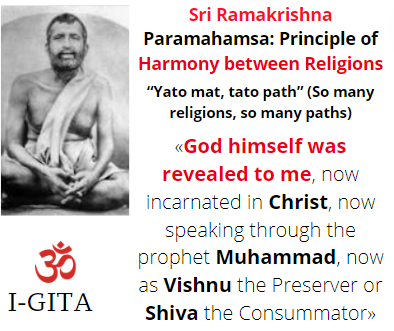
Individuals and companies operating in global markets must understand how to respond to the world's valuable religious diversity. The Principle of Interfaith Harmony, enunciated by the Hindu mystic Sri Ramakrishna Paramahansa: “So many religions, so many paths,” derived directly from Hindu Vedanta, offers the philosophical, ethical, and spiritual framework for successfully operating in this global, yet local, digital, and interfaith world, based on the concept of “Unity in Diversity.”
“The principle of Non-Violence of Mahatma Gandhi and testimony of Sri Ramakrishna to Harmony of Religions: here we have the approach and spirit that can make it possible for the human race to grow together into one family.” Arnold Toynbee.
But to accept other spiritual paths as valid, it is necessary to understand, even briefly, the ethical principles derived from these religions.
This model of global ethics based on Ahimsa in thought, words, and actions, along with Ramakrishna's principle of interfaith harmony, defines a framework compatible with all these spiritual paths and global business.
EENI Principle of Racial Harmony (James Emman Kwegyir Aggrey).

- Introduction to Global Ethics
- Searching for a Model of Global Ethics
- Religions as “Wisdom traditions” of humanity: one of the main Global Ethics sources
- Shared ethical principles of humanity
- The Golden Rule (“Ethic of Reciprocity”)
- The two fundamental principles of Global Ethics
- Harmony of Religions (Sri Ramakrishna)
- Ahimsa (Non-Violence)
- Compatibility of the Model of Global Ethics with World's Religions
- Implications for International Marketing
- Businesspeople who apply models based on Global Ethics
- Why do we need Global Ethics?
Global Ethics and World Religions
- Religion and ethical frameworks
- Religious differences and ethical conflicts
- Spiritual Globalization
- Faith-Sensitive Business Leadership
- Faith-based Marketing
- Influence of religion on financial systems
- Religion and international contracts
- Religion and international product/service policies
- Religious risks for the global enterprise
- Cultural intelligence and Religious diversity
EENI Principle of Racial Harmony (James Emman Kwegyir Aggrey).
The educational aims of the Subject “A Model of Global Ethics for International Business” are the following:
- To define the pillars of a Model of Global Ethics
- To understand the religions of humanity as sources of a Model of Global Ethics
- To analyze the two fundamental principles of Global Ethics: Ahimsa (non-violence) and Harmony of Religions
- To reflect about the impact of a Model of Global Ethics on International Business (marketing, strategies, and relationships)
- To analyze the profile of Businesspeople who apply Models of Global Ethics
Intended for all those who wish to implement a Model of Global Ethics in their enterprises based on the principles of Harmony of Religions and Ahimsa (non-violence).

The Subject “Global Ethics” is included within the curriculum of the following academic programs at EENI Global Business School:
Doctorate: Ethics, Religions & Business, World Trade.

Masters: Religions & Business, International Business.

Bhagavad Gita Courses, Realization of the Gita
Languages:  or
or  Ética Global
  Ethique mondiale
  Ética global.
- Subject Credits “Global Ethics”: 1

- Download the Subject Syllabus: “Global Ethics” (PDF)

“Ethics consist in experiencing the compulsion to show to all will-to-live the same reverence as I do to my own.” Albert Schweitzer.
Global Ethics and International Business
Global Ethics: “common values shared by the Humanity.”
“A common fundamental vision of what is legitimate, just, and fair. A global economic ethics relies on the moral principles and values that from the immemorial time have been shared by all the cultures and have been supported by a common practical experience.” Manifest for a Global Economic Ethics.
Religion and ethics are deeply intertwined, but they are not identical. Religions offer ethical frameworks that guide millions, but they also coexist with secular ethical systems. In a diverse world, the challenge is to balance religious beliefs with universal ethical principles, fostering dialogue and mutual respect.
Religious ethics are often based on belief in divine authority or a transcendental purpose, while secular ethics are grounded in reason, empathy, or social welfare. However, both, as in the case of Vedanta, can overlap in principles such as honesty and respect.
Where can we find the sources of Global Ethics?
Religions as the “wisdom traditions” of humanity: one of the main Global Ethics sources.
“Who are the greatest benefactors of living generation of Humanity? Confucius, Muhammad, Lao Tzu, Jesus, Buddha, Zoroaster, the prophets of Israel and Judah, and Socrates.” Sir Arnold Toynbee.
Perhaps many people in the West prefer to speak of “Wisdom Traditions” instead of religions.
Instead of looking for differences (Concept of Cross-Cultural Management); we will search for points of convergence, facilitating dialogue, cultural diplomacy, international relations and Global Business.
Religions (Ethics) influence significantly in the way of doing business in each market, especially in the “non-Western” countries. The great part of humanity - Africa, Latin America, Arab Countries, India, and Southeast Asia - is much more spiritual than the West.
In many countries, mixing religion and business is considered taboo. However, we disagree if we do with respect and knowledge.
The West needs to change his world's vision, and understand that the world is different; and only with the knowledge and respect to the others, the West can represent a similar role it in the new order.
Science can save lives, but also can destroy it. Religions have a positive aspects but also negative. There are many essays about the negative dimensions of the religions, a reality that history has taught us. However, the religions also have a positive side, as ancient wisdom sources, emanating ethical principles shared by almost all the higher religions.
“We should adapt the science for the advantage of Humanity” Haya Sindi (Saudi Arabia).
“The Harijan movement (Untouchables) is too big for a mere intellectual effort. There is nothing so
wrong in the entire world that
caste system. Moreover, yet I cannot leave my religion and therefore Hinduism.
My life would be a burden to me if Hinduism failed me.
I love Christianity, Islam,
and many other faiths through Hinduism. Take it away, and nothing remains for
me. However, then I cannot tolerate it with untouchability the high-and-low
belief.” Mahatma Gandhi

- Yoga of the Threefold Faith of the Bhagavad Gita
Sources of Global Ethics.
- The Universal Declaration of Human Rights (United Nations)
- The Cairo Declaration on Human Rights in Islam (Organization of Islamic Cooperation)
- The Declaration on Fundamental Principles and Rights at Work (International Labour Organization)
- The Rio Declaration on Environment and Development
Religions often define what is morally acceptable in personal relationships, and therefore in business relationships. What is acceptable or not is defined in holy books: the Bible for Christianity, the Quran for Islam, or the Bhagavad Gita for Hinduism. For example, in Islam, interest-bearing loans are prohibited under Sharia law; Sikhs emphasize righteousness, while in Hinduism and Buddhism, nonviolence is fundamental.
Declaration Towards a Global Ethic
At the Parliament of Religions of the World, Chicago (1993) (since 1893, the speech of Swami Vivekananda, a disciple of Sri Ramakrishna), lead by Hans Kung, representatives of all the World's Religions agreed on the core elements of a shared ethic.
- Principle of Humanity
- Golden Rule of Reciprocity
- A commitment to the Non-violence, justice, truthfulness, and partnership between men and women
Global Ethics:
- It is not proselytism
- It is not based on the superiority of any religion
“Today there is no living being who know enough to say for sure if a religion has been more important than all others.” Arnold Toynbee - It is not a global religion (like Baha’i)
- It is open to agnostics and atheists
- A “Global ethic for business” - is still in its development phase
The weakness of Global Ethics: fundamentalists of all religions and atheists.
Searching for a Model of Global Ethics.
The scenario for our research of Global Ethics: India.
- India is the cradle of four higher religions: Hinduism, Jainism, Buddhism, and Sikhism. Today, India is a “little world” under religion's point of view
- India, particularly Hinduism, is one of the most tolerant countries with other religions
- India is the world's third largest economy (behind the United States and China) and one of the BRICS Countries
- India is the largest democracy in the World
Globalization in business is giving rise to a new business paradigm that combines profitability with purpose, ethical values, and personal growth. This approach is gaining traction worldwide, especially among entrepreneurs seeking a deeper impact beyond the merely economic.
Spiritual businesses are developed by companies that integrate principles such as empathy, authenticity, nonviolence, consciousness, and purpose into their business model. It's not just about selling spiritual products, but about operating with a philosophy that promotes the holistic well-being of people and society.
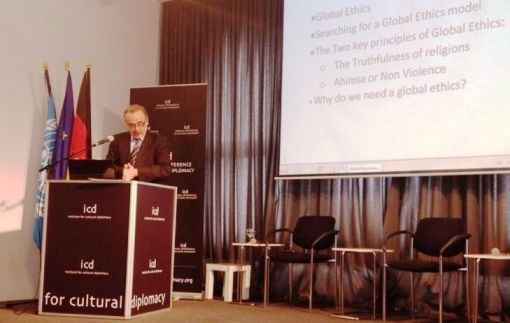
The founder of EENI, Pedro Nonell imparting the conference on “Cultural Diplomacy, International Business and Global Ethics” - The World's Religions as sources of Global Ethics at the Institute for Cultural Diplomacy (Berlin - Germany).
(c) EENI Global Business School (1995-2025)
Top of this page
