
Buddhism, Ethics and Business (Online Course)






 WhatsApp
Buddhist Economic Area (Course) Four Noble Truths. Mahayana (5 ECTS)
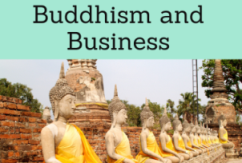
Buddhism, with 520 million followers (the world's fourth-largest religion), influences businesses in East Asia (Thailand, Sri Lanka, Japan, etc.) through its values of mindfulness and sustainability.
“This is the sum of duty: do not do to others what would cause pain if done to you” (Udana).

Discover the causes of pain and illness, and how to overcome it will be one of the “leitmotivs” of teachings of Buddha.
“Whether the world is eternal or not, finite or not, whether the soul is the same as the body or whether the soul is one thing and the body another, whether a Buddha exists after death or does not exist after death; these things the Lord does not explain to me.
So what have I explained?
I have explained the suffering, its causes and how to destroy it, that is what matters.”
Quoted in Huston Smith “World's Religions.”
Why study the course “Buddhism and Business”?.
This Professional Course is aimed mainly at those enterprises and Foreign Trade professionals who wish to do business in countries of Buddhist Economic Area, markets where the influence of Buddhism is fundamental.
In general, the knowledge of Buddhism and its influence on business is very unknown, being necessary therefore to know the pillars of Buddhism.

Religions and Global Business -
Religious diversity
The Course “Buddhism, Ethics and Business” offered by EENI Global Business School consists of two modules:
- Buddhism and Business
- Buddhist Economic Area
 Enrol / Request for Information

- Credits: 5

- Duration: five weeks It is recommended to dedicate about twelve hours of study per week following a flexible schedule. It is possible to reduce the duration dedicating more hours a week
- Tuition Fees: EUR 120
- Open Online Enrollment
- Why study Religions and Business?
- Download the syllabus: “Buddhism” (PDF)
- “Buddhist Economic Area” (PDF)
Languages: 
- Also available in For improving international communication skills, student has free access to the learning materials in these languages (free multilingual training).
 Budismo
  Bouddhisme
  Budismo
This course belongs to the following Higher Education Programs offered by EENI:
Doctorate: Global Ethics, Religions, and International Business, World Trade.

Masters: International Business, Religions and International Business.



This course contains exercises that are evaluated, which the student must work out and pass to obtain the Diploma of the Professional Course: “Buddhism, Ethics and Business” granted by EENI Global Business School.
Students who have taken this subject (Buddhism) can validate and register for a Master or Doctorate at EENI.
“One in whom there is neither hypocrisy nor pride, which has overcome greed, which is free from selfishness and desire, which is free of anger, completely serene; he is a Brahmin” Udana III-VI.
Modules of the Course
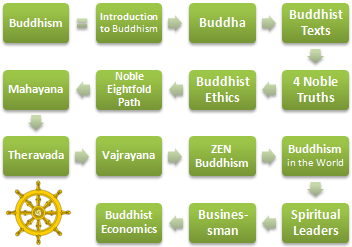
Module 1: Buddhism and Business:
- Introduction to Buddhism
- Siddhartha Gautama (Buddha)
- Buddhist sacred texts. Udama
- Teachings of Buddha (Bhagavan)
- Four Noble Truths
- Principles of Buddhist ethics
- Buddhist version of the golden rule
- Noble Eightfold Path
- Buddhist Schools
- Mahayana
- Theravada
- Vajrayana
- Zen Buddhism
- Pure Land Buddhism
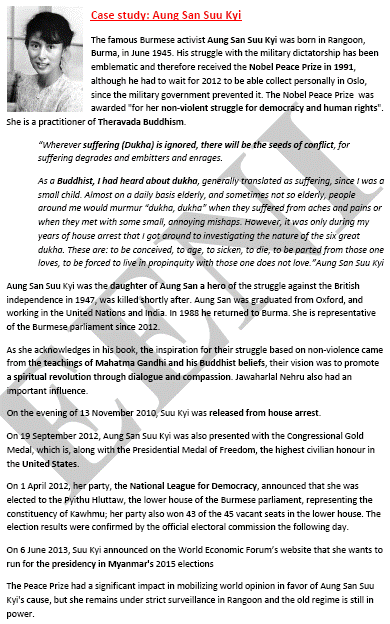
- Two Buddhist Nobel Peace Prize:
- His Holiness Dalai Lama
- Aung San Suu Kyi
- Prominent Buddhist: Chin Kung, DT Suzuki, Bhimrao Ramji, Ambedkar Babasaheb, Mapanna Mallikarjun Kharge, Daisaku Ikeda, and Jebtsundamba Khutuktu
- Principles of Buddhist Economics
- Buddhism in the World
- Influence of Buddhism in the West
- Steve Jobs (Apple)
- William Clay Ford
Buddhism, Ethics and Business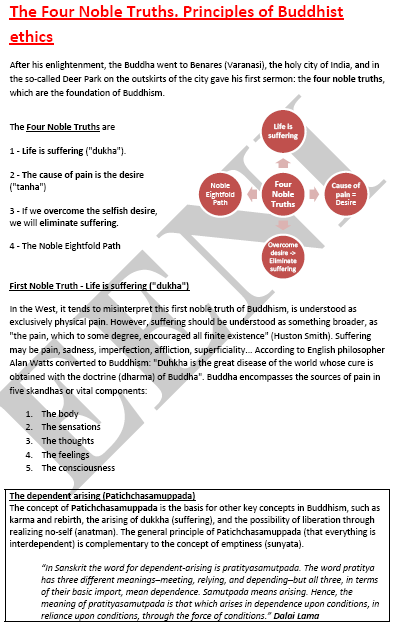
Buddhist Businessman.
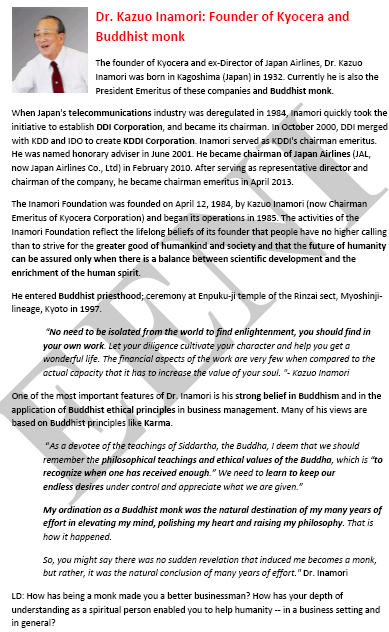
- Kazuo Inamori (Japan). Founder and Director of Japan Airlines, and a Buddhist Monk
- Kith Meng (Cambodia)
- Thaksin Shinawatra (Thailand)
- Padma Jyoti (Nepal)
- Lee Kun-hee (South Korea), President of Samsung Electronics (Won Buddhist)
Module 2- Buddhist Economic Area
- Introduction to Buddhist Economic Area
- Economic Profile of Buddhist Countries
- Economic Organizations related to Buddhist Civilization
- Economic integration process of Buddhist Civilization
- Interactions of Buddhist Civilization with other civilizations
Sample:
- To learn about fundamentals of Buddhism
- To understand the ethical principles of Buddhism
- To learn about Buddhist Schools: Mahayana, Theravada, and Vajrayana. ZEN Buddhism
- To analyze the influence of Buddhism on business
- To analyze Buddhists Businessman
- To understand the influence of Buddhism on Buddhist Civilization
- To explore the economic relationships of Buddhist Civilization with other civilizations
- To now the countries of influence of Buddhist Civilization
“I refuge in the Buddha, Dharma (doctrine) and Sangha (monastic community)”
Buddhism was born in the 6th-century BCE, with the appearance of Buddha, Siddhartha Gautama, one of the great spiritual geniuses of humanity, in north western India. It was the time of Vedic religion, controlled by the caste of Brahmins, where the sacrifice was a common practice.
Salvation was only possible for Brahmins; lower castes believed they were immersed in an endless cycle of births and resurrections.
This axial age (Karl Jaspers) is also the time of Confucius, Lao Tzu, Deutero-Isaiah or Mahavira (founder of Jainism).
Buddha teaches a message of liberation (“Be lamps unto yourselves”), for all men and women, a society in which the castes should not exist. Buddha addressed mainly to people, to all men and women regardless of race, gender or caste.
Buddhism grew until the third century BCE when the great Emperor Ashoka, proclaimed Buddhism as the official religion of the first Indian empire. Buddhism will experience a golden age in India until the 7th century AD, to almost disappear from India in the 13th century.
At the end of the 20th century, Buddhism begins to re-emerge in India, although the number of followers is slight compared to other Indian Religions.
Like Christianity, Buddhism began with a man, expanded under the leadership of a great empire (the Roman Empire with Christianity) and practically disappeared from his birthplace. From early times Buddhism begins to spread throughout Asia.
In China, Buddhism will adopt elements of Confucianism and Taoism to create Chinese and Zen Buddhism.

One of the problems of Buddhism, like Christianity, is to know how the original Buddhism was. Today, exists two Buddhist canons:
- Pali Canon (Tipitaka) - Theravada school. The Udana or “The Word of Buddha” (Pronouncement or Statement) belongs to the Sutta Pitaka. The Udana is one of the oldest texts of the Pali canon; Theravada Buddhists believe that conveys the true teaching of Buddha. It consists of eight chapters and ten sutras (sections) each one. Udana is one of the key works to understand Buddhism. We will base this essay mainly in the analysis of the Udana
- Chinese Canon
- Nepalese Canon (Sino-Tibetan Sanskrit) - Mahayana school
In Udana IX (Bahiya) we find the definition of Nirvana (instant enlightenment). Nirvana is an entirely transcendental state; when we reached, finished reincarnation and suffering
Notes:
- The analysis of China is not included in this course, but in the course: Taoism, Confucianism & Business
- Although Buddhism emerged in India, it is now practiced by only 0.8% of the Indian population
- Countries like Korea or Singapore, Buddhism is not the majority religion coexisting with other religions
(c) EENI Global Business School (1995-2025)
Top of this page
