
Taoism, Business, Taoist Ethics, Laozi






 WhatsApp
Taoists Ethical Principles. Tao Te Ching. Non-action (Taoism)
Taoism, Confucianism & Business
Taoism, based on the teachings of Laozi (6th century BC), focuses on harmony with the Tao (the universal path or principle), simplicity, adaptability, and balance. Although less structured than Confucianism, Taoism offers valuable insights for business management in a dynamic world.
“With more rules and regulations, more people will impoverish” Tao LVII
Companies like Haier have adopted a management model inspired by Taoism, with decentralized organizational structures (such as internal “micro-enterprises") that encourage innovation and adaptability in global markets. Comparison and complementarity
- Introduction to Taoism
- Laozi
- Taoist principles
- Tao Te Ching
- Tao (Sense) and Te (Virtue)
- Yin Yang
- Principle of Non-Action (Wu Wei)
- Non-Violence
- Principles of Taoist Ethics
- Taoism today
- Famous Taoist
- Government and Taoism
- Cases of enterprises with Taoist influence. Chang Yung-fa (I Kuan Tao)
Sample - Taoism, Ethics and Business
The educational aims of the Subject “Taoism, Ethics and Business” are the following:
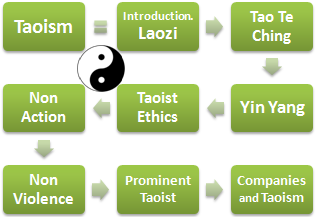
- To learn about fundamentals of Taoism
- To understand Taoist Ethical Principles
- To learn about the influence of Taoism on business
- To analyze cases of enterprises with Taoist influence
“My teaching is similar to other... The strong do not die of natural causes; this will be the starting point of my doctrine” TAO XLII.

Religions and Global Business -
Religious diversity

Learning materials (Taoism):  or
or  Taoísmo
  Taoisme.
- Credits “Taoism and Confucianism”: 3

- Download the syllabus “Taoism and Confucianism” (PDF)
The Subject “Taoism, Ethics and Business” is included within the curriculum of the following academic programs at EENI Global Business School:
Masters: International Business, Religions and Business.

Doctorate: Global Ethics, Religions, and International Business, World Trade.


Despite the difficulty of obtaining reliable data on Taoism in China; about 50 million people, mostly Chinese, practice Taoism, a religion (or philosophy) founded by Laozi (the Old Master) perhaps born in 604 BCE and who is credited with the key work of Taoism: The “Tao Te Ching” or “The Book of Reason and Virtue,” one of the shorter books of all religions with only 5000 words.
“The Sage focuses on non-action in his works, practices not saying in his speech
The myriad things arise but are disregarded
The sage produces but does not own
Acts but does not claim
Accomplishes work but does not focus on it
Does not focus on it, and thus it does not go.” Tao II
The “Tao Te Ching” is a book tough to interpret. Of all Asian religions, this is perhaps the most difficult to explain and understand for a Westerner:
“The Tao Te Ching can be read in an afternoon or a whole life.” Houston Smith.
Like Jesus, Buddha, or Confucius, Laozi would not establish any religion. Even though the time has been revered as a God or a Taoist church has emerged.
For Taoists, order and harmony of the universe are manifestations of Tao. For Laozi there are no human words to define Tao.
Tao is the cause of everything, its origin, and its end. If people follow Tao, the harmony reigns; if they do not follow it is the chaos. For Laozi, nothing is haphazard. If Confucius treated the Heaven to God, Laozi went one step further. Unlike the Christian concept of God as the Creator of the universe, the Tao has never been created, has always existed.
Like other Asian religions, the Tao speaks of the “total absence of desire” as the path to follow.
The man should not try to modify the Tao; he must let it flow.
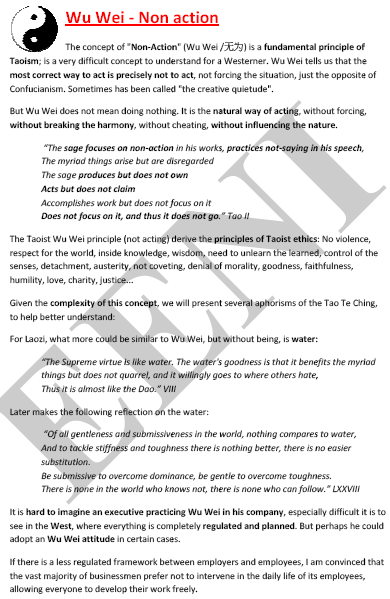
The concept of “Non-Action” (Wu Wei /无为) is a fundamental principle of Taoism; is a tough concept to understand for a Westerner. Wu Wei tells us that a correct way to act is precisely not to act, not forcing the situation, just the opposite of Confucianism. Sometimes, has been called “the creative quietude.”
Yin and Yang are manifested in any being or object, even in thought. In all the Tao; we will find constant references to the dual concept of Yin and Yang.
Taoism promotes a balance between yin and yang, which is applied to business management in the pursuit of a balance between economic profit and sustainability. Companies inspired by Taoism typically avoid excessive growth or the overexploitation of resources.
Globally, this approach resonates with the growing importance of the circular economy and sustainability, as seen in companies prioritizing environmentally friendly business models.
Taoism values simplicity, which can translate into more efficient business processes and products or services focused on real customer needs.
Global companies like Xiaomi apply this principle by offering high-quality technology products at affordable prices, eliminating unnecessary features.
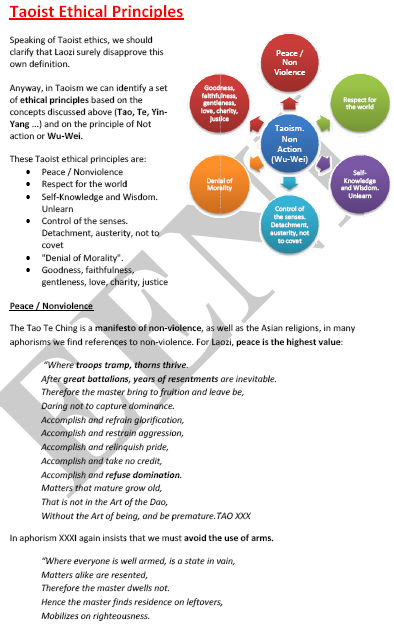


Confucianism and Taoism, Yin and Yang, classicism and romanticism, responsibility and freedom, the two poles of the Chinese society, one would not exist without the other.
These two wisdom traditions, along with Buddhism and Shamanism are part of the spiritual heritage of Sinic Civilization throughout its area of influence: China, Korea, Japan, Vietnam, Singapore, Hong Kong, and Taiwan.
(c) EENI Global Business School (1995-2025)
Top of this page
