
Confucianism: Ethics and Business. Analects








 WhatsApp
Confucian Ethics. Ritual. Business and Confucianism (China, Japan)
Taoism, Confucianism & Business
Confucianism, developed by Confucius (551–479 BC), emphasizes ethics, morality, social order, and hierarchical relationships. Its principles have shaped business culture in countries such as China, Japan, South Korea, and Singapore, and have practical applications in modern management.
“Do not do unto others what you do not want others to do unto you” - Confucianism Golden Rule.

Companies like Alibaba and Huawei reflect Confucian values in their focus on employee loyalty, building long-term relationships with global partners, and investing in local communities, which has allowed them to successfully expand into international markets.
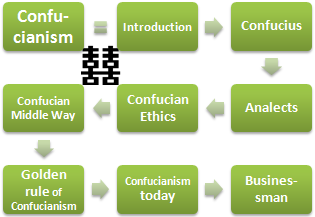
- Introduction to Confucianism
- Confucius
- Confucian books. Analects
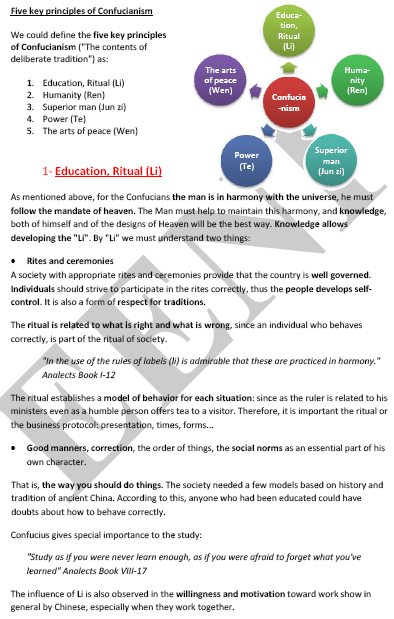
- Fundamentals of Confucianism
- Principles of Confucian Ethics
- The Confucian hierarchy
- Confucianism today
- Case Study: enterprises and Confucian values
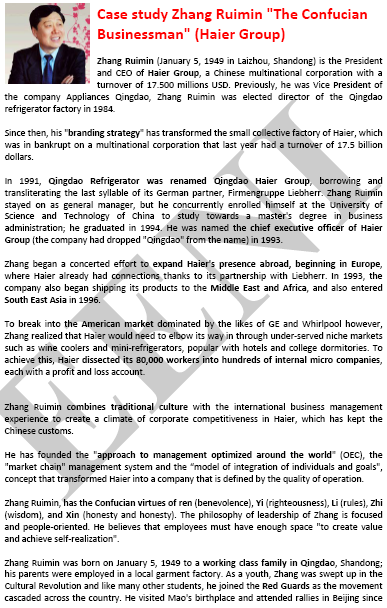
- Zhang Ruimin “The Confucian Businessman” (China)
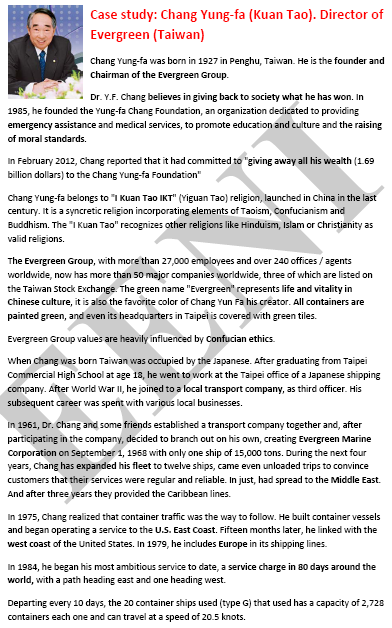
- Chang Yung-fa (I-Kuan Tao). Director Evergreen (Taiwan)
- GALANZ (China)
Sample - Confucianism, Ethics and Business

Religions and Global Business -
Religious diversity
The educational aims of the Subject “Confucianism, Ethics and Business” are the following:
- Le analyze the fundamentals of Confucianism
- To understand Confucian ethical principles
- To learn about the influence of Confucianism on business
- To analyze Confucian Businessman

The Subject “Confucianism, Ethics and Business” is included within the curriculum of the following academic programs at EENI Global Business School:
Masters: International Business, Religions and Business.

Doctorate: Global Ethics, Religions, and International Business, World Trade.

Learning materials (Confucianism):  or
or  Confucianismo
  Confucianisme.
- Credits of the module “Taoism and Confucianism”: 3

- Download the syllabus: “Taoism and Confucianism” (PDF)
Area of Knowledge: Asia.


Kongzi, also called Kung-tse, to which Jesuits put the name of Confucius, was born in 551 BCE in Kufow, in the State of Lu and died in 479 BCE at the age of 73. He was also known as the Wise or Master Kung (Kung-Fu-Tsu). Confucius was a contemporary to Laozi, Buddha, Deutero-Isaiah, Pythagoras, and Mahavira.
The time of Confucius was the so-called the Age of Warring States (5th century to the 3rd century BCE) of Chou dynasty (1122 - 256 CE) a ruined society, pigeon-holed in a feudal caste system and fragmented into small States in continuous war among themselves. Death and destruction were the usual scenarios of ordinary people; the society needed a new model. At this time came the so-called a “hundred schools” who advocated different philosophies, but only two have survived to the present day: Confucianism and Taoism.
It is important to note that Confucius did not wish to create a new religion; he was first and foremost a reformer; he admitted to being an ordinary man. He wanted politically renew society, where men pursue maximum happiness. Confucius believed in Heaven (Tsien) as something mysterious and impersonal acting in the world. He believed in gods and spirits of the land.
The Analects (Lun Yu, or “Sayings of Confucius” or “Philosophical Comments”) is the largest source of Confucian thought, in the form of dialogues summarizes the essence of the doctrine of Confucius.
Confucius was primarily a creator of a social system based on tradition that has influenced the entire area of Sinic Civilization: China, Korea, Japan, Vietnam, Singapore, Hong Kong, and Taiwan for over 2,500 years. Confucianism has significantly influenced on the society in different spheres: political, economic, social, and cultural, as well as the mentality and the way of life of all Chinese, even some foreign scholars consider as the largest religion in China.
Confucianism objectives to help the development of human beings, does not seek salvation as in other faiths, but seeks order, wisdom, and knowledge.
- Yoga of the Threefold Faith of the Bhagavad Gita
- Faith-based Marketing
Although religion of Chinese communist regime is officially atheist and the Constitution guarantees freedom of religion, Chinese people practice different faiths (Confucianism, Taoism, Buddhism, Islam, Shamanism). However, Confucianism, despite not being a formal religion in China; it is intensively practiced in China and has influences on a very outstanding way in their culture and the form of negotiation of Chinese people.
Like any other religion that has had to live in a totalitarian state, Confucianism has always survived, and today is latent in Chinese society. During the strongest period of communism in China was banned, but, as discussed below, its influence is latent on China today.
The influence of Confucianism on countries of Sinic Civilization influence is somehow equivalent to the influence of the Greek philosophy and Christianity on the West.
Confucianism has significant influence in Leo Tolstoy.
(c) EENI Global Business School (1995-2025)
Top of this page
