
Jainism and Business. Ahimsa, India








 WhatsApp
Ethical Principles of Jains (Jain Dharma). Non-Violence Ahimsa
Jainism, one of the oldest religions originating in India, has very clear ethical principles that can offer an interesting framework for business management in a global context. Although it is not cited as much as Hinduism or Buddhism in international business, its influence is present, especially in Jain communities with a strong mercantile and business tradition.
“Any living organism deserves our respect.”

In 2013 UNESCO declared Jain scriptures “SHANTINATHA CHARITHRA” as interest and value for humanity, for their contributions to Peace, Non-Violence, and brotherhood.

Religions and Global Business -
Religious diversity
Jainism, with its emphasis on nonviolence, sustainability, honesty, and diversity, provides a valuable ethical model for global business. It can be especially relevant in discussions of business ethics, fair trade, sustainability, and intercultural management.
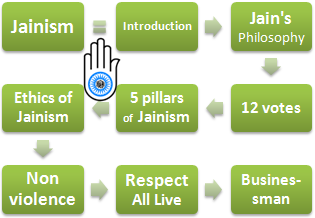
The Subject “Jainism, Ethics and Business” consist of two parts:
- Introduction to Jainism (Jain Dharma)
- Jain Businesspeople
1- Jainism
- Introduction to Jainism
- The figure of Mahavira
- Jain Schools:
- Svetambaras
- Digambaras
- Doctrines of Jainism
- Jain Scriptures “SHANTINATHA CHARITHRA”
- Fundamentals of Jainism philosophy (“Tattva”)
- Twelve Votes of Jainism
- The Five pillars of Jainism
- Ethical Principles of Jainism
- Jainism and Non-Violence (Ahimsa)
- Respect for all life
- Relationships between Jainism and Hinduism
- Influence of Jainism on the Hindu Economic Area
- Jainism and business
2- Jain Businesspeople.
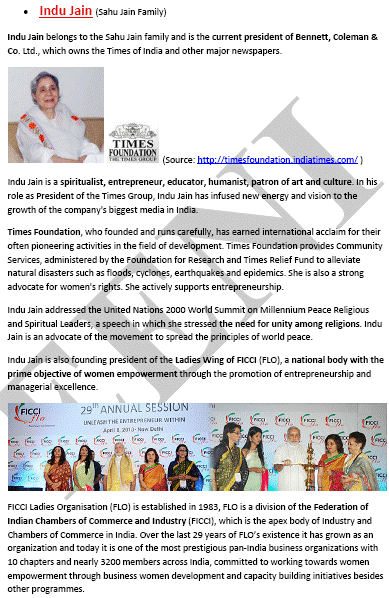
- Jain family Sahu Jain
- Gautam Adani
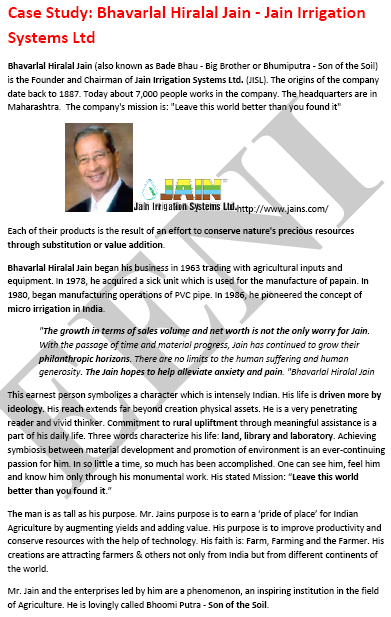
- Bhavarlal Jain
- Ajit Gulabchand
- Anand Jain
- Other Jain Businessman
Jainism, Ethics and Business
The educational aims of the Subject “Jainism, Ethics and Business” are the following:
- To learn about fundamentals of Jainism
- To understand the ethical principles of Jainism
- To learn about the influence of Jainism on business
- To analyze prominent Jain Businesspeople
- To understand the influence of Jainism on Hindu Civilization

The Subject “Jainism, Ethics and Business” is included within the curriculum of the following academic programs at EENI Global Business School:
Doctorate: Global Ethics, Religions, and International Business, World Trade.

Masters: International Business, Religions and Business.

Languages:  (or
(or  Jainismo
  Jainisme
  Jainismo).
- Subject Credits “Indian Religions - Jainism”: 4

- Duration: 4 weeks
- Download the syllabus: “Indian Religions” (PDF)

Jainism (Jain Dharma) is a religion born in India in the 6th-century BCE. In Vaishali (Bihar) as a heresy to Brahmanism. The creator of Jainism was Mahavira (549-477 BCE), a contemporary of Buddha, Confucius, and Lao-tzu. Jain people believe that Mahavira (the Great Hero) was the last one of the twenty-four holy men (Jina, winners) who lived before him.
Mahavira's teachings focus on releasing the soul (Jina) of material and guide it towards a divine consciousness and liberation (Moksha). Jain believes that the man is the absolute owner of his destiny.
For Jainist people, the whole universe is alive and therefore has a soul. The Stones, animals, clouds, or the sun are part of the universe, and therefore must be respected.
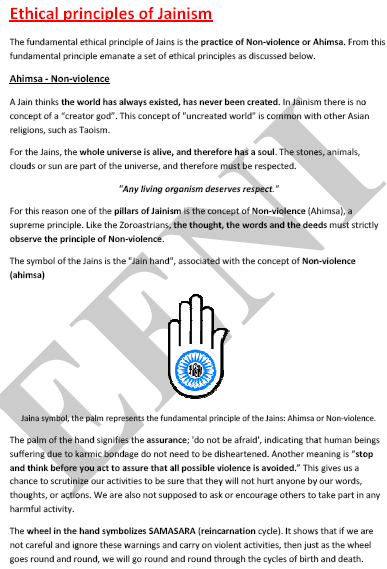
For this reason, one of the pillars of Jainism is the concept of Non-Violence (Ahimsa), a supreme principle. Like Zoroastrians, thoughts, words, and deeds must strictly observe the principle of Non-Violence.
Jain Society is very active in protecting its core values, particularly on Ahimsa:
Influence of Jainism on the Constitution of India: “Constitution does not permit any citizen to claim that it is his fundamental right to take life and kill animals.”
By practising Non-Violence, historically has led Jain people to dedicate more to business and trade than agriculture (they think that tilling a field can kill many insects) and livestock. Therefore, they tend to have a much higher education than the average of Indian people. Jain people are extremely dynamics in all aspects of business.
Prominent Jainist has participated in the construction of India since the independence.
The Jain community is strongly organized in charities Organizations that support cultural and educational initiatives and is also somewhat like a “business lobbies.”
Jainism became the official religion in many states of India, but its decline has been outstanding, especially after the Muslim invasion. Approximately there are between 5 and 6 million Jains in India especially in the states of Bengal, Rajasthan, Maharashtra, Gujarat, and Karnataka.
Despite its small number of followers, its influence on politics, economy, and culture of India is crucial.
Core principles of Jainism applied to business
- Ahimsa (non-violence):
- At the business level, this means avoiding harm to employees, customers, suppliers, animals, and the environment.
- It is reflected in sustainable business practices, corporate social responsibility (CSR) and environmental ethics.
- Aparigraha (non-possessiveness, detachment):
- In the company, this translates into avoiding excessive accumulation and promoting responsible consumption.
- It promotes transparency, profit moderation, and fair distribution of wealth.
- Satya (truthfulness):
- Commitment to honesty in contracts, negotiations, and corporate communications.
- Asteya (do not steal):
- Respect for intellectual property, compliance with regulations, and rejection of corruption.
- Anekantavada (plurality of points of view):
- In global business, it means cultural tolerance, Cross-Cultural Management, and diversity in decision-making.
Jainism
- Religion: Jainism (Jaina Dharma)
- Mahavira (549-477 BCE)
- God: Tirthankaras
- Date: 6th-century BCE
- Holy City: Valabhipura, Sravana Belgola (Karnataka)
- Sacred texts: “Upanga and Anga,” “Prakimata,” “Mulasutra”
- Country: India
- Major schools
- Svetambaras, the “white dresses”
- Digambaras, the “naked”
Jain Symbol Ahimsa = Non-Violence.

Other Jain Businessman:
- Anand Jain (1957) President of Jai Corp Limited
- Lalchand Hirachand Doshi (1904-1993) Businessman (Walchandnagar Industries), philanthropist, and Jain social leader
- Sir Seth Hukum Chand Jain (Indore 1874-1959) businessperson and Jain leader
- Vinay Maloo (1961) is the founder and President of Enso Group
- Motilal Oswal, President and General Director of Motilal Oswal Financial Services
- Narendra Patni (1943), Founder and President of Patni Computer Systems (Igate)
- Anshuman Jain (1963) Co-Managing Director (CEO) of Deutsche Bank
- Naveen K. Jain (1959) founder of InfoSpace, Intelius and Luna Express


(c) EENI Global Business School (1995-2025)
Top of this page
