
Sikhism: Business and Ethics (Sikhs) India








 WhatsApp
Ethical Principles of Sikhs. Articles of faith. Five K

“See the brotherhood of all humanity as the highest order of Yogis” Guru Nanak
Sikhism, although a minority religion globally (around 25–30 million followers, concentrated mainly in Punjab, India, and in diaspora communities in the UK, Canada and the US), has relevant implications in the global business context.
“There is neither Hindu nor Muslim, but the only man. So whose path
shall I follow?
I shall follow the path of God. God is neither Hindu nor Muslim, and the path that I follow is the path of God” Guru Nanak
In India and diaspora communities, Sikh values of service influence companies like the Punjab National Bank, which prioritize community lending. Policies favoring the wearing of turbans at companies like Deloitte in Canada are attractive to Sikh employees.
Sikhism provides a solid ethical framework for the global business world, emphasizing honesty, service, and fairness, while its cultural and religious expressions pose challenges and opportunities for managing diversity in international settings.
- Introduction to Sikhism (Sikh Dharam)
- Guru Nanak
- Ethical Principles of Sikhs
- Moral Rectitude and Honesty of Sikhs
- Articles of Faith (Five K) of Sikhism
- Relationships of Sikhism with Hinduism and Islam
- Sikh Religion Today
- Sikhs Businessman
- Case Study: Manmohan Singh (former Prime Minister of India)
- Influence of Sikhism on the Hindu Economic Area
Sample - Sikhism, Ethics and Business

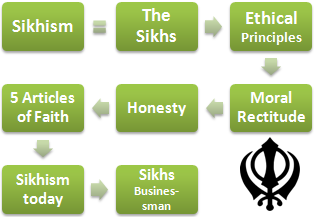
The educational aims of the Subject “Sikhism, Ethics and Business” are the following:
- To learn about fundamentals of Sikhism
- To understand the Ethical Principles of Sikhs
- To learn about the influence of Sikhism on business
- To analyze prominent Sikhs Businessman
- To understand the influence of Sikhism on Hindu Civilization

Religions and Global Business -
Religious diversity

The Subject “Sikhism, Ethics and Business” is included within the curriculum of the following academic programs at EENI Global Business School:
Doctorate: Global Ethics, Religions, and International Business, World Trade.

Masters: Religions and International Business, International Business.

Bhagavad Gita Courses, Realization of the Gita

Languages:  or
or  Sijismo
  Sikhisme
  Siquismo.
- Subject Credits “Indian Religions - Sikhism”: 4

- Duration: 4 weeks
- Download the syllabus: “Indian Religions” (PDF)


Sikhism, or Sikh Dharam, is a religion founded by Guru Nanak between the XVI and XVII centuries in India, in the actual state of Punjab, when Islam dominated the region, and the clash between Islam and Hinduism was common. Sikhism is a syncretic religion with Hinduism and Islam values.
Guru Nanak is revered today by the vast majority of Indian Muslims and Hindus.
With more than 25 million followers worldwide, Sikhism is one of the World's great religions. While the number of followers is small compared to other faiths such as Christianity, Islam, or Hinduism, its involvement in International Business, politics, science, and culture is crucial.
Perhaps the most significant fact of Sikh influence is that the former Prime Minister of India is Sikh because Sikhism is respected by Hindus and by Muslims.
- There are prominent Sikhs Executives and Businessman in several countries (the United States, India, Canada, Hong Kong, Kenya, or Singapore), almost all of them dedicate significant resources to philanthropy
- Sikhs Executives are also working in banking or in financial groups like Rothschild
- The inventor of the optical fiber is Sikh
Sikhs believe in:
- Equality of Humanity
- Universal Brotherhood
- One Supreme God
- Reincarnation (like Hinduism)
- Ten Gurus, from Guru Nanak Dev to Guru Gobind Singh
Sikhs have a solid ethical principles, proof of this is that major multinationals have hired senior managers and directors to Sikhs. The high moral rectitude and honesty tend to be a feature of Sikhs in business. The “Rehat Maryada” is Sikh code of conduct.
We could define the following ethical principles of Sikhs:
- Equality of humanity. Equality between men and women
- Moral righteousness. Self-restraint of passions and desires
- Do not Steal
- Honesty
- Philanthropy - Social Justice. 10% of its profits must be donated to charity
- Justice. Always defend the weak and oppressed (kirpan or sword)
- Truthfulness
The word “guru” in the jargon Sikh means “an illuminator and a prophet.” The Ten Gurus founded Sikhism. The first, Guru Nanak (1469-1539), rejected ritual practices of dominant religions in South Asia and based his message strictly on the divine revelation.
The tradition tells us that Guru Nanak travelled throughout India, Persia, the Arabian Peninsula to Mecca. On these trips made speeches addressed to any believer either Muslim, Jain, Zoroastrian, Hinduism or Buddhist.
The message was simple and focused on the critique of religious ritual, caste, or suicide of widows. His message was not proselytizing, rather the opposite, inviting “Muslims to be good and true Muslims” and “Hindus to be good and true Hindus.”
Values of Sikhism applied to business
- Honesty and transparency (Kirat Karni): working ethically, without exploitation or fraud. This influences business practices based on trust and reputation.
- Sharing the Wealth (Vand Chakna): Corporate social responsibility and philanthropy are core principles; many Sikh-led companies support community initiatives.
- Selfless Service (Seva): fosters service-based leadership, which can translate into inclusive and collaborative management.
- Equality and Non-Discrimination: Sikhism rejects caste and social hierarchies, promoting gender equality and inclusion in the workplace.
Sample - Sikhs Businessman

Some Sikhs Businessman.
Many Sikhs have developed successful businesses in trade, transportation, agriculture, and distribution.
- Ajaypal Singh Banga, President and Executive Director of MasterCard
- Sant Singh, President and Managing Director (CEO) of Hampshire Hotels & Resort
- Hardeep Singh, founder of Tulip Telecom and philanthropist
- Malvinder and Shivinder Singh founders of Fortis Healthcare
- PhD Jogishwar Singh Director of Rothschild Group
- Dharam Singh Deol (Punjab, 1935), Dharmendra, Indian actor
Diaspora Networks: The Sikh community in Canada, the UK, and the US exerts influence in sectors such as logistics, technology, construction, and financial services.
Khanda: Symbol of Sikhism

Sikhism
- Religion: Sikhism (Sikh Dharam)
- God: Ik Onkar
- Date: XVI and XVII centuries
- Holy City: Amritsar
- Sikh highest authority: Jathedar Singh Sahib Giani Gurbachan Singh (Amritsar, Punjab, India)
- Sacred Text: “Guru Granth Sahib” or “Sacred Wisdom Collection”
- Country of origin: India
- Followers: 25 million
- Main countries: India, also in the United States, the UK, and Canada
(c) EENI Global Business School (1995-2025)
Top of this page
