Business in Brunei Darussalam. Bruneian Economy


Bruneian Foreign Trade. Business in Bandar Seri Begawan (Brunei). Gas
- Introduction to the State of Brunei Darussalam (Southeast Asia)
- Bruneian Economy
- Petrol and gas resources of Brunei
- Business in Bandar Seri Begawan
- Bruneian International Trade
- Investment in Brunei
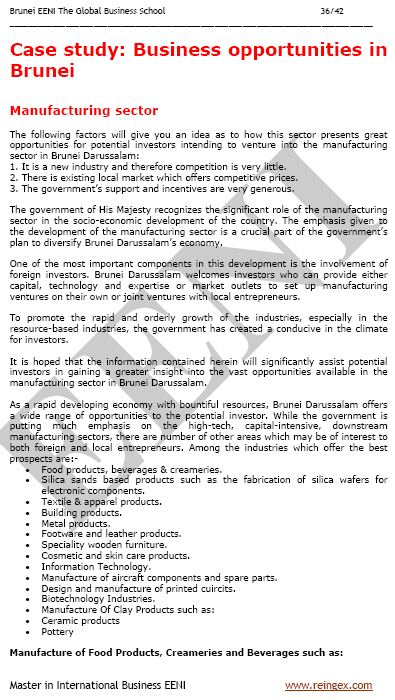
- Case Study: Business Opportunities in Brunei
- Access to the Bruneian Market
- Business Plan for Brunei
The objectives of the subject “International Trade and Business in the State of Brunei Darussalam” are the following:
- To analyze the Bruneian Economy and Global Trade
- To know the trade opportunities in Brunei Darussalam
- To explore Brunei Darussalam trade relations with the country of the student
- To know the Bruneian Trade Agreements
- To develop a business plan for the Bruneian Market

The Subject “Foreign Trade and Business in Brunei” belongs to the following Online Programs taught by EENI Global Business School:
Doctorate: Islamic Business, World Trade.

Masters: International Business, Foreign Trade.
 Higher Education programs adapted to the Bruneian Students.
 or
or 

- Credits of the subject “Doing Business in Brunei”: 1

- Duration: one week
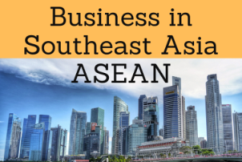
International Trade and Business in Brunei.
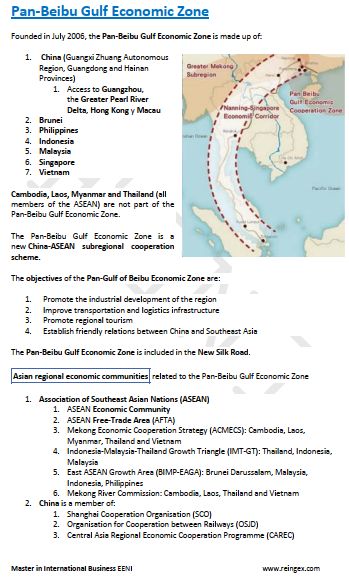
- Access to the East-West Corridor (Myanmar-Vietnam)
- Access to the Nanning-Singapore Corridor
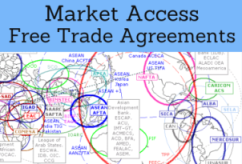
- ASEAN
- ASEAN Free-Trade Area
- ASEAN Economic Community
- East ASEAN Growth Area
- Brunei (as an ASEAN member), has Trade Agreements with Australia-New Zealand, Canada, China, India, the EU, Japan, Korea, Russia, the U.S., Pakistan, Chile
- Agreement for Trans-Pacific Partnership
- Regional Comprehensive Economic Association
- APEC
- Brunei-Japan Agreement
- EU-Brunei Partnership and Cooperation Agreement (negotiation)
- Trade Preferential System (TPS-OIC)
- Islamic Centre for Development of Trade
- WTO
- GATS
- Agreement on Sanitary Measures
- Agreement on Technical Barriers to Trade
- Agreement on Preshipment Inspection
- Agreement on Safeguards
- Trade Facilitation Agreement
- WCO
- BIC
- Chicago Convention (ICAO)
- International Maritime Organization
- Islamic Development Bank
- OIC
- Asia-Middle East Dialogue
- Boao Forum for Asia
- Asia Cooperation Dialogue
- ESCAP
- Asian Development Bank
- Colombo Plan
- Africa-Asia Strategic Partnership
- FEALAC
- UN
- WB
- WTO
- PEEC
- IMF
The State of Brunei Darussalam is advantageously situated in the South-Eastern region of Asia.
- Brunei shares borders with Indonesia and Malaysia
- The capital of Brunei is Bandar Seri Begawan
- Official language of Brunei Darussalam: Malay. English is a recognized language in Brunei
- Bruneian Population: 415,717 people
- 66% of the Bruneian are Malays (11% are Chinese)
- Type of Government: Unitary Islamic Absolute Monarchy
- Sultan: Hassanal Bolkiah
- Independence from the UK: 1984
- Area of Brunei Darussalam: 5,765 km²
Religion in Brunei Darussalam
- 66% of the population are Muslim (Sunni)
- Islam is the official religion of the State of Brunei
- The judiciary system of Brunei Darussalam is based on the English Common Law
- For Muslims, the Islamic Sharia Law substitutes civil laws
- Fiqh (Islamic Jurisprudence): Shafi
- Other religions in Brunei: Buddhism (13%) and Christianity (10%)
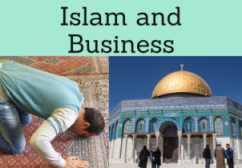
Brunei Darussalam is a member of the Islamic Civilization.
Bruneian Economy.
- Protected by the political stability of the longest serving family monarchy in the World, and the financial security of its petrol and gas resources, Brunei Darussalam is as “green oasis at the heart of Asia.”
- Brunei is a small nation with a large potential
- The State of Brunei ranks in the first position in the Islamic world (Human Development Index)
- The Bruneian people benefit from a high quality of life (USD 31,000 per capita revenue), the second largest in the ASEAN Region
- The Economy of the State of Brunei has been dominated by the petrol and gas industry for the past eighty years
- Brunei has no central Bank and operates a currency board system with the Brunei Dollar (B$) being pegged to the Singapore Dollar, enabling both currencies to be legally interchangeable in Brunei Darussalam and Singapore
- Currency: Brunei dollar (BND)
International Trade of Brunei Darussalam.
- Hydrocarbon resources account for 90% of its export and 50% of the GDP of Brunei
- Brunei is the fourth largest petrol manufacturer in Southeast Asia and the ninth largest liquefied natural gas exporter in the World
- Petrol and natural gas account for nearly all Bruneian exports
- Top import partners of Brunei Darussalam are the ASEAN countries (Indonesia, Malaysia, the Philippines, Singapore, Thailand, Vietnam, Laos, Myanmar, and Cambodia), the U.S., the EU, Japan, and China
Global Trade and Business in the State of Brunei Darussalam:
(c) EENI Global Business School (1995-2024)
We do not use cookies
Top of this page