
Trans-Pacific Partnership


Comprehensive and Progressive Agreement for Trans-Pacific Partnership (CPTPP)
- Introduction to the Comprehensive and Progressive Agreement for Trans-Pacific Partnership (CPTPP)
- Members: Australia, Brunei, Canada, Chile, Japan, Malaysia, Mexico, New Zealand, Peru, Singapore, and Vietnam
- Formerly: Trans-Pacific Partnership (TPP) Agreement
- Free trade in goods
- Rules of Origin of the Comprehensive and Progressive Agreement for Trans-Pacific Partnership
- Trade in Services
- Enlargement of the Comprehensive and Progressive Agreement for Trans-Pacific Partnership
- Regional Comprehensive Economic Association

The Subject “Comprehensive and Progressive Agreement for Trans-Pacific Partnership (CPTPP)” belongs to the following Online Programs taught by EENI Global Business School:
Masters: International Business, Foreign Trade.


Languages:  or
or  Acuerdo Transpacífico de Asociación Económica
  Accord stratégique transpacifique
  Acuerdo Transpacífico.
Comprehensive and Progressive Agreement for Trans-Pacific Partnership (CPTPP)
The Comprehensive and Progressive Agreement for Trans-Pacific Partnership (CPTPP) between Australia, Brunei, Canada, Chile, Japan, Malaysia, Mexico, New Zealand, Peru, Singapore, and Vietnam was signed in March 2018.
- Formerly: Trans-Pacific Partnership (TPP) Agreement
The Comprehensive and Progressive Agreement for Trans-Pacific Partnership (CPTPP) is one of the largest free-trade areas of the World by GDP.
- The CPTPP incorporates the provisions of the Trans-Pacific Partnership Agreement (TPP)
- The Comprehensive and Progressive Agreement for Trans-Pacific Partnership will exhaustively eliminate the tariffs between the CPTPP member economies
- All the CPTPP countries are APEC members
Enlargement of the Comprehensive and Progressive Agreement for Trans-Pacific Partnership (CPTPP):
- 2021: The United Kingdom, applied to join the Comprehensive and Progressive Agreement for Trans-Pacific Partnership (CPTPP)
- 2021: Taiwan
- Other candidate countries: China, Colombia, Indonesia, Philippines, South Korea, Thailand
Sample - Comprehensive and Progressive Agreement
for Trans-Pacific Partnership (CPTPP)
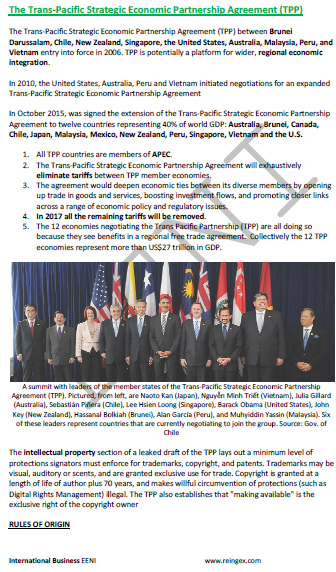
The Comprehensive and Progressive Agreement for Trans-Pacific Partnership consists of Muslim Countries (Malaysia and Brunei), Christians (Chile, New Zealand, the U.S., Australia, and Peru) and a Buddhist country: Vietnam.
The Comprehensive and Progressive Agreement for Trans-Pacific Partnership (CPTPP) is an inter-civilization agreement between the Western Civilization, Sinic - Buddhist, and the Islamic Civilization.
About the Trans-Pacific Partnership (TPP) Agreement - Not in force
- The Trans-Pacific Partnership (TPP) Agreement between Australia, Brunei, Chile, Malaysia, New Zealand, Peru, Singapore, the U.S., and Vietnam was signed in 2006
- The Trans-Pacific Partnership (TPP) Agreement - never entered into force
- In 2017, the United States withdrew the TPP
- Other name: Trans-Pacific Strategic Economic Partnership Agreement
- In 2010, the U.S., Australia, Peru, and Vietnam initiated negotiations for an expanded Comprehensive and Progressive Agreement for Trans-Pacific Partnership
Related subjects:
(c) EENI Global Business School (1995-2024)
We do not use cookies
Top of this page