
Islam in West Africa, Senegal, Nigeria






 WhatsApp
Islam: 54% of the West African Population (Sunni Muslims)
There are countries in the West African region in which Muslims are an almost absolute majority, while in others, are only a minority. In countries like Nigeria, the Northern states as in the Kano State, Sharia is applied; while in countries such as Togo or Ghana, Islam represents only 20% of the population.
1- Religious diversity in the region of ECOWAS: Islam and Christianity.
2- Case Study - Muslim Businesspeople in West Africa:
- Alhaji Aliko Dangote
- Amina Odidi
- Tunde Folawiyo
- Hajia Bola Shagaya
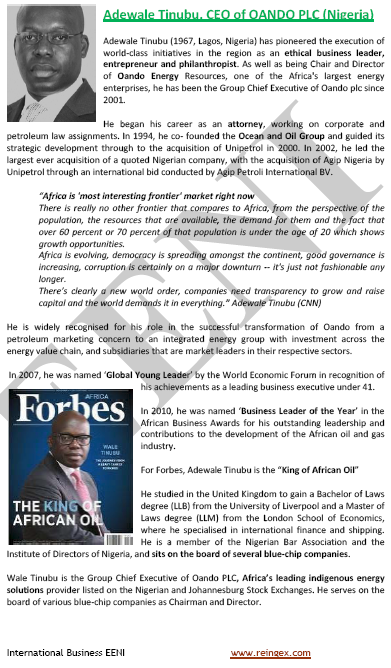
- Adewale Tinubu
- Alhaji Indimi
- Olufemi Otedola
- Abdulsamad Rabiu
3- Case Study - Christian Businesspeople in West Africa:
Sample: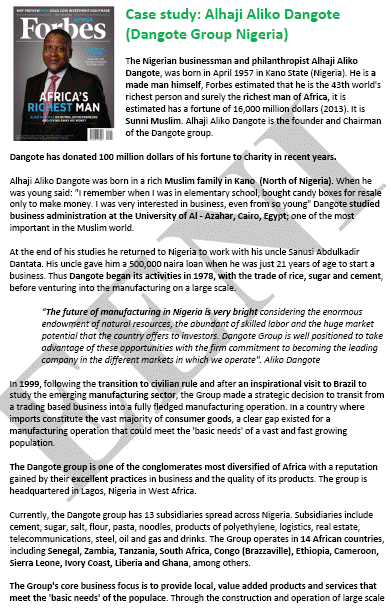

The Subject “Religious diversity in West Africa” is included within the curriculum of the following academic programs at EENI Global Business School:
Doctorate: Ethics, Religions & Business, African Business.

Masters: Religions & Business, Business in Africa.

Languages:  or
or  Islam en Afrique Ouest
  Islam en África.
religious diversity in West Africa.
The West African region (317 million inhabitants) consists of the following countries Benin, Burkina Faso, Cape Verde, Ivory Coast, the Gambia, Ghana, Guinea, Guinea-Bissau, Liberia, Mali, Niger, Nigeria, Senegal, Sierra Leone, and Togo.
There are two key economic institutions:
The Economic Community of West African States (ECOWAS) Member States cover an area of 1.5 million km², accounting for 17% of the total area of Africa.
The largest countries are Niger (24.8%) and Mali (24.3%), while the smallest country is Cape Verde (0.1%).
Islam in ECOWAS region (Africa)
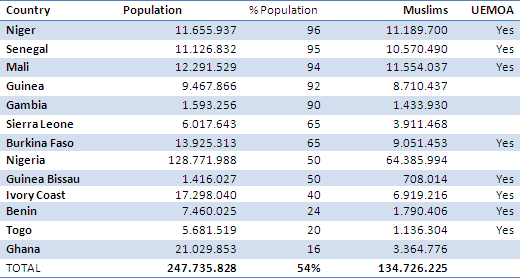
Muslim Population in West Africa (ECOWAS countries):
| Country Niger Senegal Mali Guinea The Gambia Sierra Leone Burkina Faso Nigeria Guinea-Bissau Ivory Coast Benin Togo Ghana TOTAL |
Population (million) 11.6 11.1 12.3 9.5 1.6 6.0 13.9 128.8 1.4 17.3 7.4 5.7 21.1 247.8 |
% Population 96 95 94 92 90 65 65 50 50 40 24 20 16 54% |
Muslims 11.189.700 10.570.490 11.554.037 8.710.437 1.433.930 3.911.468 9.051.453 64.385.994 708.014 6.919.216 1.790.406 1.136.304 3.364.776 134.726.225 |
As shown in this table, Islam represents 54% of the population of West Africa, representing about 135 million Muslims, mostly Sunnis. No doubt, Nigeria is the great country to be considered from this point of view.
Unlike the Arab Maghreb Union, these two institutions (ECOWAS and WAEMU) are not homogeneous from a religious point of view. More or less the “religious forces” are part divided almost equally between Islam and Christianity, without forgetting the importance of African Traditional Religions always latent in these countries.
(c) EENI Global Business School (1995-2025)
Top of this page
